




Category: Premature Ejaculation
Core Research Direction: How the 2027 AUA/SMSNA guideline amendment and recent randomized and meta-analytic evidence reframe first-line and adjunctive drug options for premature ejaculation, including PDE5 inhibitors, SSRIs such as dapoxetine, and clomipramine/sildenafil combinations, balanced against physiotherapy alternatives and their limitations
Search Intent: What does recent trial and guideline evidence say about which drug or non-drug options actually prolong intravaginal ejaculatory latency in men with premature ejaculation, and how strong is that evidence?
Platform: SANYUN Science Center
Evidence reviewed through: 2026-11-25
Premature ejaculation (PE) is a common male sexual complaint with substantial effects on quality of life and relationships, and clinicians have long worked from a limited drug menu. The 2027 amendment to the AUA/SMSNA Disorders of Ejaculation guideline now supports daily or on-demand phosphodiesterase-5 (PDE5) inhibitors as a first-line option for PE, while keeping daily selective serotonin reuptake inhibitors (SSRIs) and topical penile anesthetics strongly recommended. Clomipramine, tramadol and alpha-1 blockers moved to second line. The evidence reviewed through 25 November 2026 requires a layered reading of that change, because the PDE5 inhibitor statement rests on expert opinion rather than high-certainty trial data.[1][2][3]
Executive Summary
The most prominent update is that the guideline now supports daily or on-demand PDE5 inhibitors as a first-line treatment option for PE, alongside the daily SSRIs paroxetine, sertraline, fluoxetine and citalopram and topical penile anesthetics. The amendment was informed by a search of literature published between 1 January 2020 and 19 December 2024: 727 abstracts were identified, 89 met inclusion criteria, and data on 25 studies were assessed for statement updates. That is a meaningful but bounded evidence base, and it does not mean every first-line option carries the same certainty.
The comparative evidence is more nuanced than the headline change. A 2026 systematic review and meta-analysis pooled six trials of physiotherapy versus pharmacological treatment in men with PE. Dapoxetine 30 mg showed a statistically significant advantage in intravaginal ejaculatory latency time (IELT), with a pooled mean difference of minus 0.80 seconds, where negative values favour dapoxetine, and a 95% confidence interval of minus 1.53 to minus 0.06 seconds. Heterogeneity was high at I-squared equal to 83%. A difference of under one second on a stopwatch is statistically detectable but clinically marginal, and the authors themselves urged caution.[4]
A multicenter phase 3 randomized controlled trial has been published comparing on-demand clomipramine/sildenafil combination therapy with clomipramine alone or sildenafil alone in men with PE. Its design is clear; its results were not available in the material reviewed for this analysis. Combination pharmacotherapy therefore remains an open question rather than an established standard.[5]
Why This Matters
PE and delayed ejaculation are common conditions that affect men and their relationships, not merely the timing of ejaculation. A consensus review from the 5th International Consultation on Sexual Medicine synthesises current understanding of their epidemiology, evaluation and management, and describes both conditions as having substantial impact on quality of life. Treatment therefore involves distress, perceived control, partner satisfaction, tolerability and long-term adherence, not just a stopwatch reading.
Guideline amendments determine what clinicians offer first, what patients are likely to be prescribed, and which options are considered only after failure or intolerance. Adding PDE5 inhibitors to first line widens options for men who do not tolerate SSRIs or who have coexisting erectile difficulty. Moving clomipramine to second line signals that its adverse-effect profile now weighs heavily against its use, even though new data supported a statement on its daily or on-demand use. The amendment also explicitly makes shared decision-making the fundamental precept in managing ejaculatory disorders, whatever option is chosen.
Diagnosis and Biological Context
The amended guideline defines lifelong PE as an ejaculation latency time of less than 2 minutes that has been present since sexual debut and is accompanied by lack of control and clinically significant distress. That definition embeds distress and control alongside timing, which matters because latency alone does not capture the clinical problem. The threshold is not universal. The meta-analysis source notes that the International Society for Sexual Medicine uses a 1-minute threshold for lifelong PE, so men near the boundary can be classified differently depending on which framework is applied.
The update emphasises evaluation for comorbid conditions that can contribute to acquired PE, including hypertension, diabetes, chronic prostatitis, lower urinary tract symptoms, depression, erectile dysfunction and metabolic dysfunction. Erectile dysfunction screening is specifically recommended because PE may develop as an adaptation to reduced erectile confidence. That mechanism is framed as a possible pathway rather than proven causation, but it is one reason PDE5 inhibitors are biologically plausible for some men: treating an erectile problem may reduce a secondary ejaculatory problem.
The mechanism story for SSRIs is different. Daily SSRIs such as paroxetine, sertraline, fluoxetine and citalopram are thought to delay ejaculation through serotonergic modulation of the ejaculatory reflex, and they remain strongly recommended, as do topical penile anesthetics that reduce glans sensitivity. Dapoxetine, a short-acting SSRI widely used outside the United States, was the comparator drug in the physiotherapy meta-analysis. Its appeal is on-demand timing. The review notes that SSRI treatment for PE is limited by adverse effects such as nausea and dizziness and by high discontinuation, reported at 70.6% to 89.6% after the first year of treatment, although that range describes SSRIs as a class rather than dapoxetine specifically.
| Option | Guideline position in the 2027 amendment | What the supporting evidence shows | Key caveat |
|---|---|---|---|
| Daily or on-demand PDE5 inhibitors | First-line option for PE | New Expert Opinion statement added after review of 2020-2024 literature | Expert opinion rather than high-certainty trial evidence |
| Daily SSRIs (paroxetine, sertraline, fluoxetine, citalopram) and topical anesthetics | Continue to be strongly recommended | Existing evidence base retained through the amendment | Class-level discontinuation reported at 70.6% to 89.6% after the first year |
| Clomipramine | Moved to second line | New evidence supported a statement on daily or on-demand use, with caveats | Adverse-effect profile drives the downgrade; informed consent and a trained clinician required |
| Glans hyaluronic acid injection | Conditional recommendation after other therapies fail or are declined | New statement supported by evidence, with important caveats | Reserved for men who fail or decline other therapies; procedural risk |
| Physiotherapy (biofeedback, pelvic floor training, exercise, acupuncture) | Non-pharmacological guidance revised to reflect emerging evidence | Pooled analysis favours dapoxetine 30 mg over physiotherapy on IELT by minus 0.80 seconds | High heterogeneity (I-squared 83%); interventions differ across trials; blinding rarely feasible |
What the Evidence Shows: Drug Options
The guideline amendment's pharmacologic message is layered. Daily SSRIs and topical anesthetics retain strong recommendations, while PDE5 inhibitors enter first line through an Expert Opinion statement. That distinction is easy to flatten in headlines. A first-line listing means clinicians may reasonably offer the option; it does not mean the evidence behind it is equivalent in quality to the evidence behind SSRIs, nor that every man with PE will respond. The amendment's own abstract notes that new data supported statements on PDE5 inhibitors, clomipramine and glans hyaluronic acid injection, but that the latter two recommendations carry important caveats.
Glans hyaluronic acid injection received a conditional recommendation only for men with PE who fail or decline other therapies. The panel also revised guidance on non-pharmacological therapies to reflect emerging evidence that some behavioural and procedural interventions may be effective. These are conditional or revised statements, not blanket endorsements, and they belong in a shared decision-making conversation rather than in a standard prescription pathway.
Combination pharmacotherapy remains an active research question rather than an established standard. A multicenter phase 3 randomized controlled trial compared on-demand clomipramine/sildenafil combination therapy with clomipramine alone or sildenafil alone in men with PE. The material reviewed here establishes the design and publication of that trial but does not report its outcomes, so no claim about superiority or added safety of the combination can be made from the available evidence.
Delayed ejaculation offers a brief contrast that matters for interpretation. The amendment lowered its estimated latency threshold from 25-30 minutes to 15 minutes, a change intended to improve diagnostic sensitivity while maintaining specificity, and the panel found insufficient evidence to recommend routine use of several agents studied for it. Drug logic that works for PE does not transfer automatically to the opposite ejaculatory disorder.
What the Evidence Shows: Physiotherapy and Comparative Data
The 2026 physiotherapy review asked a practical question: in men with PE, does physiotherapy increase IELT compared with drug treatment? Six trials entered the quantitative meta-analysis, drawn from publications between 2014 and 2024. The pooled effect was statistically significant in favour of dapoxetine 30 mg, with a mean difference of minus 0.80 seconds and a 95% confidence interval of minus 1.53 to minus 0.06 seconds, where negative values favour dapoxetine. Heterogeneity was high at I-squared equal to 83%, and 416 participants contributed to the pooled comparison.
That result needs careful translation. The mean difference is expressed in seconds and is very small in absolute terms, even though the authors describe the standardised effect as large under Cohen's criteria. Statistical significance and clinical significance are not the same thing, especially on a stopwatch measure where a sub-second pooled difference is unlikely to be noticed by a patient or partner. High heterogeneity means the trials did not agree closely, likely because physiotherapy was not one intervention. Included studies used biofeedback, pelvic floor muscle strengthening, physical exercise and acupuncture in varying protocols, and blinding of patients, therapists and assessors was rarely feasible.
The qualitative synthesis is more encouraging for non-drug care. Trials of yoga, biofeedback, pelvic floor rehabilitation and acupuncture reported improvements in IELT without significant adverse effects. The authors concluded that dapoxetine 30 mg was significantly more effective than physiotherapy for prolonging IELT in lifelong PE, but also positioned physiotherapy as a safe and beneficial option for men intolerant to medication, and suggested that combined therapy produced the largest improvements. Those latter points come from qualitative synthesis rather than from pooled quantitative comparison and should be read as hypotheses to test.
The numbers within individual trials illustrate why the pooled estimate should not be read as a complete ranking. Dapoxetine studies showed substantial IELT gains over weeks, while physical activity and acupuncture arms improved less consistently. The authors themselves cautioned that scarcity and heterogeneity of physiotherapy-versus-drug trials prevent definitive conclusions. Across the six included trials the total sample was 466 men, with 18 to 120 participants per study; the 416 figure refers to the subset pooled in the quantitative analysis. Either way, this is a small evidence base for a common condition.
Interpretation and Limitations
Three limitations dominate this evidence base. First, the guideline's PDE5 inhibitor recommendation is an Expert Opinion statement, not a high-certainty trial recommendation, so its first-line label reflects panel judgment as much as trial data. Second, the comparative physiotherapy meta-analysis is small, heterogeneous and largely unblinded, which inflates uncertainty around both the direction and size of differences. Third, the clomipramine/sildenafil phase 3 trial record reviewed here lacks outcomes, so the combination cannot yet be positioned in practice.
Statistical significance does not equal clinical transformation. A pooled mean difference of minus 0.80 seconds in favour of dapoxetine is statistically detectable but small on a stopwatch; the standardised effect size is larger because it is scaled against between-person variability, not because it represents many additional minutes. Adherence data add another caution: reported SSRI discontinuation rates range from 70.6% to 89.6% after the first year, which means efficacy measured in trials may not translate into real-world persistence. These figures come from prior literature cited in the review rather than a new primary trial.
Publication window and eligibility limits also matter. The guideline amendment reviewed literature from 1 January 2020 to 19 December 2024 across Ovid MEDLINE and Embase, so newer trials and unpublished data sit outside its formal scope. The physiotherapy review searched publications from 2014 to 2024 and excluded studies involving chronic prostatitis, neurological disease or pulmonary disease, which limits applicability to men with complex comorbidity. The included trials were graded with the 0-10 PEDro scale, and although the review describes overall methodological quality as good, blinding limitations affected several items.
Research Outlook
The highest-value next steps are practical rather than exotic. Head-to-head trials with adequate blinding and standardised physiotherapy protocols would clarify whether combined drug and behavioural care outperforms either alone, since the current signal for combination comes from qualitative synthesis rather than pooled evidence. The clomipramine/sildenafil phase 3 trial, once its outcomes are reported, should clarify whether combination pharmacotherapy adds benefit or mainly adds adverse effects.
Guideline panels will also need to revisit how they grade PDE5 inhibitors as trial data accumulate. The current Expert Opinion statement is a reasonable placeholder given the plausibility of treating coexisting erectile dysfunction, but it should not be cited as proof that PDE5 inhibitors are equivalent to SSRIs for all men with PE. Until then, shared decision-making remains the explicit foundation of the guideline, regardless of which option is chosen.
Key Takeaways
- The 2027 AUA/SMSNA amendment adds daily or on-demand PDE5 inhibitors as a first-line PE option, but through an Expert Opinion statement rather than high-certainty trial evidence.
- Daily SSRIs (paroxetine, sertraline, fluoxetine, citalopram) and topical anesthetics remain strongly recommended; clomipramine, tramadol and alpha-1 blockers moved to second line.
- In a 2026 meta-analysis of six trials with 416 participants pooled, dapoxetine 30 mg outperformed physiotherapy on IELT by a pooled mean difference of minus 0.80 seconds, with high heterogeneity; the absolute difference is under one second and clinically marginal.
- Physiotherapy is a safe alternative for men who cannot tolerate medication, and combined approaches showed the largest improvements in qualitative synthesis, but the evidence base is small and heterogeneous.
- The clomipramine/sildenafil phase 3 trial design is published, but outcomes were not available in the reviewed record, so combination superiority remains unproven.
- Reported SSRI class discontinuation of 70.6% to 89.6% after the first year highlights the gap between trial efficacy and real-world persistence.
Questions and Answers
What does the 2027 AUA/SMSNA guideline change about PDE5 inhibitors for premature ejaculation?
The amendment supports daily or on-demand PDE5 inhibitors as a first-line treatment option for premature ejaculation, alongside daily SSRIs and topical anesthetics, while clomipramine moved to second line. The PDE5 inhibitor statement is an Expert Opinion recommendation added after review of 2020-2024 literature, not a high-certainty trial recommendation. First-line listing means clinicians may reasonably offer it, not that it is proven equivalent to SSRIs for every man.
Is dapoxetine more effective than physiotherapy for premature ejaculation?
A 2026 meta-analysis of six trials found dapoxetine 30 mg significantly more effective than physiotherapy for prolonging IELT, with a pooled mean difference of minus 0.80 seconds, where negative values favour dapoxetine. The absolute difference is under one second, so it is statistically detectable but clinically marginal, and heterogeneity was high at I-squared equal to 83%. Physiotherapy remains a safe option for men who cannot tolerate medication.
How strong is the evidence for physiotherapy in male premature ejaculation?
It is promising but limited. Six trials with 466 men used heterogeneous interventions including biofeedback, pelvic floor training, exercise and acupuncture, and blinding was rarely feasible. The qualitative review found improvements without significant side effects, but only 416 participants entered the pooled comparison and the authors cautioned that scarcity and heterogeneity prevent definitive conclusions, especially about physiotherapy as a rival to dapoxetine rather than a complement.
Why did clomipramine move to second-line therapy for premature ejaculation?
The guideline moved clomipramine from first line to second line because of its adverse-effect profile, even though new data supported a statement on its daily or on-demand use. The panel required informed consent and trained-clinician involvement for clomipramine and glans hyaluronic acid injection, and gave glans hyaluronic acid a conditional recommendation only after other therapies fail or are declined.
Does the clomipramine and sildenafil combination work better than either drug alone for premature ejaculation?
That cannot be answered from the reviewed material. A multicenter phase 3 randomized controlled trial was designed to compare on-demand clomipramine/sildenafil with clomipramine alone or sildenafil alone in men with premature ejaculation. The record establishes the trial design and publication, but outcome data were not reported in the supplied text, so superiority or added safety cannot be claimed from this evidence.
How much does statistical significance matter when a premature ejaculation trial reports IELT gains?
It matters less than the size of the gain. In the 2026 meta-analysis, the pooled IELT difference favouring dapoxetine 30 mg over physiotherapy was statistically significant at minus 0.80 seconds with a 95% confidence interval of minus 1.53 to minus 0.06, yet under one second is unlikely to be noticed clinically. Reported SSRI discontinuation of 70.6% to 89.6% after the first year further separates trial results from real-world persistence.
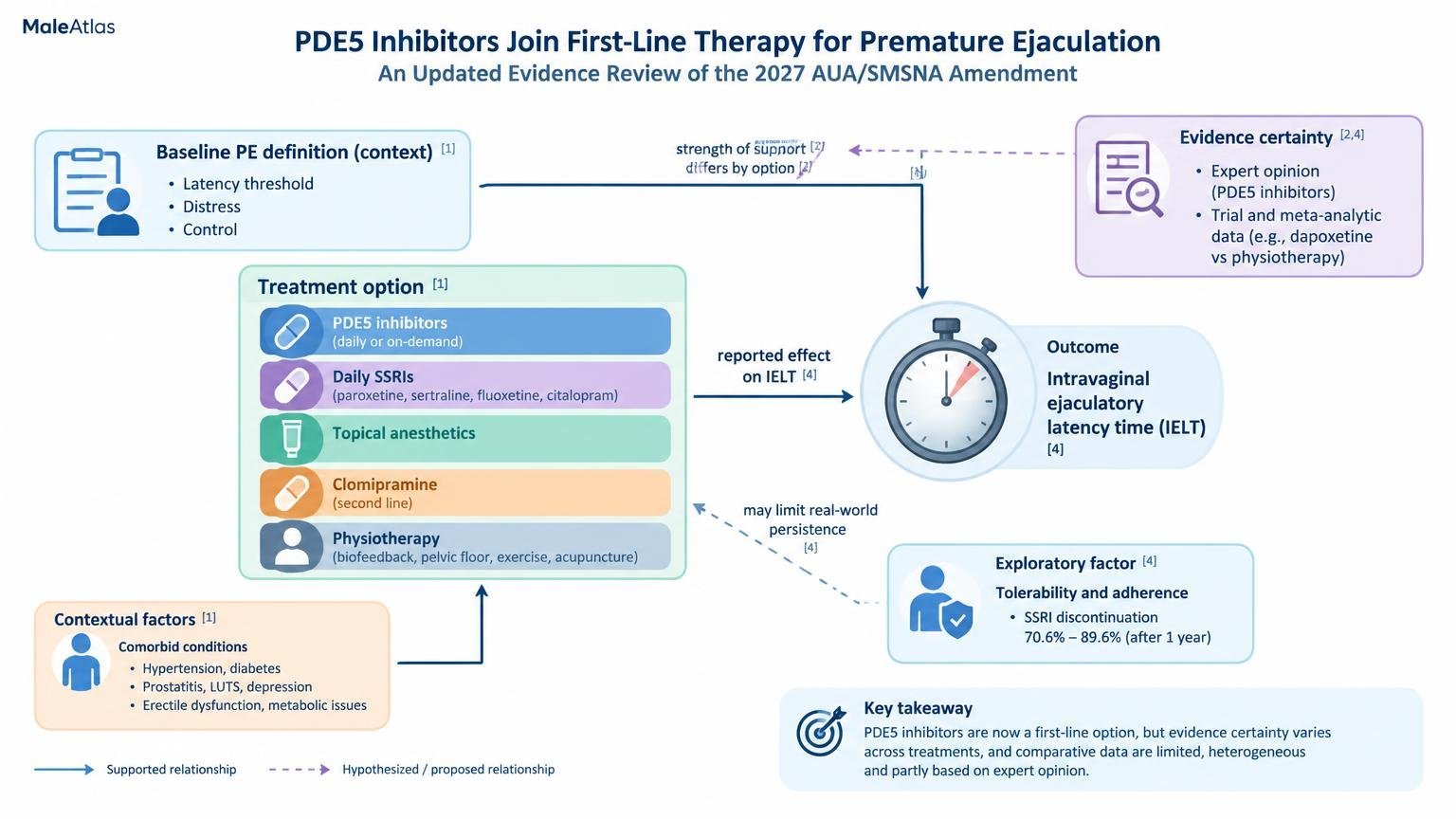
Conceptual framework: Conceptual framework. The figure maps treatment options against IELT outcomes, with baseline PE definition as context, tolerability and adherence as an exploratory factor, and evidence certainty separating expert opinion from trial and meta-analytic data. Relations are supported or proposed as labelled; this is an organising device, not a tested causal model. Population: adult men with PE. Key limitation: comparative evidence is small, heterogeneous and partly based on expert opinion.
Academic References & Evidence
- Erin Brooks; Petar Bajic; Shindel AW. PDE5 inhibitors join first-line therapy for premature ejaculation. J Urol. 2026
- Disorders of Ejaculation: AUA/SMSNA Guideline (2027) | Journal of Urology. Journal of Urology DOI: 10.1097/JU.0000000000005378.
- Contemporary consensus and emerging directions in premature and delayed ejaculation: recommendations from the 5th International Consultation on Sexual Medicine.. Sexual medicine reviews PMID: 42855438.
- Esther M Medrano-Sánchez; Ana López-del-Castillo; Maud Boisseau; Juan C Fernández-Domínguez; Esther Díaz-Mohedo. Effectiveness of physiotherapy in male premature… : The Journal of Sexual Medicine. The Journal of Sexual Medicine. 2026 23(5) DOI: 10.1093/jsxmed/qdag096.
- Jae Heon Kim; Won Ki Lee; Sung Chul Kam; Soo Woong Kim; Tae Hyo Kim; Hong Seok Shin; Chul Young Oh; Seung Wook Lee; Seung Hwan Lee; Ji-Kan Ryu; Heung Jae Park; Sae Woong Kim; Du Geon Moon. Efficacy and Safety of On-Demand Therapy with Clomipramine/Sildenafil Combination Compared to Clomipramine or Sildenafil Alone in Patients with Premature Ejaculation: A Multicenter Phase 3 Randomized Controlled Trial. 2026
SANYUN Science Center explains published research on men's reproductive and sexual health, connecting scientific evidence with everyday questions while making sources and limitations clear.
Disclaimer: This article is for scientific education and research communication only. It does not provide medical advice, diagnosis, or individualized treatment recommendations, and does not endorse any medication, supplement, device, penile enlargement procedure, or other intervention. Decisions about sexual and reproductive health should be made in consultation with a qualified healthcare professional. Do not delay seeking professional care because of information in this article.
Original Content & Copyright Notice
- This article is prepared for SANYUN Science Center, drawing on published research and publicly available academic literature on men’s sexual and reproductive health. Its editorial explanations and presentation are developed for this platform.
- Copyright in the original editorial content, selection, and arrangement is reserved by SANYUN Science Center to the extent protected by applicable law. Referenced research, quotations, and third-party materials remain subject to the rights of their respective owners. This notice does not claim ownership of scientific facts or third-party research.
- Except where permitted by applicable law or an applicable license, prior written permission is required to reproduce, republish, translate, adapt, redistribute, or commercially reuse protected content. Attribution alone does not grant permission for such reuse.
- For permitted quotation or authorized reuse, clearly identify the source and retain a link to the original article.
- Source: SANYUN Science Center
- Original URL: Retain the original article URL on science.san-yun.com.
- Copyright Holder: SANYUN Science Center, for its own protected editorial content.
- Quotation, excerpts, or authorized reuse must not distort the scientific meaning, omit material limitations or disclaimers, or imply unverified medical claims, product efficacy, or endorsement by SANYUN Science Center.



