




Category: Premature Ejaculation
Core Research Direction: Psycho-behavioural versus pharmacological and combined treatment of premature ejaculation in adult men: which interventions change intravaginal ejaculatory latency time and distress, and how strong and current is the trial evidence
Search Intent: In adult men with premature ejaculation, does adding behavioural or psycho-behavioural therapy to drug treatment (or using it alone) improve ejaculatory latency and sexual satisfaction, and how reliable is that evidence?
Platform: SANYUN Science Center
Evidence reviewed through: 2026-11-21
Executive Summary
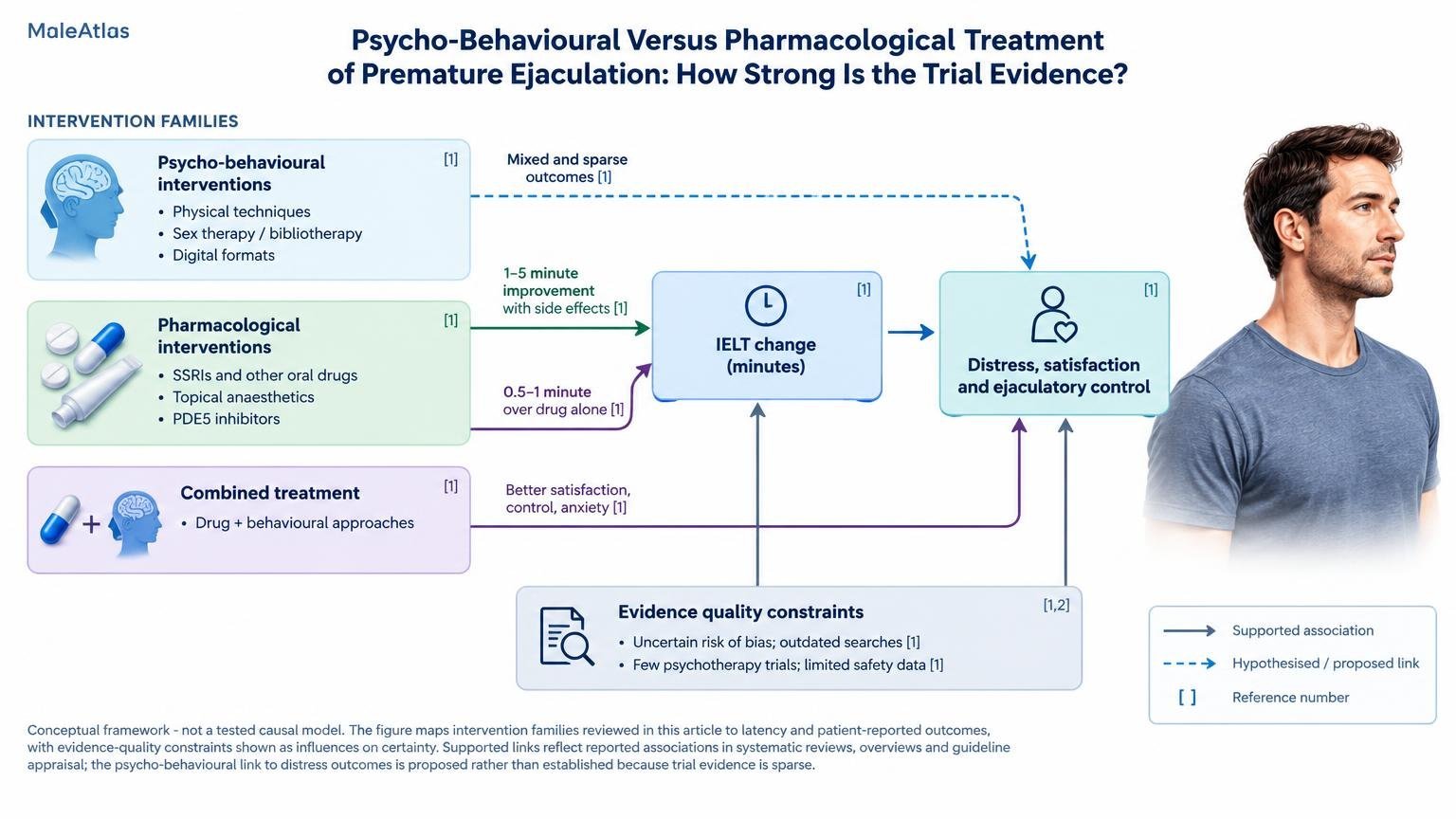
Premature ejaculation is defined partly by short latency and partly by distress, so treatment research tracks both time to ejaculation and how men feel about sex. The main intervention families are pharmacological (oral drugs and topical anaesthetics), psycho-behavioural (physical techniques, sex therapy, bibliotherapy and digital formats) and combinations of the two. A 2019 overview of 30 systematic reviews found that SSRIs, other oral drugs, topical anaesthetics and combined drug-plus-behavioural treatment improved time to ejaculation by 1 to 5 minutes.[1]
The behavioural literature is smaller and less consistent. A 2015 systematic review of 10 randomised trials with 521 participants judged overall risk of bias uncertain and found limited evidence: two of four waitlist-controlled trials reported 7–9 minute latency gains while two found no latency difference. Only one of the 10 trials included a psychotherapeutic approach, and the 2019 overview rated behavioural and psychological evidence as insufficient compared with drug trials. This is a research gap, not a finding that psychotherapy fails.
Combination appears to add a small latency advantage over drug treatment alone — 0.5 to 1 minute across three trials — alongside better satisfaction, ejaculatory control and anxiety scores. Guideline-level appraisal has moved in parallel: a statement on non-pharmacological therapies was revised to reflect new evidence that some may be effective. Robust conclusions remain constrained by small samples, heterogeneous outcome measures, uncertain blinding and search cutoffs that predate recent trials.[2]
Why This Matters
Premature ejaculation is common enough that treatment choices have population-level implications, and the condition sits at an awkward intersection of measurable physiology and subjective distress. The International Consultation on Sexual Medicine consensus frames the field around definition, classification and treatment of premature and delayed ejaculation, and it treats both ejaculatory disorders as having substantial impact on quality of life and relationships. That framing matters because a treatment that adds minutes without reducing distress may satisfy a statistical endpoint but not a patient.[3]
The practical question is not simply whether drugs work — they generally do — but whether adding or substituting psychological and behavioural work changes outcomes in ways that matter to men and partners. The 2027 AUA/SMSNA amendment explicitly recommends shared decision-making as the fundamental precept in managing ejaculatory disorders regardless of the treatment option utilized, which places comparative evidence, side-effect burden and patient values on the same table.
How the Interventions Differ
Drug treatment for premature ejaculation has a reasonably consistent mechanism story. SSRIs and clomipramine delay ejaculation through serotonergic modulation of the ejaculatory reflex, topical anaesthetics reduce glans sensitivity, and PDE5 inhibitors are used on the hypothesis that erectile confidence and nitric-oxide signalling influence ejaculatory control. A 2019 Bayesian network meta-analysis of 25 studies ranked SSRI plus PDE5 inhibitor first for IELT at 4–6 weeks, but the same authors concluded SSRIs remained first-line oral drugs because PDE5 inhibitors carried gastrointestinal and central nervous system side effects. A ranking is not a clinical recommendation, and the network estimate depends on indirect comparisons and trial-level assumptions.
Psycho-behavioural approaches target a different set of processes: awareness of pre-ejaculatory sensation, reduced performance anxiety, interruption of avoidance cycles and couple communication. Physical techniques such as stop-start, compression and sensate focus are the most commonly trialled, alongside bibliotherapy, group formats and internet-delivered programmes. The 2015 review judged risk of bias uncertain for this literature, and direct comparisons of behavioural therapy against drug treatment were mixed, mostly favouring drug treatment or showing no significant difference. No adverse effects were reported, but safety data were limited, which is itself a limitation rather than proof of harmlessness.
What the Trial Evidence Shows
For latency, the clearest signal comes from pharmacological and combined interventions. The 2019 overview reported 1 to 5 minute improvements in time to ejaculation across SSRIs, other oral drugs, topical anaesthetics and combined drug-plus-behavioural treatment, with most drug treatments associated with adverse effects.
Behavioural results are bimodal rather than uniformly positive. In the 2015 review, two waitlist-controlled trials of compression, stop-start and sensate focus reported 7–9 minute latency differences, while a web-based sensate-focus programme and a stimulation device found no latency difference. For other outcomes including sexual satisfaction, desire and self-confidence, some waitlist comparisons significantly favoured behavioural therapy and others were non-significant. That pattern is important: the same review contained both large reported effects and null results, which is what a small, methodologically heterogeneous literature tends to produce.
The older trial table adds texture. Masters and Johnson's 186-subject sex-therapy report described improvements in 98% of subjects, but it had no control group and used categorical, unblinded assessment. A 64-man bibliotherapy trial versus a 32-man waiting list reported that 55% to 65% of subjects improved at two months. In a 32-man trial, sex therapy and fluoxetine produced equivalent improvements of 50%–62.5%. A 36-man internet-based sex therapy trial found improvements equivalent to a waiting list. And in a 25-man trial, three therapy formats produced improvements, but bibliotherapy alone had 45% dropout.[4]
Durability is a recurring weakness. In an 8-subject sex-therapy trial, 6 showed significant improvement after treatment, but only 2 retained gains at 3 years. A 20-subject trial found significant post-treatment improvements that were not maintained at three years despite continued sexual satisfaction. A larger 120-man bibliotherapy trial versus a 66-man waiting list, however, reported improvements sustained to 6- and 12-month follow-up. The literature therefore does not support a single claim about long-term benefit; it supports recognising that some programmes show persistence and others show decay.
When drugs and psychotherapy are placed head-to-head, the picture is mixed. In one 32-man trial, sex therapy and fluoxetine were equivalent. In a 157-man trial, sex therapy plus dapoxetine was equal to sex therapy alone, and both were superior to dapoxetine alone. Adding a vibratory device to sex therapy outperformed sex therapy alone in a 35-man trial, and combining psychotherapy with a mobile-app exercise programme outperformed psychotherapy alone in a 32-man trial. These are small single trials, not a coherent comparative literature.
Combined Treatment: Small Time Gain, Broader Benefit
The strongest quantitative case for combining behavioural and drug treatment comes from three trials in the 2015 review. Combination outperformed drug treatment alone with a small but significant IELT difference of 0.5 to 1 minute, and it also produced significantly better sexual satisfaction, ejaculatory control and anxiety scores. The time gain alone would be easy to dismiss. The accompanying improvement in control and anxiety is more clinically interesting because these are the domains the condition's distress-based definition prioritises.
That interpretation needs restraint. Three trials are few, the combination effect was not uniform across the broader trial table, and the anxiety and satisfaction measures were not reported here with effect sizes or confidence intervals. What can be said is that the combination literature is directionally consistent with a modest additive benefit, while the magnitude and durability remain uncertain.
| Intervention family | Reported latency signal | Other outcomes | Key evidence limitation |
|---|---|---|---|
| SSRIs, other oral drugs, topical anaesthetics | 1–5 minute improvement in time to ejaculation | Most drug treatments associated with adverse effects | Overview-level summary without trial-specific doses or populations |
| Behavioural techniques alone | 7–9 minute gains in 2 of 4 waitlist-controlled trials; no difference in the other 2 | Mixed satisfaction, desire and self-confidence results | Uncertain risk of bias; search to August 2014 |
| Behavioural plus drug combination | 0.5–1 minute additional IELT versus drug alone across 3 trials | Better satisfaction, ejaculatory control and anxiety scores | Small latency gain; few trials |
| Conversational psychotherapy | Not separately quantified in the reviewed evidence | Sparse outcome data | Only 1 of 10 behavioural trials included a psychotherapeutic approach |
| SSRI plus PDE5 inhibitor | Ranked first for IELT at 4–6 weeks in network meta-analysis | PDE5 inhibitors carried gastrointestinal and CNS side effects | Ranking not a clinical recommendation; indirect comparisons |
How Current Is the Evidence?
Recency is a genuine constraint. The behavioural review searched to August 2014 and the overview to July 2018, so trials published after those dates are not captured. That matters because the field has produced newer work, some of which reached guideline committees. The 2027 AUA/SMSNA amendment searched Ovid MEDLINE and Embase for studies published between January 1, 2020 and December 19, 2024, identified 727 abstracts, included 89, and used 25 studies for evidence quality assessment to inform statement updates. Only a minority of included studies directly informed revised statements, which is typical of guideline amendments but limits how much can be inferred.
The guideline amendment revised a statement on non-pharmacological therapies for premature ejaculation to reflect new evidence that some of these therapies may be effective. It also introduced new statements on PDE5 inhibitors and on daily or on-demand clomipramine or glans hyaluronic acid injection, with the latter two explicitly framed around informed consent and use by a trained clinician. Those are recommendations with caveats, not proof of superiority over established options.
Interpretation and Limitations
Four limitations shape how this evidence should be read. First, outcome heterogeneity: latency measured in minutes is not the same construct as categorical improvement, and trials using different instruments cannot be pooled casually. Second, sample size and durability: many behavioural trials enrolled between 8 and 90 men, and the ones that followed participants for years often showed loss of gains. Third, blinding and expectancy: psychological and behavioural interventions are difficult to blind, and the 2015 review's uncertain risk-of-bias judgement reflects that. Fourth, freshness: the more recent evidence is filtered through an overview and a guideline amendment rather than a comprehensive re-analysis of all trials.
Statistical and clinical meaning diverge here. A 0.5 to 1 minute combination advantage is statistically detectable in three trials but may not be the change a man notices most; conversely, a 7–9 minute behavioural gain in a small waitlist-controlled trial is large in magnitude but uncertain in reproducibility. Direction of effect is not causal proof, and the network ranking of drug combinations should not be read as a treatment algorithm.
Practical Understanding for Clinicians and Patients
The evidence supports a stepped conversation rather than a single first choice. Drug options have the more consistent latency signal and measurable side-effect burden; behavioural and psychological options have a weaker, more heterogeneous evidence base but address control, anxiety and couple dynamics that latency alone does not capture. Combined treatment has modest additive support. The 2025 guideline-level position that shared decision-making should be the fundamental precept aligns with this reading: the trials do not identify one universally superior package, and patient values and side-effect tolerance carry real weight.
Two evidence gaps deserve explicit acknowledgement. Conversational psychotherapy directed at performance anxiety, confidence and relationship factors has barely been tested in randomised trials, so absence of evidence should not be presented as evidence of ineffectiveness. And the durability of behavioural gains is inconsistent, with some programmes showing persistence at 6–12 months and others showing substantial decay by three years. These are questions for future trials, not settled clinical facts.
Research Outlook
The 2015 review's authors called for larger and better randomised trials of psychotherapy, and the 2019 overview rated behavioural and psychological evidence as insufficient compared with drug trials. Progress would require adequately powered trials with blinded outcome assessment where feasible, standardised IELT and patient-reported distress measures, longer follow-up, and prespecified combination comparisons. The 2027 AUA/SMSNA amendment's search window ending December 19, 2024 leaves a clear space for new evidence published after that date to be appraised.
Key Takeaways
- Pharmacological and combined treatments show the most consistent latency improvements, with a 1–5 minute gain across SSRIs, other oral drugs, topical anaesthetics and combined drug-plus-behavioural approaches.
- Behavioural evidence is limited and inconsistent: 7–9 minute gains in two waitlist-controlled trials, no latency difference in two others, and uncertain overall risk of bias.
- Combining behavioural and drug treatment adds a small 0.5–1 minute latency advantage but also better satisfaction, ejaculatory control and anxiety scores across three trials.
- Conversational psychotherapy has minimal randomised evidence — one of 10 behavioural trials — which is a gap, not proof of failure.
- Recent guideline appraisal revised non-pharmacological statements and emphasised shared decision-making, but the underpinning review literature searched only to 2014–2018 plus a 2020–2024 amendment window.
Questions and Answers
What is the difference between psycho-behavioural and pharmacological treatment for premature ejaculation?
Pharmacological treatment uses oral drugs such as SSRIs, clomipramine or PDE5 inhibitors, and topical anaesthetics, aiming mainly to lengthen time to ejaculation. Psycho-behavioural treatment uses techniques such as stop-start, compression and sensate focus, plus sex therapy and bibliotherapy, aiming at ejaculatory awareness, anxiety and couple communication. Combination treatment uses both. In the reviewed literature, drug and combined approaches show the more consistent latency signal, while behavioural approaches have a weaker and more heterogeneous evidence base.
How much does combined drug and behavioural therapy improve ejaculatory latency in the trials?
Across three trials in a 2015 systematic review, combined behavioural plus pharmacological treatment outperformed drug treatment alone with a small but significant IELT difference of 0.5 to 1 minute. It also produced significantly better sexual satisfaction, ejaculatory control and anxiety scores. The time gain is modest, so much of the clinical value may lie in the control and anxiety domains rather than minutes alone. Only three trials support this comparison.
How strong is the evidence that behavioural therapy alone helps premature ejaculation?
It is limited. A 2015 review of 10 randomised trials with 521 participants judged overall risk of bias uncertain. Two of four waitlist-controlled trials reported 7–9 minute latency gains while two found no latency difference. Other outcomes were mixed. The 2019 overview rated behavioural and psychological evidence as insufficient compared with drug trials. Sample sizes were often small and follow-up inconsistent, so the evidence supports possible benefit rather than a firm effect estimate.
Does sex therapy or psychotherapy work as well as drug treatment for premature ejaculation?
Direct comparisons are mixed. In one 32-man trial, sex therapy and fluoxetine produced equivalent improvements of 50%–62.5%. In a 157-man trial, sex therapy plus dapoxetine was equal to sex therapy alone, and both were superior to dapoxetine alone. Overall, the 2015 review found head-to-head comparisons mostly favouring drug treatment or showing no significant difference. Psychotherapy specifically has been tested in very few randomised trials, with only one of 10 behavioural trials including a psychotherapeutic approach.
What are the limitations of the premature ejaculation treatment evidence base?
Key limitations include uncertain risk of bias in behavioural trials, small sample sizes, heterogeneous outcome measures, limited safety reporting, and inconsistent durability of gains. The behavioural review searched to August 2014 and the overview to July 2018, so recent trials are underrepresented. A 2027 guideline amendment covering 2020–2024 identified 727 abstracts but used only 25 studies for evidence quality assessment. Statistical significance in small trials does not guarantee clinically meaningful or reproducible benefit.
What do current guidelines say about choosing between drug and behavioural treatment for premature ejaculation?
The 2027 AUA/SMSNA guideline amendment recommends shared decision-making as the fundamental precept in managing ejaculatory disorders regardless of the treatment option utilized. It revised a statement on non-pharmacological therapies to reflect new evidence that some may be effective, and added caveated statements on PDE5 inhibitors and on clomipramine or glans hyaluronic acid injection with informed consent and trained-clinician involvement. The trials do not identify one universally superior treatment package.
Conceptual framework: Conceptual framework – not a tested causal model. The figure maps intervention families reviewed in this article to latency and patient-reported outcomes, with evidence-quality constraints shown as influences on certainty. Supported links reflect reported associations in systematic reviews, overviews and guideline appraisal; the psycho-behavioural link to distress outcomes is proposed rather than established because trial evidence is sparse.
Academic References & Evidence
- Ciocanel O; Power K; Eriksen A; Cooper K; Qin Z; Wang Y; Zhu J. Tratamiento de la eyaculación precoz: la evidencia | MyFreud. DOI: 10.1038/s41443-019-0146-7.
- Disorders of Ejaculation: AUA/SMSNA Guideline (2027) | Journal of Urology. Journal of Urology. 2027 DOI: 10.1097/JU.0000000000005378.
- Contemporary consensus and emerging directions in premature and delayed ejaculation: recommendations from the 5th International Consultation on Sexual Medicine.. Sexual medicine reviews PMID: 42855438.
- Systematic review of trials of psycho-behavioural treatments for premature ejaculation. Sexologies 31(1)
SANYUN Science Center explains published research on men's reproductive and sexual health, connecting scientific evidence with everyday questions while making sources and limitations clear.
Disclaimer: This article is for scientific education and research communication only. It does not provide medical advice, diagnosis, or individualized treatment recommendations, and does not endorse any medication, supplement, device, penile enlargement procedure, or other intervention. Decisions about sexual and reproductive health should be made in consultation with a qualified healthcare professional. Do not delay seeking professional care because of information in this article.
Original Content & Copyright Notice
- This article is prepared for SANYUN Science Center, drawing on published research and publicly available academic literature on men’s sexual and reproductive health. Its editorial explanations and presentation are developed for this platform.
- Copyright in the original editorial content, selection, and arrangement is reserved by SANYUN Science Center to the extent protected by applicable law. Referenced research, quotations, and third-party materials remain subject to the rights of their respective owners. This notice does not claim ownership of scientific facts or third-party research.
- Except where permitted by applicable law or an applicable license, prior written permission is required to reproduce, republish, translate, adapt, redistribute, or commercially reuse protected content. Attribution alone does not grant permission for such reuse.
- For permitted quotation or authorized reuse, clearly identify the source and retain a link to the original article.
- Source: SANYUN Science Center
- Original URL: Retain the original article URL on science.san-yun.com.
- Copyright Holder: SANYUN Science Center, for its own protected editorial content.
- Quotation, excerpts, or authorized reuse must not distort the scientific meaning, omit material limitations or disclaimers, or imply unverified medical claims, product efficacy, or endorsement by SANYUN Science Center.



