




Category: Premature Ejaculation
Core Research Direction: Comparative evidence on the durability and comparative effectiveness of premature ejaculation treatments (dapoxetine, tadalafil, physiotherapy) and what clinical guidance says can and cannot be concluded
Search Intent: Does treating premature ejaculation with drugs like dapoxetine produce lasting benefit after treatment stops, and how does pharmacotherapy compare with physiotherapy according to available trial evidence?
Platform: SANYUN Science Center
Evidence reviewed through: 2026-11-26
A 2026 systematic review and meta-analysis in the Journal of Sexual Medicine pooled six small trials and found dapoxetine 30 mg more effective than physiotherapy for lengthening intravaginal ejaculatory latency time (IELT) in men with lifelong premature ejaculation, but with high heterogeneity and a caution against definitive conclusions. The same evidence set does not establish that benefits persist after treatment stops, and the durability question remains largely unanswered.[1]
Executive Summary
The central question for many men is whether treatment for premature ejaculation (PE) produces lasting benefit once it stops. In this packet the answer is mostly no for established treatments and unclear for one preliminary signal. For dapoxetine, a short-acting selective serotonin reuptake inhibitor used on demand, trial summaries reviewed by NICE report improvements in ejaculation timing and patient-reported outcomes versus placebo during treatment, while longer-term safety and efficacy data beyond 24 weeks are described as limited. Permanent resolution after stopping is not established.[2]
For physiotherapy, the 2026 meta-analysis of six trials with 416 participants found a statistically significant pooled difference in IELT favouring dapoxetine 30 mg, with a mean difference of −0.80 s (95% CI −1.53 to −0.06; P=.03) and high heterogeneity (I2=83%). Physiotherapy was described as a safe option and a promising alternative for men intolerant to drugs, but the durability of its effect after stopping was not pooled or established. The authors also caution that scarcity and heterogeneity of physiotherapy-versus-drug trials limit definitive conclusions.
For daily tadalafil 5 mg, one randomized placebo-controlled preprint in 160 men with erectile dysfunction reported that mean IELT rose during 3 months of treatment and remained above baseline 2 years after stopping in 75 men with follow-up, though below the on-treatment level. That is a hypothesis-generating durability signal from a preprint in which PE was assessed secondarily, not evidence of lasting PE treatment.[3]
Clinical guidance now emphasizes shared decision-making and has broadened statements on non-pharmacological therapies and PDE5 inhibitors, but guideline statements do not by themselves demonstrate durability. Across the packet, symptom control during treatment is better supported than lasting resolution after stopping.[4]
Why This Matters
PE is common and affects quality of life and relationships. The 2026 physiotherapy review notes that approximately 75% of men will experience PE at some point, and that SSRI treatment is limited by adverse effects such as nausea and dizziness and by high discontinuation rates ranging from 70.6% to 89.6% after the first year of treatment. If patients expect a course of medication to permanently reset ejaculatory control, a return of symptoms after stopping may be misread as personal or treatment failure rather than as the expected difference between symptom management and cure.
Practically, the distinction matters for treatment review. A meaningful on-treatment response can be clinically worthwhile even when it is not permanent, and judging success requires attention to perceived control, distress and tolerability rather than to timing alone.
Biological and Clinical Mechanism
Dapoxetine is a short-acting SSRI taken on demand, thought to delay ejaculation by influencing serotonergic signalling while the drug is active. The pharmacy educational source in this packet frames this as a treatment effect rather than a permanent retraining of ejaculatory control, and states that there is no basis for promising permanent continuation after the drug is stopped. The 5th International Consultation on Sexual Medicine review lists dapoxetine, SSRIs and psychotherapy among the concepts relevant to PE management, but its abstract does not provide durability estimates.[5]
Tadalafil is a PDE5 inhibitor. The randomized preprint in this packet administered daily tadalafil 5 mg for 3 months to men with erectile dysfunction and measured IELT as a secondary PE-related outcome. Any mechanism linking PDE5 inhibition to ejaculatory latency is not established by that design, and the AUA/SMSNA amendment added only an Expert Opinion statement on potential PDE5 inhibitor use for PE, not a durability claim.
Physiotherapy approaches in the reviewed trials included pelvic floor muscle strengthening, biofeedback, electrostimulation, acupuncture, yoga and physical exercise. These are proposed to influence pelvic floor function and ejaculatory control without systemic drug adverse effects, but the review authors note that scarcity and heterogeneity of the comparisons limit definitive conclusions.
What the Evidence Shows
The most directly comparative evidence in this packet is the 2026 systematic review and meta-analysis of physiotherapy versus pharmacological treatment. Six clinical trials met inclusion criteria, with 416 participants in the pooled analysis, and the trials were published between 2014 and 2024. Methodological quality by the PEDro scale was high in three studies, medium in one and low in two, with blinding items scoring lowest.
The pooled result favoured dapoxetine 30 mg over physiotherapy for IELT, with a mean difference of −0.80 s (95% CI −1.53 to −0.06; P=.03) and high heterogeneity (I2=83%). The review authors describe this as a statistically significant effect and label it a large standardised effect, while cautioning about the small number and heterogeneity of trials. A sub-second mean difference in raw units is statistically detectable in a pooled analysis but is not, by itself, evidence of a large or durable clinical advantage for an individual man.
Individual trials illustrate the range. In one trial described in the review, dapoxetine groups starting at a mean IELT of 37.2 s reached 168.2±36.6 s at 30 mg and 193.2±43.8 s at 60 mg by 6 weeks. In another, moderate physical activity raised IELT from 39.3±8.8 s to 188.6±82.9 s, while minimal activity raised it only from 33.8±14.7 s to 50.3±19.1 s. These are single small trials and were not all pooled, so they should not be read as head-to-head certainties.
The qualitative synthesis suggested that a combined therapeutic approach produced the largest IELT improvements. That statement is a hypothesis from narrative review, not a pooled estimate, and it does not show that combining treatments produces durable benefit after stopping.
For dapoxetine specifically, the pharmacy educational source citing NICE reports improvements in ejaculation timing and patient-reported outcomes versus placebo during trials, with limited safety and efficacy data beyond 24 weeks. It gives an example of average IELT increasing from 0.9 to 3.1 minutes with dapoxetine 30 mg and reports treatment-emergent adverse events in 47% of men on 30 mg and 60.3% on 60 mg. These figures come from a secondary commercial source rather than primary trial reports in this packet.
For tadalafil, the randomized placebo-controlled preprint enrolled 160 men with erectile dysfunction and divided them into two groups of 80: tadalafil 5 mg daily for 3 months or placebo. Mean IELT rose from 37±11.24 s to 120.5±47.37 s with tadalafil (p<0.001), while placebo showed no significant change from 35.98±10.8 s to 39.43±13.6 s (p>0.05). Two years after stopping, 75 men from the tadalafil group with follow-up still had IELT significantly above baseline at 98±18.3 s, but below the 3-month level. This is a durability signal within one preprint, not confirmation of lasting benefit.
| Treatment and context | Reported IELT outcome | Durability evidence | Main limitation |
|---|---|---|---|
| Dapoxetine 30 mg versus physiotherapy, pooled meta-analysis of six trials (416 participants) | Pooled mean difference −0.80 s (95% CI −1.53 to −0.06; P=.03), favouring dapoxetine; heterogeneity I2=83% | Not assessed in this pooled comparison; longer-term dapoxetine data beyond 24 weeks described as limited | Few small heterogeneous trials; blinding limitations |
| Daily tadalafil 5 mg for 3 months in men with erectile dysfunction (randomized placebo-controlled preprint, 160 men) | IELT 37±11.24 s to 120.5±47.37 s (p<0.001); placebo 35.98±10.8 s to 39.43±13.6 s (p>0.05) | Two years after stopping, 75 men with follow-up had IELT 98±18.3 s, above baseline but below the 3-month level | Preprint; enrolled for erectile dysfunction; PE assessed secondarily; attrition |
| Dapoxetine 30 mg and 60 mg in one included trial (Pastore et al., as described in review) | Mean IELT 37.2 s at baseline to 168.2±36.6 s (30 mg) and 193.2±43.8 s (60 mg) at 6 weeks | Post-stop durability not reported in this packet | Small subgroups; single trial |
| Moderate versus minimal physical activity in one included trial (Kilinc et al., as described in review) | Moderate activity IELT 39.3±8.8 s to 188.6±82.9 s; minimal activity 33.8±14.7 s to 50.3±19.1 s | Post-stop durability not reported in this packet | Single small trial; not pooled |
| Dapoxetine in a NICE-cited secondary summary | Example average IELT 0.9 to 3.1 minutes with 30 mg; treatment-emergent adverse events 47% (30 mg) and 60.3% (60 mg) | No basis for promising permanent continuation after stopping; limited data beyond 24 weeks | Secondary commercial source; primary trials not detailed in packet |
Interpretation and Limitations
The evidence in this packet supports a narrow conclusion. Dapoxetine improves IELT and some patient-reported outcomes during treatment compared with placebo in trial summaries, and it outperforms physiotherapy for IELT in a pooled analysis with important heterogeneity. It does not establish that dapoxetine permanently cures PE or that benefit persists after stopping. The tadalafil preprint offers a hypothesis-generating durability signal but should not be generalised to men whose primary complaint is PE.
Several limitations temper interpretation. The physiotherapy meta-analysis included only six trials with 416 participants, and the authors themselves caution that scarcity and heterogeneity limit definitive conclusions. The pooled mean difference of −0.80 s is statistically significant but small in absolute terms; statistical significance in a pooled analysis should not be equated with a clinically important or durable difference for an individual. Blinding was a weak point in the included trials, which matters when subjective outcomes such as control and distress are considered.
The packet also includes consumer health explainers and a commercial pharmacy blog. These are useful for understanding how patients frame questions about treatment courses and stopping medication but are not primary trial evidence. The explainers note that different PE drugs have different onset and duration, that daily-dosed drugs more closely resemble a course requiring weeks of continuous use, and that unregulated delay products may contain undeclared drugs with dangerous interactions, including blood pressure drops with nitrate medications. These points are clinically relevant to safety discussions but do not establish efficacy or durability.[6][7]
Guidance context is also relevant. The AUA/SMSNA amendment searched MEDLINE and Embase for studies published January 1, 2020 to December 19, 2024, identifying 727 abstracts of which 89 met inclusion criteria. The amendment revised non-pharmacological therapy statements and added an Expert Opinion statement on PDE5 inhibitors, and it supported new statements on clomipramine and glans hyaluronic acid injection with informed-consent caveats. Guideline statements are not durability trials and should not be read as proof that treatment effects persist after stopping.
The most important interpretive boundary is between association and causation, and between on-treatment improvement and post-treatment durability. The dapoxetine-versus-physiotherapy meta-analysis compares IELT during treatment; it does not randomise men to stop treatment and measure relapse. The tadalafil preprint followed men after stopping, but without a reported placebo follow-up group in this packet, the persistence signal cannot be confidently attributed to the drug rather than to natural variation, regression to the mean or selection of men who remained in follow-up.
Research Outlook
What would change the picture is not another small on-treatment comparison but trials designed around durability: randomised discontinuation designs, long-term follow-up after planned stopping, and outcome measures that include patient-reported control and distress alongside IELT. Adherence is a major obstacle, with SSRI discontinuation rates reported as 70.6% to 89.6% after the first year, which complicates any claim about long-term durability because many men do not remain on treatment long enough to test it.
The AUA/SMSNA amendment's inclusion of new statements on non-pharmacological therapies, PDE5 inhibitors, clomipramine and glans hyaluronic acid injection signals that the treatment landscape is broadening, with the panel emphasising that some treatments should be used only with informed consent and by a trained clinician and that shared decision-making should be the fundamental principle regardless of treatment chosen. Future research should test whether combined approaches, which qualitative synthesis suggested may yield the largest IELT improvements, also produce durable benefit after treatment is reduced or stopped.
Key Takeaways
- Dapoxetine improves IELT and some patient-reported outcomes during treatment in trial summaries, but permanent resolution after stopping is not established, and longer-term data beyond 24 weeks are described as limited in a secondary source.
- In a 2026 meta-analysis of six trials with 416 participants, dapoxetine 30 mg outperformed physiotherapy for IELT with a pooled mean difference of −0.80 s (95% CI −1.53 to −0.06; P=.03), but heterogeneity was high at I2=83% and the authors caution that few heterogeneous trials limit definitive conclusions.
- Physiotherapy was described as a safe alternative for men intolerant to drugs, and qualitative synthesis suggested combined therapy yielded the largest IELT improvements, but that combined benefit is a hypothesis rather than a pooled finding.
- One randomized placebo-controlled preprint in men with erectile dysfunction reported that daily tadalafil 5 mg raised IELT during 3 months and that IELT remained above baseline 2 years after stopping in 75 men with follow-up, but this is a preprint with secondary PE assessment and should not be generalised as durable PE treatment.
- Clinical guidance emphasises shared decision-making and has expanded statements on non-pharmacological therapies and PDE5 inhibitors, but guideline statements do not demonstrate that treatment effects persist after stopping.
Questions and Answers
Does dapoxetine permanently cure premature ejaculation?
No. Trial summaries reviewed by NICE report that dapoxetine improves ejaculation timing and some patient-reported outcomes during treatment compared with placebo, but permanent resolution after stopping is not established. The source states there is no basis for promising that improvement will permanently continue after dapoxetine is stopped, and longer-term efficacy and safety data beyond 24 weeks are limited.
How does dapoxetine compare with physiotherapy for premature ejaculation in meta-analysis?
A 2026 systematic review and meta-analysis of six trials with 416 participants found a statistically significant pooled difference favouring dapoxetine 30 mg over physiotherapy for IELT, with a mean difference of −0.80 s (95% CI −1.53 to −0.06; P=.03). Heterogeneity was high at I2=83%, the absolute difference was small, and the authors caution that few heterogeneous trials limit definitive conclusions.
Does daily tadalafil produce lasting benefit for premature ejaculation after stopping?
One randomized placebo-controlled preprint in 160 men with erectile dysfunction reported that daily tadalafil 5 mg for 3 months raised IELT from 37±11.24 s to 120.5±47.37 s, and that 2 years after stopping, 75 men with follow-up had IELT of 98±18.3 s, above baseline but below the 3-month level. This is a hypothesis-generating signal from a preprint with secondary PE assessment, not established durable treatment.
What is the difference between symptom control and a cure in premature ejaculation treatment?
Symptom control means meaningful improvement while a treatment is active, such as longer IELT or better perceived control during dapoxetine use. A cure would mean the condition is eliminated in a lasting way so treatment is no longer needed. The evidence in this packet supports symptom improvement during treatment more strongly than permanent resolution after stopping, and the tadalafil persistence signal remains preliminary.
What are the limitations of the physiotherapy versus dapoxetine meta-analysis?
The meta-analysis included only six trials with 416 participants, and the authors caution that scarcity and heterogeneity limit definitive conclusions. Three studies had high methodological quality, one medium and two low by the PEDro scale, with blinding items scoring lowest. Heterogeneity was high at I2=83%, and the pooled mean difference of −0.80 s, while statistically significant, is small in absolute terms and does not establish durability after stopping.
What do clinical guidelines say about treatment choices for premature ejaculation?
The AUA/SMSNA amendment revised non-pharmacological therapy statements to reflect some may be effective, added an Expert Opinion statement on PDE5 inhibitor use, and supported new statements on clomipramine and glans hyaluronic acid injection with informed-consent caveats. The panel recommends shared decision-making as the fundamental principle regardless of treatment chosen. Guidelines guide choices but do not demonstrate that treatment effects persist after stopping.
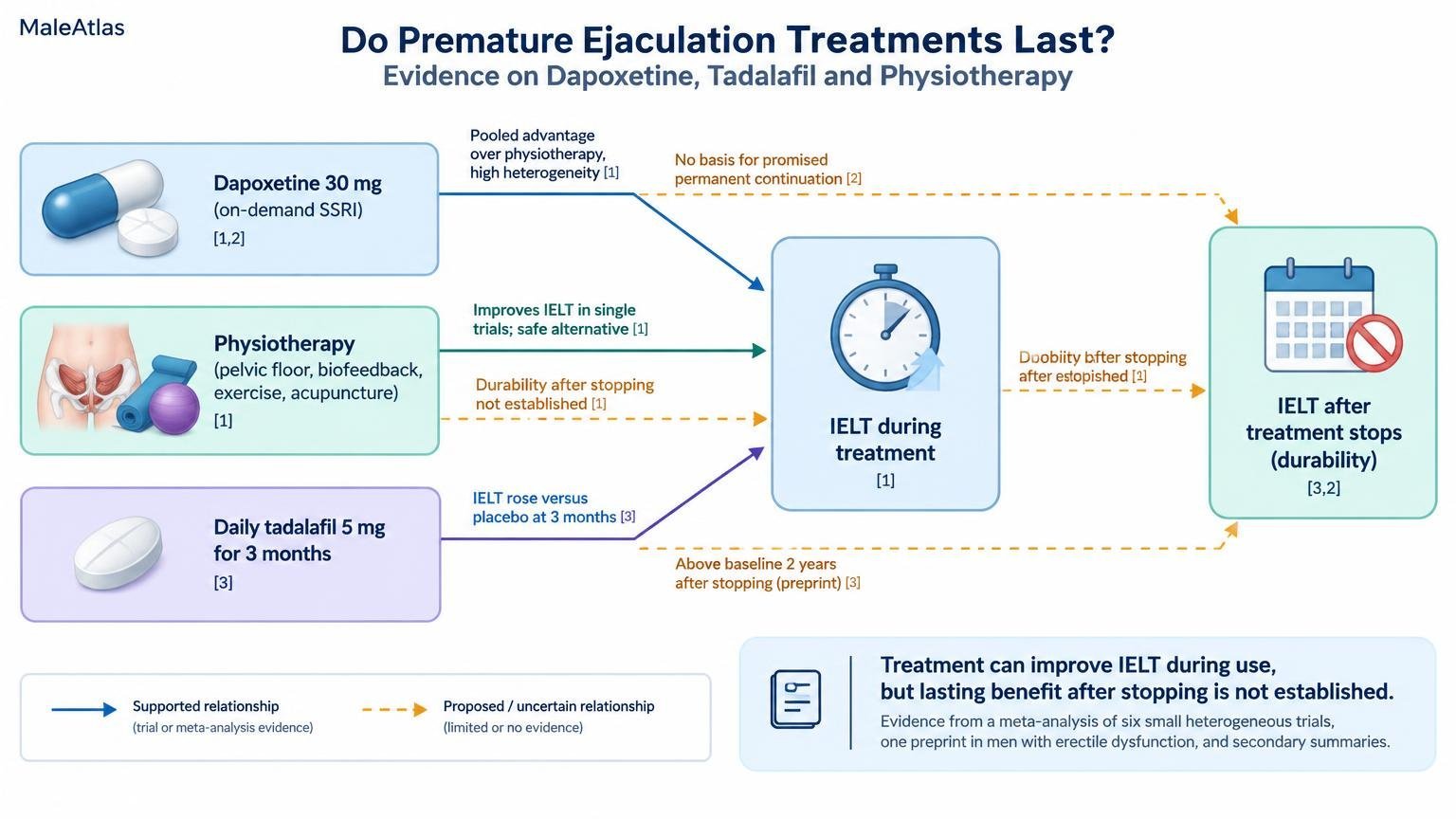
Conceptual framework: Conceptual framework, not a tested causal model. It summarises how three treatment approaches in the reviewed evidence relate to IELT during treatment and to durability after stopping. Supported edges reflect reported associations or trial results; proposed edges reflect uncertainty. Evidence includes a meta-analysis of six small heterogeneous trials, one preprint in men with erectile dysfunction, and secondary summaries; it does not establish permanent cure.
Academic References & Evidence
- Esther M Medrano-Sánchez; Ana López-del-Castillo; Maud Boisseau; Juan C Fernández-Domínguez; Esther Díaz-Mohedo. Effectiveness of physiotherapy in male premature… : The Journal of Sexual Medicine. The Journal of Sexual Medicine. 2026 23(5) DOI: 10.1093/jsxmed/qdag096.
- Does Dapoxetine Cure Premature Ejaculation Permanently?.
- Gharib, T.; Abdel-Al, I.; Elatreisy, A.; Salih, E. M.; Sebaey, A.. Short and Long-Term Follow up Results of Daily 5 Mg Tadalafil as a Treatment for Erectile Dysfunction and Premature Ejaculation. Research Square. 2021 DOI: 10.21203/rs.3.rs-473408/v1. (preprint)
- Disorders of Ejaculation: AUA/SMSNA Guideline (2027) | Journal of Urology. Journal of Urology DOI: 10.1097/JU.0000000000005378.
- Contemporary consensus and emerging directions in premature and delayed ejaculation: recommendations from the 5th International Consultation on Sexual Medicine.. Sexual medicine reviews PMID: 42855438.
- 早泄药需要按疗程吃吗?医生提醒别自行停药. 39健康网. 2026
- 早泄药要按疗程吃吗?不规范用药可能白费功夫. 39健康网. 2026
SANYUN Science Center explains published research on men's reproductive and sexual health, connecting scientific evidence with everyday questions while making sources and limitations clear.
Disclaimer: This article is for scientific education and research communication only. It does not provide medical advice, diagnosis, or individualized treatment recommendations, and does not endorse any medication, supplement, device, penile enlargement procedure, or other intervention. Decisions about sexual and reproductive health should be made in consultation with a qualified healthcare professional. Do not delay seeking professional care because of information in this article.
Original Content & Copyright Notice
- This article is prepared for SANYUN Science Center, drawing on published research and publicly available academic literature on men’s sexual and reproductive health. Its editorial explanations and presentation are developed for this platform.
- Copyright in the original editorial content, selection, and arrangement is reserved by SANYUN Science Center to the extent protected by applicable law. Referenced research, quotations, and third-party materials remain subject to the rights of their respective owners. This notice does not claim ownership of scientific facts or third-party research.
- Except where permitted by applicable law or an applicable license, prior written permission is required to reproduce, republish, translate, adapt, redistribute, or commercially reuse protected content. Attribution alone does not grant permission for such reuse.
- For permitted quotation or authorized reuse, clearly identify the source and retain a link to the original article.
- Source: SANYUN Science Center
- Original URL: Retain the original article URL on science.san-yun.com.
- Copyright Holder: SANYUN Science Center, for its own protected editorial content.
- Quotation, excerpts, or authorized reuse must not distort the scientific meaning, omit material limitations or disclaimers, or imply unverified medical claims, product efficacy, or endorsement by SANYUN Science Center.



