




Category: Premature Ejaculation
Core Research Direction: Patient-reported pathways to care for premature ejaculation versus erectile dysfunction (detection, time to consultation, treatment, and satisfaction), together with current consensus framing of PE definition, classification, and management.
Search Intent: How and when do men with premature ejaculation actually seek and receive care, and how does this compare with erectile dysfunction?
Platform: SANYUN Science Center
Evidence reviewed through: 2026-11-22
Executive Summary
Premature ejaculation (PE) and erectile dysfunction (ED) are both common sexual complaints with substantial effects on quality of life, yet the routes men take from first symptoms to consultation and treatment appear to differ in ways that matter for clinical practice. A Spanish observational, multicentric survey of patients attending urology routine-control visits reported that men with PE waited longer than men with ED before deciding to see a doctor, were less likely to report seeing a doctor as their reaction to symptom onset, and were more likely to search the internet first. The same survey found that PE patients reported the highest degree of sexual dissatisfaction among the groups studied, even though many men in both groups had received treatment.[1]
These findings are patient-reported, cross-sectional, and drawn from a sample that under-recruited PE patients relative to its own protocol. They describe associations between condition type and care-seeking behavior, not causal pathways, and they cannot establish whether delayed consultation worsens outcomes. The 5th International Consultation on Sexual Medicine review provides the contemporary consensus frame for defining, classifying, and treating PE, but its recommendations are consensus-based rather than derived from the same patient survey. Taken together, the evidence supports a practical distinction: ED appears to prompt earlier and more partner-involved help-seeking in this cohort, whereas PE remains more often hidden, delayed, and associated with dissatisfaction that persists until care is initiated.[2]
Why This Matters
Sexual health complaints are frequently underdiagnosed and undertreated, and the reasons are partly cultural, partly clinical, and partly structural. The Spanish survey authors note that both patients and clinicians encounter cultural or moral difficulty in addressing sexual problems during visits, and that this contributes to underdiagnosis. In their cohort, about one third of participants said their sexual problem was not the main reason for the visit and instead emerged during conversation with the doctor. That single observation has practical implications: if a substantial minority of sexual concerns only surface opportunistically, then routine clinical encounters become an important detection point, and relying on patients to volunteer sexual symptoms may miss cases.
The care-seeking contrast between PE and ED is clinically relevant because the two conditions may require different conversational entry points. ED has a longer history of public awareness and a well-established association with cardiovascular and metabolic health, which may make it easier to raise in a general medical visit. PE, by contrast, is often framed around ejaculatory timing and relationship distress, and in this survey was associated with the highest prevalence of sexual dissatisfaction. Men with PE also reported less discussion of the problem with their partner than men with ED, suggesting that the partner may be less available as a prompt to seek care. Understanding these patterns does not replace clinical judgment, but it can inform how clinicians ask about sexual function and how services are designed to reduce delay.
The consensus framing of PE itself has evolved. The 5th ICSM review addresses definition, classification, and treatment of PE and delayed ejaculation, including distinctions such as lifelong versus acquired PE, the role of intravaginal ejaculatory latency time (IELT), and management options including dapoxetine, selective serotonin reuptake inhibitors (SSRIs), and psychotherapy. That framework matters for interpreting patient-survey data because it clarifies what should be measured and what counts as treatment success. Without a shared definition, care-seeking studies risk comparing heterogeneous groups, and clinicians risk treating distress rather than a defined disorder, or vice versa.
The practical stakes are not trivial. PE is associated with relationship distress, reduced self-confidence, and dissatisfaction, and the survey found that treated PE patients reported higher self-confidence with intercourse than untreated patients. That before-and-after contrast is observational and cannot prove that treatment caused the improvement, but it is consistent with the consensus view that PE is a treatable condition rather than a fixed personal characteristic. For clinicians, the question is not whether PE matters but how to make it easier for men to raise the topic early enough for care to be useful.
How the Spanish Patient Survey Was Designed
The PANDORA patient survey was an observational, national, multicentric study conducted in Spain using a self-administered online questionnaire designed and reviewed by a committee of andrologists. Patients were recruited consecutively by urologists, with each investigator including up to the first 20 patients attending for ED and the first 12 attending for a PE visit. Eligible participants had to be over 18 years old with a known diagnosis of ED or PE, attending a routine control visit, and able to provide written informed consent. The study was approved as a post-authorization observational study by the Spanish Agency of Medicinal Products and Medical Devices, with ethics approval through a reference committee.
The protocol originally planned to enroll 960 patients, comprising 600 with ED and 360 with PE, to achieve a global precision of 4.4% and 4.9% for each subgroup. Those were planned targets, not observed outcomes. Because the COVID-19 pandemic made in-person specialist visits difficult and limited the number of patients who could sign informed consent, the final sample was 306 ED patients and 70 PE patients. The achieved precision was 5.6% for ED and 11.6% for PE, meaning the PE subgroup estimates are considerably less precise than originally intended. This is a critical limitation: proportions and means for PE are based on 70 participants, and subgroup analyses within PE are smaller still.
The questionnaire covered detection, diagnosis, treatment, the patient-physician relationship, and the partner's role. Most variables were self-reported categorical or ordinal items, analyzed with frequencies and percentages, and quantitative variables were summarized with measures of distribution. Group comparisons used chi-square tests for nominal variables and ANOVA or non-parametric equivalents for continuous variables where appropriate. Because the survey was cross-sectional and based on retrospective recall, it cannot establish temporal ordering beyond what respondents remember, and the before-and-after treatment comparisons are not randomized. These design features are important when interpreting differences between ED and PE care pathways.
Definitions and Classification of Premature Ejaculation
The 5th International Consultation on Sexual Medicine review frames PE as a disorder with a substantial impact on quality of life and relationships, and organizes recommendations around definition, classification, evaluation, and management. The keywords of that review reflect the constructs currently central to the field: acquired versus lifelong PE, intravaginal ejaculatory latency time (IELT), and treatment modalities including dapoxetine, selective serotonin reuptake inhibitors, psychotherapy, and consideration of penile hypersensitivity. The review also covers delayed ejaculation, which is relevant because ejaculatory disorders are best understood on a spectrum rather than as a single binary abnormality.
Classification matters for both research and practice. Lifelong PE typically refers to a pattern present from early sexual experience, whereas acquired PE develops after a period of normal ejaculatory function and may be associated with medical, psychological, or relationship factors. The Spanish survey reported that most PE patients in its sample had acquired PE, which may reflect the urology-clinic recruitment setting and the mean age of the PE group. That distribution should not be generalized to community populations, because men attending specialist clinics are likely to differ from men who never seek care. In the consensus frame, definition and classification are steps toward matching treatment to subtype rather than applying a single intervention to all ejaculatory complaints.
The consensus review is a synthesis and recommendation document, not a primary epidemiological study. Its authority comes from expert evaluation of existing evidence under the auspices of the International Consultation on Sexual Medicine, not from new empirical data. That distinction is important when comparing it with the Spanish survey: the consensus tells us how experts currently conceptualize and treat PE, while the survey tells us how a particular clinical sample reported their care experiences. Neither source alone can answer whether delayed care-seeking causes worse outcomes, because neither was designed to test that question.
What the Evidence Shows: Detection, Delay, and Diagnosis
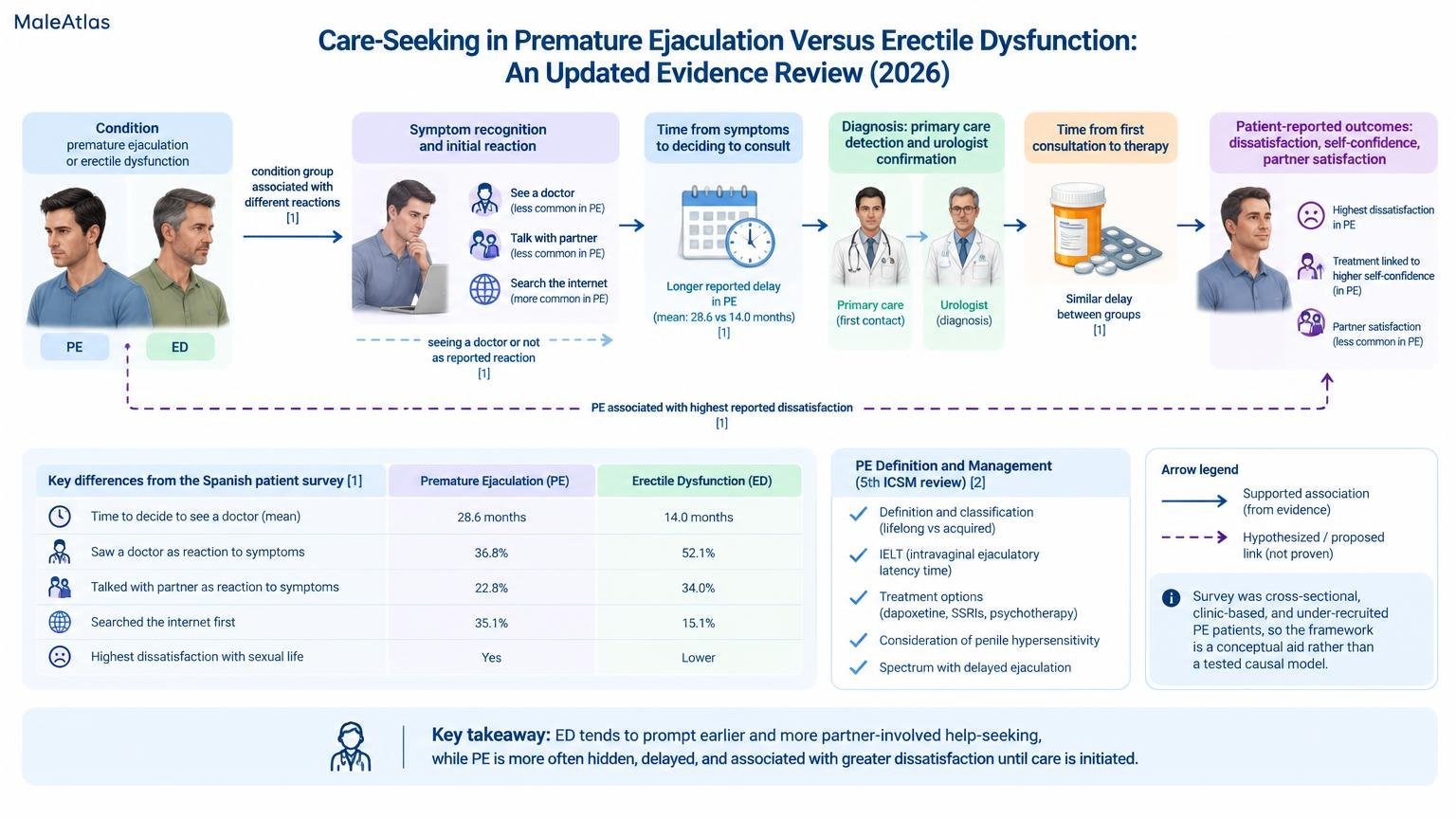
The most striking care-seeking difference in the Spanish survey was the time from first symptoms to deciding to see a doctor. Men with PE reported a mean of 28.6 months, compared with 14.0 months for men with ED, a difference described as statistically significant. The medians were somewhat closer, at 12.0 months for both groups, with wider interquartile ranges for PE, which suggests a skewed distribution in which a subset of PE patients waited considerably longer. The mean difference is therefore a useful summary but should not be read as a uniform doubling of delay across all individuals. Because the data are retrospective self-report, recall error and reinterpretation of early symptoms are plausible.
Recognition of symptoms was broadly similar between groups, with more than 80% of participants in each group acknowledging the appearance of symptoms. What differed was the reaction. Seeing a doctor as a response to symptom onset was reported by 52.1% of ED patients versus 36.8% of PE patients, and talking with a partner was reported by 34.0% versus 22.8%. Conversely, searching the internet for symptoms was more common in PE, at 35.1% versus 15.1% for ED. These are associations within a self-selected clinic sample; they do not establish that internet searching delays care, nor that partner discussion causes earlier consultation. They do, however, suggest different behavioral routes into care.
The first point of contact was often primary care, chosen as a first option by 51.3% of ED and 57.1% of PE cases, yet the diagnosis was made mainly by urologists, at 74.8% for ED and 75.7% for PE. The survey also noted that primary care physicians were the original detection point in 42.5% of ED and 34.3% of PE cases, although the abstract-reported comparison of diagnosis versus detection is somewhat difficult to disentangle as presented. The key clinical message is that urology retains a central diagnostic role, but primary care is a common entry point. If primary care is where many men first raise the issue, or where it emerges incidentally, then the quality of that first conversation matters for subsequent pathway efficiency.
About one third of participants said their sexual problem was not the main reason for the visit. This suggests that opportunistic detection is a real part of the care pathway for both conditions. It also complicates simple interpretations of delayed consultation: some men may not have been actively concealing a concern but rather waiting for a natural opportunity to discuss it. The survey did not report separate figures for ED and PE on this item, so it is not possible to say whether incidental detection was more common in one group. That is a gap the published report leaves open.
Treatment Pathways and Patient-Reported Outcomes
Time from first consultation for symptoms to start of therapy was 8.7 months for ED patients treated with oral drugs and 7.6 months for PE patients treated with dapoxetine. The authors explicitly stated that this difference was not statistically significant. The similar treatment delays are notable because they contrast with the much larger difference in pre-consultation delay. In other words, once men with PE reached care, their time to treatment was not substantially longer than for men with ED in this cohort, at least among those who received these therapies. That pattern suggests that the biggest care-seeking gap occurs before the first consultation rather than after it.
Treatment patterns differed in ways that reflect the available evidence base. Among PE patients, 54.2% used a non-pharmacological approach, and at least 62.5% of the sample rated its efficacy poorly. Dapoxetine, which holds a specific authorization for PE, was prescribed in 42.4% of cases, corresponding to 26 patients. Of those given dapoxetine, 42.3% rated its efficacy as moderate. Topical creams were prescribed in many PE cases, but their potential to improve ejaculatory latency was judged null by 37.5% of the subgroup using them. These figures are perceptions of efficacy, not controlled outcome measurements, and the small numbers limit precision. They nonetheless illustrate that treatment satisfaction in PE is mixed even when guideline-recognized options are used.
The survey also reported changes in sexual experience after treatment. Among PE patients, reported self-confidence with sexual intercourse was 35% in untreated versus 60% in treated patients. Other items, including feeling less prone to failure and a greater sense of completeness, also improved, with the authors reporting statistical significance for several comparisons. These are before-and-after observational contrasts, not randomized comparisons, so treatment indication and other unmeasured differences could explain part of the change. The direction is consistent with the consensus view that PE is treatable, but the magnitude should not be interpreted as a causal effect estimate. The survey also reported that partners of men with ED were more often satisfied than partners of men with PE, at 49.8% versus 23.8%, which underscores that PE can carry relational as well as individual burden.
For clinicians, the treatment data raise a practical question: if care is delayed until dissatisfaction is entrenched and treatment response is perceived as only moderate by many patients, then earlier discussion might change the trajectory. The survey cannot prove that, but it is a plausible hypothesis generated by the data rather than a demonstrated effect. It should be tested with designs that measure care-seeking time prospectively and link it to standardized outcomes. Until then, the reasonable interpretation is that delayed consultation is a modifiable target worth addressing, not a proven cause of poorer treatment response.
Communication, Stigma, and the Partner's Role
Communication emerged as a central theme. About half of the surveyed men agreed that initiating a discussion about sexual concerns of this nature was taboo, and agreement was particularly noted among older subjects. A substantial majority agreed that their doctors had extensive knowledge of the disorders and that they could talk openly with their doctor, yet the taboo belief persisted alongside that confidence. This combination suggests that stigma is not simply a matter of distrust in clinicians; it may operate as a social norm that makes it difficult to introduce the topic at all. The survey's cross-sectional design cannot tell us whether stigma causes delay or whether delayed care reinforces stigma.
The partner's role also differed. Men with ED more often reported discussing the problem with their partner, and partners accompanied ED patients to initial visits more often than in PE, at 34.3% versus 22.9%. Most respondents disagreed that their partner encouraged them to seek medical advice, and most did not identify the partner as the person who detected the problem. These findings qualify a common assumption that partners are the primary driver of help-seeking. In this sample, men themselves were more often the ones who recognized the problem, but they did not necessarily act on it promptly or involve their partner in the process.
The clinical implication is that asking about sexual function in a routine visit may be more effective than waiting for a partner to prompt disclosure or for the patient to volunteer a concern. That is a service-design inference, not a tested intervention. It aligns with the observation that about one third of sexual problems emerged incidentally during a visit. A clinician who asks directly may shorten the path from symptom to care, but the survey does not provide evidence on whether a specific question or screening approach changes consultation behavior or outcomes. The gap between plausible practice and proven practice should remain explicit.
Interpretation and Limitations
The Spanish survey has several limitations that materially affect interpretation. Recruitment was consecutive within urology clinics, meaning that all participants had a known diagnosis and were attending routine control visits. Men who never sought care, who were managed entirely in primary care, or who dropped out of care are not represented. The PE subgroup was small, with 70 participants and an achieved precision of 11.6%, far from the planned 4.9%. Subgroup comparisons within PE, such as those by age or acquired versus lifelong subtype, are therefore exploratory. The study was also conducted during the COVID-19 pandemic, which affected recruitment and possibly the care-seeking behavior being studied.
The observational design limits causal inference throughout. The difference in pre-consultation delay between PE and ED is an association; it does not prove that having PE causes delay independent of age, relationship factors, education, or comorbidity. The two groups differed in mean age, with ED patients older than PE patients, and statistical comparisons in the survey were generally unadjusted. The before-and-after treatment findings are similarly vulnerable to confounding by indication and regression to the mean. Patient-reported efficacy is not the same as measured efficacy, and perceived improvement can reflect expectation, relationship changes, or natural fluctuation. The survey is valuable for describing experience and generating hypotheses, not for establishing treatment effects.
The 5th ICSM consensus review is a different kind of evidence: a synthesis and recommendation document rather than a primary study. It provides current expert framing of definitions, classification, and management, but it does not supply patient-level data on care-seeking. Where this article juxtaposes the consensus with the survey, the juxtaposition is interpretive. The consensus does not validate the survey's proportions, and the survey does not test the consensus recommendations. Both sources are useful, but they answer different questions and should not be treated as mutually confirming evidence for the same claim.
There is also a measurement issue that affects cross-study comparison. PE definitions in research often rely on IELT thresholds, distress, and perceived control, and different studies operationalize these constructs differently. The survey did not report IELT-based outcomes in the material available, and its PE group was defined by known diagnosis rather than by a standardized research definition. The consensus review emphasizes classification and measurement, which is precisely the kind of framework needed to make future care-seeking studies comparable. Until such standardization is applied, estimates of delay and dissatisfaction should be read as setting-specific rather than universally generalizable.
A Comparison Table of Key Care-Seeking Variables
| Variable | ED Finding | PE Finding | Interpretation |
|---|---|---|---|
| Mean time from first symptoms to deciding to see a doctor | 14.0 months | 28.6 months | PE patients reported roughly twice the delay; statistically significant but based on retrospective self-report and a small PE subgroup. |
| Seeing a doctor as reaction to symptom onset | 52.1% | 36.8% | A smaller proportion of PE patients reported seeing a doctor as their initial response; association only, not causal. |
| Talking to partner about the problem | 34.0% | 22.8% | Partner discussion was less commonly reported in PE; may reduce opportunities for partner-prompted care. |
| Searching the internet for symptoms | 15.1% | 35.1% | PE patients more often turned to the internet first; the survey cannot show whether this delayed or facilitated care. |
| Physician making the diagnosis: urologist | 74.8% | 75.7% | Urology remained the main diagnostic setting in both groups; recruitment setting likely inflates this proportion. |
| Mean time from first consultation to therapy | 8.7 months (oral drugs) | 7.6 months (dapoxetine) | No statistically significant difference reported; the main delay occurred before consultation, not after. |
| Self-reported sexual dissatisfaction | Not the highest group in the reported comparison | 78% | PE patients reported the highest dissatisfaction; self-report and small subgroup limit precision. |
| Reported self-confidence with intercourse | Not the focus of this item | 35% untreated versus 60% treated | Before-and-after observational contrast; cannot establish that treatment caused the difference. |
Research Outlook
The most important next step is prospective, community-based research that follows men from first symptoms rather than recruiting them after diagnosis. Such a design could measure time to consultation more accurately, reduce recall bias, and include men who never seek care. It could also test whether specific interventions, such as routine sexual-function questions in primary care or partner-inclusive consultation models, shorten delay or improve satisfaction. The Spanish survey provides a rationale for these questions but cannot answer them. The consensus review provides the definitional and management framework against which such studies should measure outcomes.
A second priority is standardized measurement of PE outcomes in care-seeking research. Studies should report IELT, perceived control, distress, and relationship satisfaction in a consistent way, and should distinguish lifelong from acquired PE. The survey's findings suggest that dissatisfaction and self-confidence are important patient-centered outcomes, but their measurement was not standardized in a way that permits comparison across studies. Linking care-seeking delay to these outcomes prospectively would clarify whether earlier consultation is associated with better treatment response, a hypothesis that current data can only suggest.
Finally, research should examine the role of primary care more directly. The survey found that primary care was a common first option but that urologists made most diagnoses. Whether this reflects appropriate specialization, diagnostic uncertainty in primary care, or referral patterns is unclear. Understanding the primary care conversation about PE, including barriers to asking and to diagnosing, could identify a high-yield point for improving early care. This is a health-services question rather than a purely clinical one, and it requires designs suited to studying communication, referral, and access.
Key Takeaways
- In a Spanish multicentric survey, men with PE reported waiting 28.6 months on average from first symptoms to deciding to see a doctor, compared with 14.0 months for men with ED; the difference was statistically significant but based on retrospective self-report and a PE subgroup of 70.
- PE patients less often reported seeing a doctor or talking to a partner as their reaction to symptoms, and more often reported searching the internet first, compared with ED patients.
- Once men reached care, time from first consultation to therapy was not significantly different between groups: 8.7 months for ED oral drugs and 7.6 months for dapoxetine in PE, suggesting the larger gap is pre-consultation.
- PE patients reported the highest degree of sexual dissatisfaction, at 78%, and reported lower self-confidence with intercourse when untreated than when treated, although the treatment comparison is observational and cannot establish causality.
- About half of surveyed men agreed that initiating a discussion about sexual concerns was taboo, and about one third said their sexual problem was not the main reason for the visit, highlighting the importance of opportunistic clinical detection.
- The 5th International Consultation on Sexual Medicine review provides the current consensus framework for PE definition, classification, and management, including dapoxetine, SSRIs, and psychotherapy, but its recommendations are consensus-based and distinct from the patient-survey findings.
Questions and Answers
What defines premature ejaculation in current consensus guidance?
The 5th International Consultation on Sexual Medicine review organizes premature ejaculation around definition, classification, evaluation, and management, distinguishing lifelong from acquired patterns and using intravaginal ejaculatory latency time as a key construct. Treatment options discussed include dapoxetine, selective serotonin reuptake inhibitors, and psychotherapy. The review is a consensus synthesis rather than a primary study, so its recommendations reflect expert evaluation of existing evidence rather than new empirical data.
How long do men with premature ejaculation wait before seeing a doctor compared with erectile dysfunction?
In a Spanish multicentric survey, men with premature ejaculation reported a mean of 28.6 months from first symptoms to deciding to see a doctor, versus 14.0 months for men with erectile dysfunction, a statistically significant difference. The medians were closer, at 12.0 months in both groups, indicating a skewed distribution. These are retrospective self-reports from a specialist-clinic sample, and the premature ejaculation subgroup was small.
How strong is the evidence that premature ejaculation causes delayed care-seeking?
It is associational, not causal. The Spanish survey was cross-sectional and recruited patients already attending urology clinics, so it cannot show that premature ejaculation itself causes delay independent of age, relationship factors, or other variables. The groups were not adjusted for confounders in the reported comparisons, and the premature ejaculation subgroup had limited precision. The findings generate hypotheses about care pathways but do not establish causal effects.
Does treatment improve sexual confidence in premature ejaculation?
The Spanish survey reported that self-confidence with sexual intercourse was 35% in untreated versus 60% in treated premature ejaculation patients, with statistical significance. However, this was a before-and-after observational comparison, not a randomized trial, so treatment indication and other unmeasured factors could explain part of the difference. It is consistent with the view that premature ejaculation is treatable but does not prove that treatment caused the improvement.
What role do partners play in help-seeking for premature ejaculation versus erectile dysfunction?
In the Spanish survey, men with erectile dysfunction more often discussed the problem with their partner than men with premature ejaculation, at 34.0% versus 22.8%. Partners accompanied patients to initial visits more often in erectile dysfunction than in premature ejaculation, at 34.3% versus 22.9%. Most respondents disagreed that their partner encouraged them to seek care, suggesting that in this sample men themselves usually recognized the problem but did not always act promptly on it.
Why might routine clinic visits matter for detecting premature ejaculation?
About one third of surveyed men said their sexual problem was not the main reason for the visit and instead emerged during conversation with the doctor, indicating that opportunistic detection is part of the care pathway. About half also agreed that raising sexual concerns was taboo. Together these findings suggest that direct questioning in routine visits may help surface concerns that patients do not volunteer, though the survey did not test whether any specific screening approach improves outcomes.
Conceptual framework: Conceptual framework. This diagram summarizes variables reported in a Spanish multicentric patient survey comparing care-seeking and treatment experiences in premature ejaculation versus erectile dysfunction. Arrows indicate reported associations or proposed relationships, not causal effects. The survey was cross-sectional, clinic-based, and under-recruited premature ejaculation patients, so the framework is a conceptual aid rather than a tested causal model.
Academic References & Evidence
- Ana Mª Puigvert-Martínez; Rafael Prieto-Castro; Remei Artigas-Feliuc; Patricia Illán-Mateo; Nuria Cruz-Culebra; Gloria González-Ayala. An observational, national and multicentric study to describe the detection, diagnosis and treatment of erectile dysfunction and premature ejaculation from the patient's perspective. Revista Internacional de Andrología. 2023 21(2)
- Contemporary consensus and emerging directions in premature and delayed ejaculation: recommendations from the 5th International Consultation on Sexual Medicine.. Sexual medicine reviews PMID: 42855438.
SANYUN Science Center explains published research on men's reproductive and sexual health, connecting scientific evidence with everyday questions while making sources and limitations clear.
Disclaimer: This article is for scientific education and research communication only. It does not provide medical advice, diagnosis, or individualized treatment recommendations, and does not endorse any medication, supplement, device, penile enlargement procedure, or other intervention. Decisions about sexual and reproductive health should be made in consultation with a qualified healthcare professional. Do not delay seeking professional care because of information in this article.
Original Content & Copyright Notice
- This article is prepared for SANYUN Science Center, drawing on published research and publicly available academic literature on men’s sexual and reproductive health. Its editorial explanations and presentation are developed for this platform.
- Copyright in the original editorial content, selection, and arrangement is reserved by SANYUN Science Center to the extent protected by applicable law. Referenced research, quotations, and third-party materials remain subject to the rights of their respective owners. This notice does not claim ownership of scientific facts or third-party research.
- Except where permitted by applicable law or an applicable license, prior written permission is required to reproduce, republish, translate, adapt, redistribute, or commercially reuse protected content. Attribution alone does not grant permission for such reuse.
- For permitted quotation or authorized reuse, clearly identify the source and retain a link to the original article.
- Source: SANYUN Science Center
- Original URL: Retain the original article URL on science.san-yun.com.
- Copyright Holder: SANYUN Science Center, for its own protected editorial content.
- Quotation, excerpts, or authorized reuse must not distort the scientific meaning, omit material limitations or disclaimers, or imply unverified medical claims, product efficacy, or endorsement by SANYUN Science Center.



