




Category: Latest Research
Core Research Direction: Recent randomised controlled trial evidence on whether low-intensity extracorporeal shockwave therapy (Li-ESWT) and home-based pelvic floor muscle training (PFMT), added to sildenafil, improve penile arterial blood flow and erectile function in men with type 2 diabetes and arteriogenic erectile dysfunction, and how these compare with each other and with sildenafil alone.
Search Intent: For men with type 2 diabetes and arteriogenic erectile dysfunction already taking sildenafil, do low-intensity shockwave therapy or home pelvic floor muscle training improve penile blood flow and erectile function more than sildenafil alone, and which is more effective?
Platform: SANYUN Science Center
Evidence reviewed through: 2026-11-20
Executive Summary
A three-arm randomised trial published in 2026 tested whether low-intensity extracorporeal shockwave therapy (Li-ESWT) or home-based pelvic floor muscle training (PFMT) adds benefit to sildenafil in men with type 2 diabetes and arteriogenic erectile dysfunction. All 90 participants received sildenafil 25 mg daily plus 50 mg on demand; one group also received weekly Li-ESWT for six weeks, one performed home PFMT for six weeks, and one continued sildenafil alone.[1]
Both active groups improved bilateral cavernosal artery peak systolic velocity (PSV) and IIEF-5 scores compared with sildenafil alone. Li-ESWT produced larger changes than PFMT: a 10 cm/sec greater mean change in PSV (95% CI 9 to 11) and a 1.4-point greater mean change in IIEF-5 (95% CI 0.9 to 1.9). The trial was short, lacked a sham shockwave arm and enrolled a narrow, all-smoker population, so the findings are best read as promising short-term evidence rather than proof of durable or disease-modifying benefit.
Why This Matters
Erectile dysfunction is common in men with type 2 diabetes, and arteriogenic ED — impaired arterial inflow confirmed by penile Doppler ultrasound — is a frequent pattern. Phosphodiesterase-5 inhibitors such as sildenafil remain first-line drug therapy, but they treat symptoms rather than reverse underlying vascular pathology, and some men respond poorly. This creates demand for adjuncts that might improve penile blood flow itself.[2]
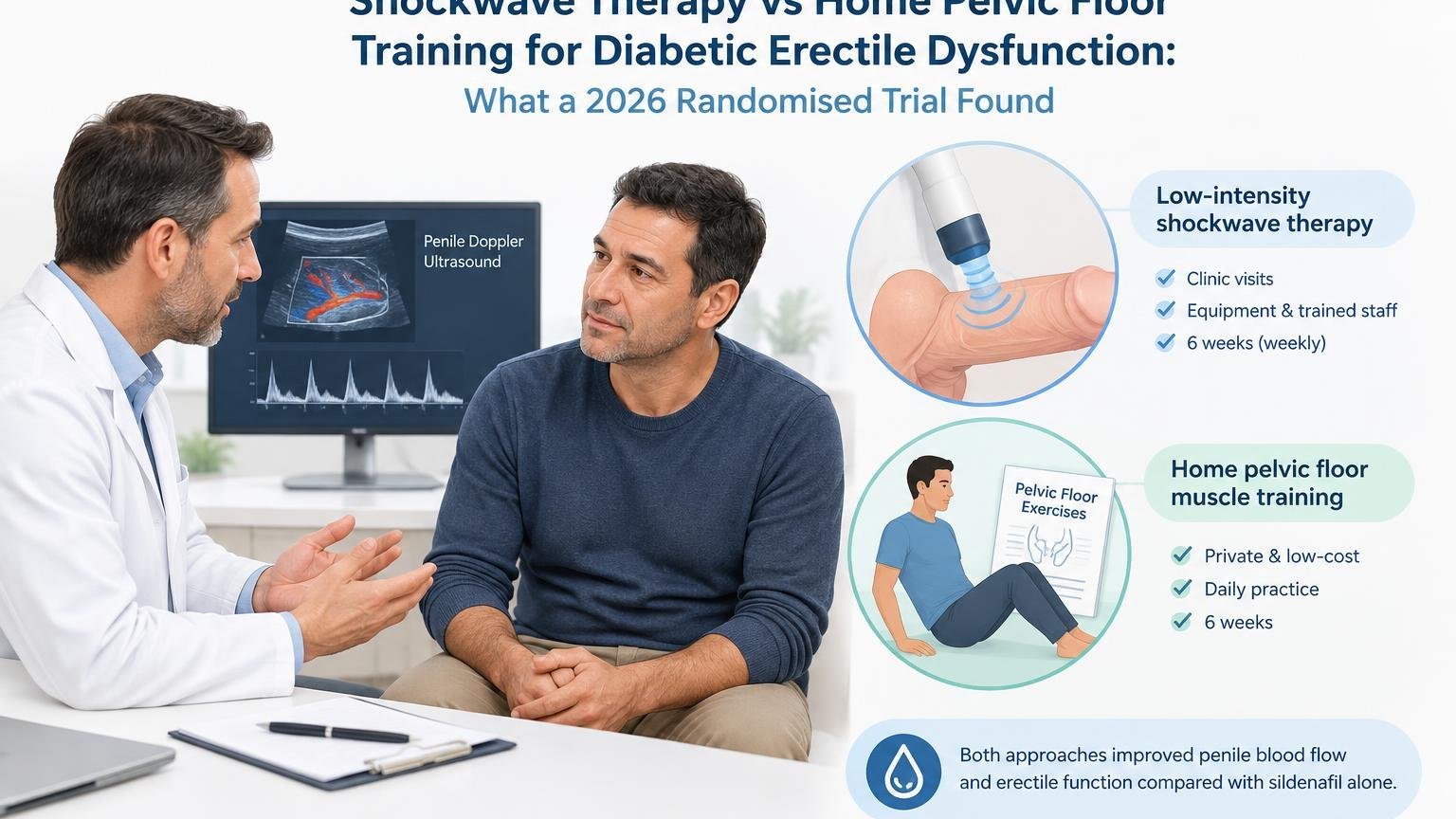
Li-ESWT and PFMT are attractive in principle because they are non-drug, non-surgical options with different practical profiles. Shockwave requires clinic visits, equipment and trained providers; home PFMT is low-cost and private but depends on correct technique and adherence. Until this trial, direct head-to-head evidence in diabetic arteriogenic ED was limited, so the comparison addresses a genuine clinical question rather than only a mechanistic one.
Biological and Clinical Mechanisms
The proposed rationale for Li-ESWT is that low-energy shockwaves stimulate angiogenesis and upregulate endothelial nitric oxide synthase and vascular endothelial growth factor expression, potentially improving cavernosal arterial inflow. This mechanism is plausible and consistent with the trial's primary endpoint — PSV measured by Doppler ultrasound — but it was not directly tested in the trial. The observed PSV changes are therefore physiological signals whose cellular basis remains inferential.
For PFMT, the proposed mechanism is enhanced contractility of the bulbospongiosus and ischiocavernosus muscles, with improved penile rigidity through reduced venous outflow. Anatomical reviews describe the ischiocavernosus as promoting erection through contraction and the bulbospongiosus, which encircles roughly 33-50% of the penile base, as compressing deep penile veins. These descriptions support biological plausibility but do not establish how much of the trial's PSV change came from muscle conditioning versus other factors.[3]
Sildenafil itself increases cyclic guanosine monophosphate signalling and smooth-muscle relaxation, improving inflow. Because every participant received sildenafil, the trial measures add-on effects, not the independent efficacy of either intervention. This distinction matters clinically: the results cannot support replacing drug therapy with shockwave or pelvic floor training.
What the Evidence Shows
The trial randomised 90 men aged 35 to 55 years with type 2 diabetes for more than five years, erectile dysfunction for more than six months, Doppler-confirmed arteriogenic ED, body mass index under 30 kg/m² and HbA1c below 9%. Allocation was concealed, assessors were blinded and analysis was by intention to treat. All participants completed the study, and reported PFMT adherence was 85%.
Within-group PSV changes over six weeks were +21 cm/sec for Li-ESWT plus sildenafil, +11 cm/sec for PFMT plus sildenafil and +5 cm/sec for sildenafil alone. Mean final PSV in the shockwave group was around 39 cm/sec, above the commonly cited 30 cm/sec threshold for normal arterial inflow. These are short-term changes at a single post-baseline timepoint, not evidence of sustained vascular remodelling.
Mean IIEF-5 improvements were +3.6 points with Li-ESWT, +2.2 points with PFMT and +1.0 point with sildenafil alone. The shockwave improvement approached but did not clearly exceed the commonly cited 4-point minimal clinically important difference, and the 1.4-point between-group difference versus PFMT is below that threshold. Statistical separation from control is therefore clearer than patient-perceived clinical importance, especially for PFMT.
| Outcome (6 weeks) | Li-ESWT + sildenafil | PFMT + sildenafil | Sildenafil alone |
|---|---|---|---|
| Mean change in cavernosal artery PSV | +21 cm/sec | +11 cm/sec | +5 cm/sec |
| Mean change in IIEF-5 | +3.6 points | +2.2 points | +1.0 point |
| Difference vs PFMT (PSV) | 10 cm/sec higher (95% CI 9 to 11) | Reference | Not applicable |
| Difference vs PFMT (IIEF-5) | 1.4 points higher (95% CI 0.9 to 1.9) | Reference | Not applicable |
| Final mean PSV | About 39 cm/sec | Not reported in summary | Not reported in summary |
Interpretation and Limitations
The strongest finding is the PSV difference: shockwave therapy produced a larger objective improvement in penile arterial inflow than home pelvic floor training, which in turn exceeded sildenafil alone. Because PSV is measured by ultrasound rather than self-report, it is less vulnerable to expectation than symptom scores. However, a six-week horizon is short for a therapy often framed as regenerative, and the trial cannot show whether the PSV advantage persists after treatment stops.
The absence of a sham shockwave group is a major limitation. Erectile function outcomes are sensitive to placebo, expectation and psychological conditioning, and the IIEF-5 is subjective. The trial cannot separate specific shockwave effects from ritual, attention and hope. The commentator's judgement that the findings are promising rather than definitive reflects these design constraints and the narrow population.
Generalisability is limited. Participants were 35 to 55 years old, had relatively controlled diabetes (HbA1c below 9%), were not obese (BMI under 30 kg/m²), had no other ED aetiologies and were all smokers. Men outside these criteria — older men, those with worse glycaemic control, non-smokers or men with mixed ED causes — may respond differently. Because everyone received sildenafil, the trial also cannot tell us whether either intervention works without drug therapy.
Context from pelvic floor research in other populations is mixed. A narrative review of seven randomised trials found that most tested pelvic floor exercise with electrical stimulation or biofeedback after radical prostatectomy and only three reported significant effects on erectile function; its conclusion stated that the seven trials showed no significant effect of pelvic floor muscle exercise on erectile dysfunction. That review is not directly comparable to the diabetes trial, but it cautions against assuming PFMT is reliably effective across ED populations.
Research and Clinical Outlook
Longer sham-controlled trials are needed to test durability, to separate specific from nonspecific effects and to define optimal shockwave protocols in diabetic men. Future work should also compare Li-ESWT and PFMT without background sildenafil, include men with a wider range of glycaemic control and body mass index, and measure outcomes beyond six weeks. Cost, access and bother are relevant to informed choice but were not tested here.
Clinically, the trial supports a conversation rather than a protocol. Men already taking sildenafil may reasonably ask whether adding shockwave therapy or home pelvic floor training could help. The evidence suggests a short-term physiological advantage for shockwave and a smaller but real advantage for pelvic floor training, with different demands and burdens. Decisions should acknowledge the short follow-up, the lack of sham control and the narrow population before either is presented as a proven long-term solution.
Key Takeaways
- In 90 men with type 2 diabetes and arteriogenic ED, adding six weeks of Li-ESWT or home PFMT to sildenafil improved cavernosal artery PSV and IIEF-5 compared with sildenafil alone.
- Li-ESWT produced a 10 cm/sec greater PSV change and a 1.4-point greater IIEF-5 change than PFMT, but the IIEF-5 difference is below the commonly cited 4-point clinical threshold.
- The six-week follow-up, absence of a sham shockwave arm, universal sildenafil background and narrow all-smoker population limit how far the results can be generalised.
- The mechanisms proposed for both interventions — angiogenesis and endothelial signalling for shockwave, bulbospongiosus and ischiocavernosus conditioning for PFMT — remain plausible but were not directly measured.
Questions and Answers
What is low-intensity extracorporeal shockwave therapy for erectile dysfunction?
Li-ESWT delivers low-energy acoustic pulses to penile tissue, typically at energy flux densities such as 0.09 mJ/mm². In this trial it was given once weekly for six weeks to six points on the ventral penile shaft and both crura, with 3,000 shocks per session. Proposed benefits involve angiogenesis and endothelial nitric oxide signalling, but the trial did not directly measure these mechanisms.
Did shockwave therapy or pelvic floor training improve penile blood flow in diabetic men?
Yes, both improved cavernosal artery peak systolic velocity over six weeks when added to sildenafil. Mean PSV rose by 21 cm/sec with shockwave, 11 cm/sec with home pelvic floor training and 5 cm/sec with sildenafil alone. Shockwave produced a 10 cm/sec greater change than pelvic floor training (95% CI 9 to 11). These are short-term Doppler findings, not proof of lasting vascular improvement.
How did shockwave therapy compare with home pelvic floor muscle training for erectile function scores?
Shockwave produced a larger IIEF-5 improvement: +3.6 points versus +2.2 for pelvic floor training and +1.0 for sildenafil alone. The between-group difference versus training was 1.4 points (95% CI 0.9 to 1.9). That difference is statistically distinguishable but below the commonly cited 4-point minimal clinically important difference, so patient-perceived benefit from training may still be meaningful.
How strong is the evidence that shockwave therapy helps diabetic erectile dysfunction?
It is promising but not definitive. The trial was randomised with concealed allocation, assessor blinding and intention-to-treat analysis, and it used an objective ultrasound endpoint. However, it followed participants for only six weeks, lacked a sham shockwave arm and enrolled a narrow population. Placebo and expectation effects on symptom scores cannot be excluded, and durability is unknown.
Can these results apply to men who are not middle-aged smokers with well-controlled diabetes?
Not necessarily. Participants were 35 to 55 years old, had diabetes for more than five years, HbA1c below 9%, BMI under 30 kg/m² and no other ED causes, and all were smokers. Men who are older, have worse glycaemic control, are not smokers or have mixed ED causes may respond differently. Everyone also received sildenafil, so the trial does not show whether either therapy works alone.
Why does the trial not prove that shockwave therapy or pelvic floor training can replace sildenafil?
All three groups received sildenafil 25 mg daily plus 50 mg on demand. The trial therefore measures added benefit on top of drug therapy, not independent efficacy. It cannot show whether shockwave or pelvic floor training would produce similar improvements without sildenafil, and it should not be interpreted as evidence that either can substitute for medication.
Sources and References
- Ahmad AM; Abosteit EH; Said Kadah A; Draz RS. Ahmad AM. et al., 2026: Low-intensity shockwave therapy and pelvic floor muscle training each mitigate erectile dysfunction in men with diabetes: a randomised controlled trial.. J Physiother. 2026 72(2):122-127 DOI: 10.1016/j.jphys.2026.03.009.
- 低强度冲击波疗法与盆底肌训练均能改善糖尿病男性勃起功能障碍:一项随机对照试验. Journal of Physiotherapy. 2026
- Kwang Lae Kim. The Role of Pelvic Floor Muscle Exercise in Erectile Dysfunction. 2024
SANYUN Science Center explains published research on men's reproductive and sexual health, connecting scientific evidence with everyday questions while making sources and limitations clear.
Disclaimer: This article is for scientific education and research communication only. It does not provide medical advice, diagnosis, or individualized treatment recommendations, and does not endorse any medication, supplement, device, penile enlargement procedure, or other intervention. Decisions about sexual and reproductive health should be made in consultation with a qualified healthcare professional. Do not delay seeking professional care because of information in this article.
Original Content & Copyright Notice
- This article is prepared for SANYUN Science Center, drawing on published research and publicly available academic literature on men’s sexual and reproductive health. Its editorial explanations and presentation are developed for this platform.
- Copyright in the original editorial content, selection, and arrangement is reserved by SANYUN Science Center to the extent protected by applicable law. Referenced research, quotations, and third-party materials remain subject to the rights of their respective owners. This notice does not claim ownership of scientific facts or third-party research.
- Except where permitted by applicable law or an applicable license, prior written permission is required to reproduce, republish, translate, adapt, redistribute, or commercially reuse protected content. Attribution alone does not grant permission for such reuse.
- For permitted quotation or authorized reuse, clearly identify the source and retain a link to the original article.
- Source: SANYUN Science Center
- Original URL: Retain the original article URL on science.san-yun.com.
- Copyright Holder: SANYUN Science Center, for its own protected editorial content.
- Quotation, excerpts, or authorized reuse must not distort the scientific meaning, omit material limitations or disclaimers, or imply unverified medical claims, product efficacy, or endorsement by SANYUN Science Center.



