




Category: Clinical Insights
Core Research Direction: Clinical utility, methodology-specific SDF thresholds, and evidence-graded management strategies for sperm DNA fragmentation testing in male infertility and assisted reproduction
Search Intent: How useful is sperm DNA fragmentation testing in assisted reproduction, and what thresholds and management strategies does the current evidence support?
Platform: SANYUN Science Center
Evidence reviewed through: 2026-11-15
Executive Summary
Sperm DNA fragmentation (SDF) has emerged as a biomarker that may offer diagnostic information beyond conventional semen analysis in the evaluation of male infertility, particularly for couples with otherwise normal semen parameters who face recurrent pregnancy loss or assisted reproductive technology (ART) failure. A 2026 narrative review examined four principal testing modalities and their methodology-specific thresholds, proposing clinical indications and evidence-based management strategies. The review acknowledges that universal thresholds remain elusive, but suggests that assay-specific cut-off values can provide meaningful clinical guidance when interpreted alongside factors such as female partner age, oocyte quality, and planned ART modality.[1]
Why This Matters
Conventional semen analysis remains the cornerstone of male fertility assessment, but it does not capture DNA integrity within sperm. The inclusion of SDF testing in the World Health Organization 6th edition laboratory manual signals its growing recognition in reproductive medicine. For couples experiencing unexplained infertility or repeated ART failure, SDF testing may provide an additional explanatory pathway that standard semen parameters cannot address.
Biological and Clinical Context
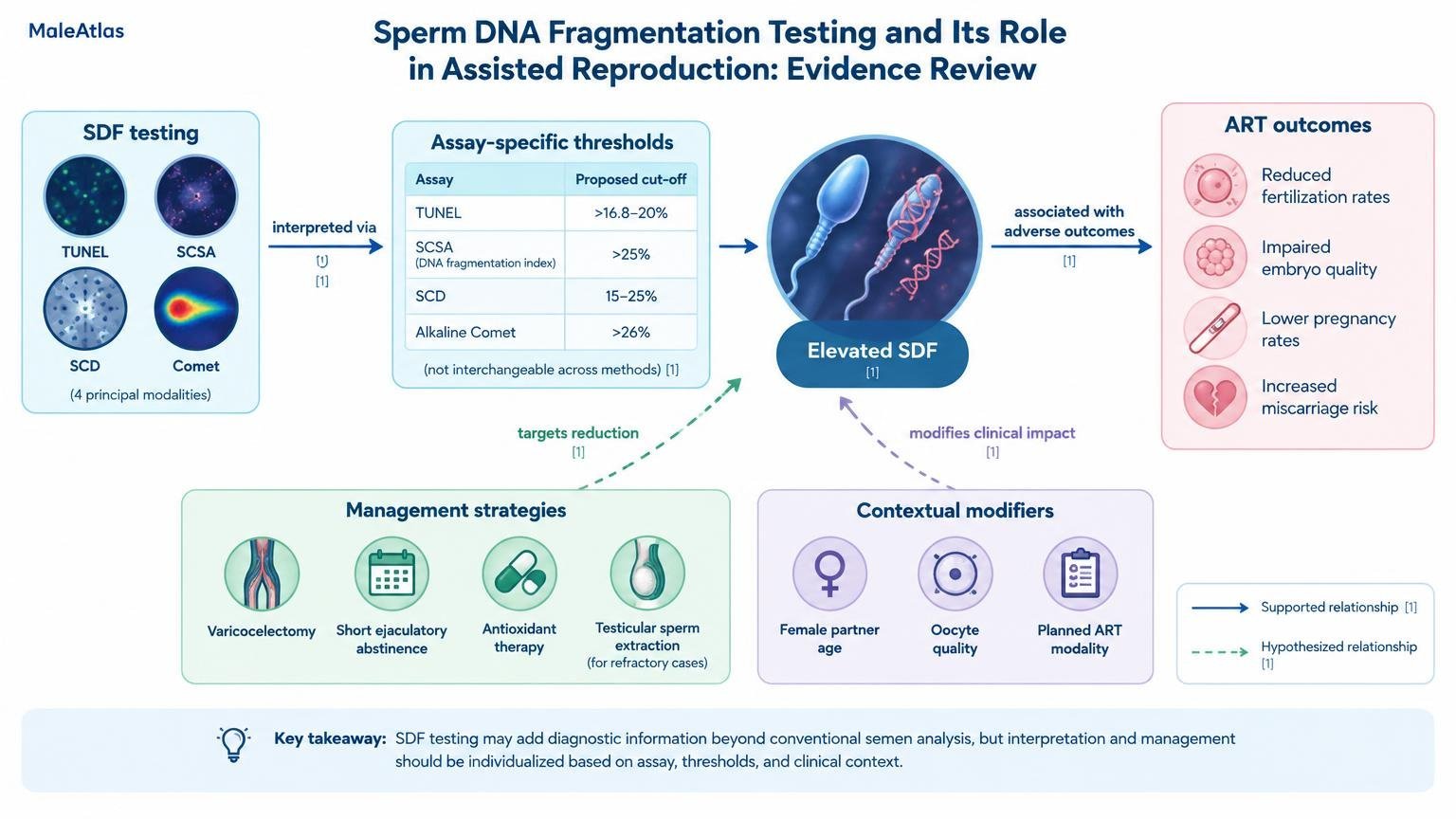
Sperm DNA fragmentation refers to breaks or damage in the DNA strands carried within spermatozoa. Elevated SDF has been associated in the reviewed literature with reduced fertilization rates, impaired embryo quality, decreased pregnancy rates, and increased miscarriage risk. These associations are particularly notable in couples whose conventional semen parameters appear normal, suggesting that SDF may capture a dimension of sperm quality that routine analysis misses.
The clinical significance of an elevated SDF result is not absolute. The review emphasizes that interpretation must be contextualized by female partner age, oocyte quality, and the planned ART modality. A high SDF value in a couple where the female partner is young with good oocyte quality may carry different implications than in a couple with advanced maternal age or poor oocyte yield, underscoring that SDF is one variable within a broader reproductive picture.
What the Evidence Shows
The review compared four principal SDF testing modalities: terminal deoxynucleotidyl transferase dUTP nick end labelling (TUNEL), sperm chromatin structure assay (SCSA), sperm chromatin dispersion (SCD) test, and the Comet assay. These methods differ in their technical characteristics, reproducibility, and predictive value for ART outcomes. Because the assays measure different aspects of DNA damage and use different detection chemistries, their results are not directly interchangeable.
Methodology-specific cut-off values proposed by the review are summarized below. These thresholds are drawn from heterogeneous literature and should be understood as assay-specific reference points rather than universal diagnostic criteria.
| Assay | Proposed cut-off | Interpretation |
|---|---|---|
| TUNEL | >16.8–20% | Elevated SDF by this assay is proposed as clinically meaningful above this range. |
| SCSA (DNA fragmentation index) | >25% | A DNA fragmentation index above 25% is proposed as the relevant threshold. |
| SCD | 15–25% | The proposed interpretation range spans 15% to 25% for this assay. |
| Alkaline Comet | >26% | An alkaline Comet value above 26% is proposed as the relevant threshold. |
Clinical indications for SDF testing listed by the review include recurrent pregnancy loss, unexplained infertility, and recurrent ART failure. These are contexts in which conventional semen analysis has not provided a sufficient explanation and where additional sperm integrity information may inform counseling or management decisions.
The review describes management strategies for elevated SDF as including varicocelectomy, short ejaculatory abstinence protocols, antioxidant therapy, and testicular sperm extraction for refractory cases. These approaches target different underlying contributors to DNA damage—from anatomical and vascular factors to oxidative stress and ejaculatory interval effects—and are presented as a stepwise framework rather than a single intervention.
Interpretation and Limitations
Several limitations warrant attention when interpreting this evidence. First, the source is a narrative review rather than a systematic review with meta-analysis; the thresholds and strategies are synthesized from heterogeneous literature without pooled effect estimates. The cut-off values are proposed as methodology-specific guidance, not as universally validated diagnostic criteria. Second, the associations between elevated SDF and adverse reproductive outcomes are described as associations, not proven causal relationships. Third, the management strategies are summarized narratively without effect sizes, so the magnitude of benefit for each intervention is not quantified in the supplied material.
The review itself acknowledges that universal thresholds remain elusive, which reflects genuine biological and technical heterogeneity across assays. A result above a given cut-off on one platform cannot be automatically translated to another. Clinicians should also weigh that SDF testing adds cost and complexity to an already multi-factorial fertility evaluation, and that the clinical impact of an elevated result depends substantially on female partner factors and the planned ART approach.
Research Outlook
The inclusion of SDF testing in the WHO 6th edition laboratory manual may encourage broader clinical adoption, but it also highlights the need for standardization and prospective validation. Future research would benefit from head-to-head comparisons of assay predictive value, consensus on assay-specific reference ranges, and randomized trials of management strategies with reproductive outcomes as endpoints. Until such evidence accumulates, SDF testing is best understood as a supplementary tool that requires careful contextual interpretation.
Key Takeaways
- SDF testing may add diagnostic information beyond conventional semen analysis, particularly for couples with normal semen parameters but recurrent pregnancy loss or ART failure.
- Assay-specific thresholds are proposed (TUNEL >16.8–20%, SCSA >25%, SCD 15–25%, alkaline Comet >26%), but no universal threshold exists and results are not interchangeable across methods.
- Management options described include varicocelectomy, short ejaculatory abstinence, antioxidant therapy, and testicular sperm extraction for refractory cases.
- Interpretation of SDF results should account for female partner age, oocyte quality, and planned ART modality, as these factors influence clinical impact.
Questions and Answers
What is sperm DNA fragmentation and why is it tested?
Sperm DNA fragmentation refers to breaks in the DNA within sperm. Testing measures the proportion of sperm with damaged DNA. It is used to assess a dimension of sperm quality not captured by conventional semen analysis, particularly in couples with unexplained infertility, recurrent pregnancy loss, or recurrent ART failure. Elevated levels have been associated with reduced fertilization, impaired embryo quality, lower pregnancy rates, and higher miscarriage risk.
What are the proposed sperm DNA fragmentation thresholds for different assays?
The reviewed evidence proposes methodology-specific cut-offs: TUNEL >16.8–20%, SCSA DNA fragmentation index >25%, SCD 15–25%, and alkaline Comet assay >26%. These are not universal thresholds; they reflect assay-specific interpretations drawn from heterogeneous literature. Results from one assay cannot be directly translated to another, and clinical interpretation should consider the specific method used.
What management strategies are suggested for elevated sperm DNA fragmentation?
The reviewed evidence describes several strategies: varicocelectomy, short ejaculatory abstinence protocols, antioxidant therapy, and testicular sperm extraction for refractory cases. These are presented as a stepwise framework. The review does not provide pooled effect sizes for these interventions, so the magnitude of benefit for each remains uncertain and should be discussed with a specialist.
How strong is the evidence for sperm DNA fragmentation testing in assisted reproduction?
The evidence derives from a 2026 narrative review, not a systematic review with meta-analysis. Associations between elevated SDF and adverse reproductive outcomes are described without pooled causal estimates. Methodology-specific thresholds are proposed but not universally validated. Management strategies are summarized narratively without effect sizes. The evidence is therefore suggestive but not definitive, and clinical decisions should integrate multiple factors.
What factors influence how an elevated sperm DNA fragmentation result should be interpreted?
Interpretation should be contextualized by female partner age, oocyte quality, and planned ART modality. These factors substantially influence the clinical impact of elevated SDF. An elevated result in one couple may carry different implications than in another with different maternal age or treatment plan. SDF is one variable within a broader reproductive assessment and should not be interpreted in isolation.
Is sperm DNA fragmentation testing part of standard male infertility evaluation?
SDF testing is not a first-line routine test for all men. The reviewed evidence lists clinical indications including recurrent pregnancy loss, unexplained infertility, and recurrent ART failure. Its inclusion in the WHO 6th edition laboratory manual reflects growing relevance, but it remains a supplementary tool. Whether to test should be discussed with a fertility specialist based on individual circumstances.
Conceptual framework: Conceptual framework of sperm DNA fragmentation testing in assisted reproduction. The diagram shows supported associations between elevated SDF and adverse ART outcomes, assay-specific threshold interpretation, proposed management targets, and contextual modifiers that influence clinical impact. This is a conceptual model based on a narrative review, not a tested causal pathway. Illustrative only.
Academic References & Evidence
- Xiaodong Zhao; Jianwen Wang; Huabin Wang; Cheng Peng; Lin Liu; Yongwei Shan. Sperm DNA Fragmentation Testing in the Era of Assisted Reproduction: Clinical Utility, Thresholds, and Management Strategies. Archivos Españoles de Urología. 2026 79(3):371-380 DOI: 10.56434/j.arch.esp.urol.20267903.44.
SANYUN Science Center explains published research on men's reproductive and sexual health, connecting scientific evidence with everyday questions while making sources and limitations clear.
Disclaimer: This article is for scientific education and research communication only. It does not provide medical advice, diagnosis, or individualized treatment recommendations, and does not endorse any medication, supplement, device, penile enlargement procedure, or other intervention. Decisions about sexual and reproductive health should be made in consultation with a qualified healthcare professional. Do not delay seeking professional care because of information in this article.
Original Content & Copyright Notice
- This article is prepared for SANYUN Science Center, drawing on published research and publicly available academic literature on men’s sexual and reproductive health. Its editorial explanations and presentation are developed for this platform.
- Copyright in the original editorial content, selection, and arrangement is reserved by SANYUN Science Center to the extent protected by applicable law. Referenced research, quotations, and third-party materials remain subject to the rights of their respective owners. This notice does not claim ownership of scientific facts or third-party research.
- Except where permitted by applicable law or an applicable license, prior written permission is required to reproduce, republish, translate, adapt, redistribute, or commercially reuse protected content. Attribution alone does not grant permission for such reuse.
- For permitted quotation or authorized reuse, clearly identify the source and retain a link to the original article.
- Source: SANYUN Science Center
- Original URL: Retain the original article URL on science.san-yun.com.
- Copyright Holder: SANYUN Science Center, for its own protected editorial content.
- Quotation, excerpts, or authorized reuse must not distort the scientific meaning, omit material limitations or disclaimers, or imply unverified medical claims, product efficacy, or endorsement by SANYUN Science Center.



