




Category: Latest Research
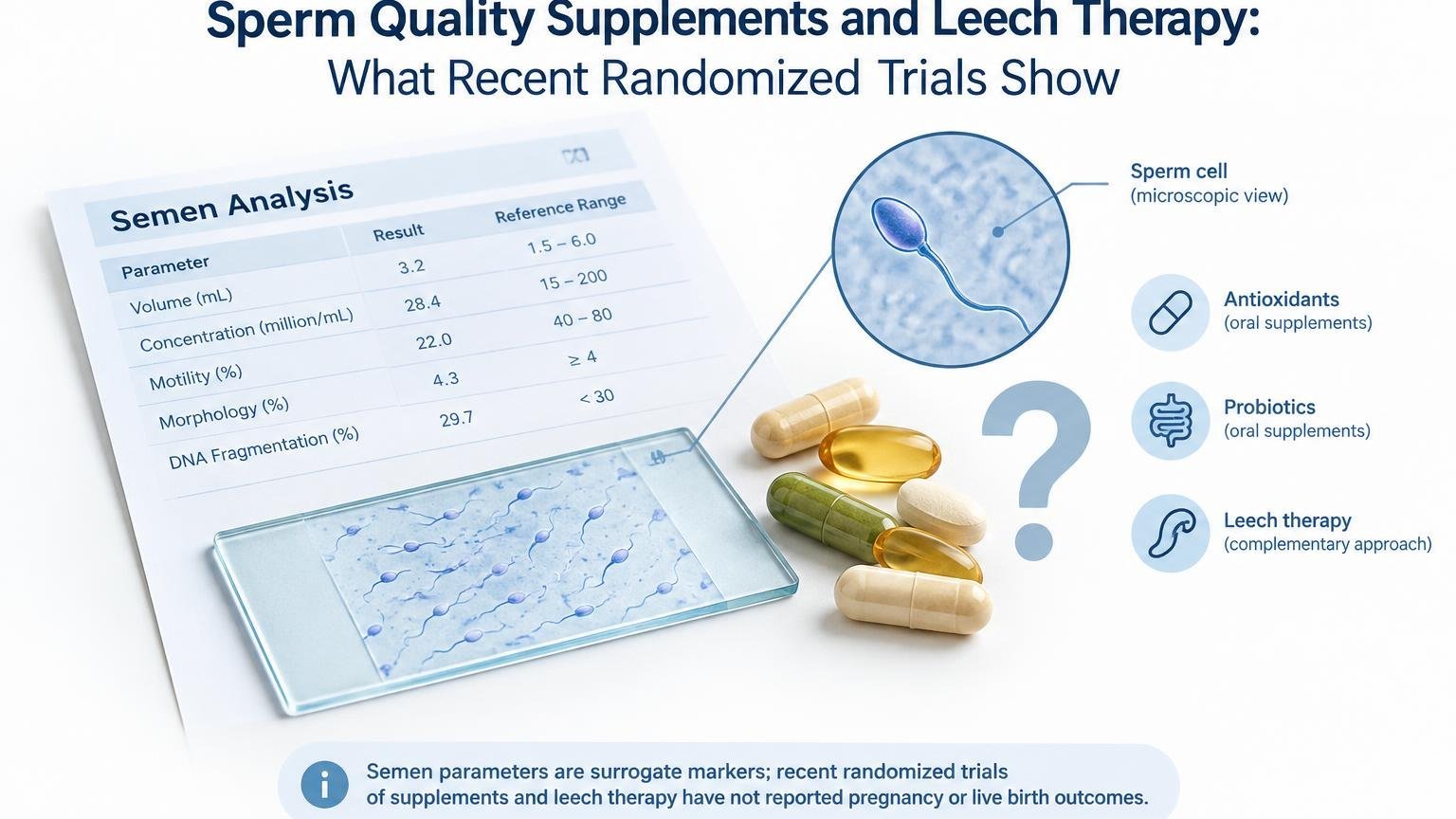
Core Research Direction: Recent randomized-controlled-trial evidence on sperm-quality interventions in men—orally administered supplements (antioxidants, probiotics) and a non-drug complementary approach (medicinal leech therapy)—and what these trials can and cannot establish for adult male reproductive health.
Search Intent: Do recent randomized trials show that supplements or complementary therapies actually improve sperm concentration, motility, morphology, or DNA integrity in men, and how strong is that evidence?
Platform: SANYUN Science Center
Evidence reviewed through: 2026-11-21
What the Recent Randomized Trials Found
Recent randomized trials of sperm-quality interventions do not show a clear, consistent benefit. A treatment-versus-placebo trial found that sperm motility improved within both arms by day 90 with no significant between-group difference, a pattern that argues against attributing the change to the intervention. The same trial reported a significant between-group p-value for sperm morphology even though the group means were nearly identical. A three-arm supplement trial reported adjusted improvements in the antioxidant arm for concentration, motility and morphology, but the available table does not show sample sizes, and the absolute changes are modest. A leech-therapy trial in 50 men with idiopathic infertility reported a rise in sperm concentration and a small reduction in DNA fragmentation, but its control received no sham treatment. None of these trials reports pregnancy or live birth.[1][2][3]
Why This Matters
Male infertility is common, and semen analysis remains central to evaluation. When results are borderline or unexplained, men often ask whether a supplement or complementary therapy could improve their numbers. The appeal is understandable: oral antioxidants are inexpensive and widely marketed, and leech therapy, though unfamiliar in many countries, has historical and cultural roots in some regions. The clinical question is not whether a product is popular but whether randomized evidence shows a benefit that exceeds placebo and that matters for reproduction. That question is harder to answer than headlines suggest, because the trials differ in design, comparison group and outcome.
A useful starting point is what a semen analysis actually measures. Concentration, motility and morphology describe different aspects of the ejaculate, and each can vary between samples. For a broader guide to reference limits and repeat testing, see our article on interpreting an abnormal semen analysis.
Proposed Mechanisms and Their Uncertainty
The rationale for antioxidant supplementation rests on the idea that oxidative stress can damage sperm membranes and DNA. If seminal oxidative stress is elevated, antioxidants might theoretically protect sperm function. Probiotics have been proposed to influence oxidative and inflammatory pathways, though the mechanism in male reproduction is less established. The three-arm trial tested both approaches against placebo, allowing a comparison of their adjusted effects on semen parameters.
Leech therapy has a different and more speculative rationale. The source notes that the mechanism remains undetermined and may involve salivary anticoagulants, anti-inflammatory compounds or other bioactive constituents. This is explicitly a hypothesis, not an established pathway. The trial measured sperm DNA fragmentation by TUNEL assay and protamine deficiency by chromomycin A3 staining, which are relevant to sperm chromatin integrity, but a plausible mechanism does not substitute for a well-controlled clinical effect. For more on what DNA fragmentation testing can and cannot tell clinicians, see our evidence review of sperm DNA fragmentation testing in male infertility.
What the Evidence Shows
The treatment-versus-placebo trial enrolled 125 treatment and 128 placebo participants for semen analysis, with smaller subsets for DNA fragmentation index and for men aged 40 years and above. Mean sperm count rose within the treatment arm from 27.56 to 39.25 million/mL by day 90, but the within-group p-value was 0.0800, the placebo arm also rose, and the between-group comparison was not significant (p=0.1639). The standard deviation in the treatment arm was very wide at day 90, indicating substantial variability.
Motility tells a similar cautionary story. Mean motility increased from 17.18% to 21.88% in the treatment arm and from 17.84% to 23.03% in the placebo arm, both within-group changes being statistically significant. The between-group p-value was 0.7878, so the trial did not show that the treatment outperformed placebo. This is a classic pattern in which within-group improvement is mistaken for treatment effect when the control group improves similarly.
DNA fragmentation results in the same trial add nuance. The treatment arm fell from 32.59% to 26.81% with a within-group p=0.0073, while placebo fell from 31.38% to 28.45% with p=0.0688. The between-group comparison at day 90 was not significant (p=0.6218). Because only 66 treatment and 75 placebo participants had DFI data, the analysis is less powered than the main semen analysis. A within-group change in a small subset should not be presented as proof of a treatment effect.
Morphology in the treatment-versus-placebo trial illustrates a separate interpretive trap. At day 90, mean morphology was 4.28% in the treatment arm and 4.31% in placebo, yet the between-group p-value was 0.0199. The within-group p-value in the treatment arm was 0.0010, while placebo was 0.2859. A significant p-value with nearly identical means indicates that the result is sensitive to the statistical model and sample size, not that men should expect a clinically meaningful morphological improvement.
The three-arm supplement trial reported adjusted mean improvements in the antioxidant arm for sperm concentration (5.03 to 8.55 ×10^6/mL), motility (22.16% to 26.58%) and morphology (1.47% to 2.21%). Semen volume did not show a significant group-by-time interaction (P=0.710). The placebo arm changed little in concentration (4.79 to 4.91 ×10^6/mL), and the probiotic-versus-placebo comparison had P=0.007. These are interesting signals, but several cautions apply: the table does not give sample sizes, the absolute changes are small, and adjusted means can obscure variability.
| Trial and comparison | Parameter and time point | Reported result | Interpretation |
|---|---|---|---|
| Treatment vs placebo; semen analysis n=125 treatment, 128 placebo | Mean motility at day 90 | Treatment 21.88% vs placebo 23.03%; between-group p=0.7878 | Both arms improved; no significant between-group difference |
| Treatment vs placebo; DFI subset n=66 treatment, 75 placebo | Mean DNA fragmentation index at day 90 | Treatment 26.81% vs placebo 28.45%; between-group p=0.6218 | Within-treatment fall but no significant between-group difference |
| Treatment vs placebo; all ages | Mean morphology at day 90 | Treatment 4.28% vs placebo 4.31%; between-group p=0.0199 | Statistically significant but numerically near-identical means |
| Antioxidant vs placebo; adjusted means | Sperm concentration at 3 months | Antioxidant 5.03 to 8.55 ×10^6/mL; placebo 4.79 to 4.91 ×10^6/mL; group-by-time P=0.003 | Within-arm rise with significant interaction; sample sizes not shown |
| Antioxidant vs probiotic; adjusted means | Motility at 3 months | Antioxidant 22.16% to 26.58%; antioxidant vs probiotic P=0.009 | Modest absolute change; pairwise difference reported |
| Leech therapy vs no intervention; n=25 per arm | Sperm concentration after 3 months | 57.7 to 63.4 million/mL; p=0.006 | Improvement reported; no sham control |
The leech-therapy trial randomized 50 men aged 20-50 with idiopathic infertility to weekly treatment for three months or no intervention. Sperm concentration rose from 57.7 to 63.4 million/mL, and the trial reported improvements in total sperm count, progressive motility and normal morphology. DNA fragmentation fell by a mean difference of -3.9% versus controls (p=0.04), and protamine deficiency declined (p=0.02). No adverse effects related to the intervention were observed, but the sample is small and the follow-up limited to three months.
Interpretation and Limitations
Several limitations cut across these trials. The treatment-versus-placebo trial's DFI analysis included only 66 treatment and 75 placebo participants, and its older-age subgroup included just 25 treatment and 20 placebo participants. The three-arm trial table does not report sample sizes, so precision and power cannot be judged from the available data. The leech trial lacked a sham control and the source itself notes that this could introduce placebo and attention biases; it also calls the findings preliminary and recommends larger, blinded, sham-controlled trials.
The most important limitation is outcome selection. Semen parameters are intermediate markers. A trial can show a statistically significant change in concentration or motility without demonstrating that more couples conceive or that live birth rates improve. None of the sources reports pregnancy or live birth outcomes, so the clinical relevance for a man trying to father a child remains uncertain. This is not a reason to dismiss the data, but it is a reason to avoid claiming that these interventions improve fertility.
Another issue is multiplicity and reporting. The treatment-versus-placebo trial reports many subgroup and parameter comparisons, which increases the chance of isolated significant findings. The morphology result, with near-identical group means and a significant p-value, is a concrete example of why effect sizes and confidence intervals matter more than p-values alone. Readers should also note that the intervention in that trial is not named in the available table, so the result cannot be attributed to a specific product or class.
Research Outlook
The leech-therapy source explicitly calls for larger, blinded, sham-controlled trials. That is the right standard for any procedural complementary therapy, where expectation and attention can produce measurable changes. For oral supplements, the next steps are adequately powered trials with prespecified primary outcomes, transparent reporting of sample sizes and effect estimates, and follow-up long enough to assess durability. Including pregnancy and live birth as outcomes, or at least reporting them, would help bridge the gap between semen analysis and reproductive success.
For clinicians and patients, the practical message is to treat these findings as preliminary. A man with abnormal semen parameters should have repeat testing and a proper evaluation for identifiable causes before adding supplements or complementary procedures. If a patient chooses to try an antioxidant or probiotic, the decision should be framed as a time-limited trial with repeat semen analysis rather than an assumption of benefit. Leech therapy should be considered only in research or highly supervised settings given its invasive nature and the absence of sham-controlled evidence.
Key Takeaways
- In a treatment-versus-placebo trial, motility improved in both arms by day 90 with no significant between-group difference (p=0.7878), so within-group improvement should not be attributed to the treatment.
- A significant between-group p-value for morphology (p=0.0199) occurred alongside nearly identical group means (4.28% vs 4.31%), showing that statistical and clinical significance are not interchangeable.
- The three-arm supplement trial reported adjusted improvements in antioxidant-arm concentration, motility and morphology, but sample sizes were not shown in the available table and absolute changes were modest.
- Leech therapy improved sperm concentration from 57.7 to 63.4 million/mL and reduced DNA fragmentation by a mean difference of -3.9%, but the trial had 25 men per arm, no sham control and only three months of follow-up.
- No trial in this packet reports pregnancy or live birth, so claims that these interventions improve fertility remain unsupported.
Questions and Answers
Do antioxidant supplements improve sperm concentration in randomized trials?
A three-arm trial comparing antioxidant, probiotic and placebo reported that adjusted mean sperm concentration in the antioxidant arm rose from 5.03 to 8.55 ×10^6/mL over three months, with a group-by-time P=0.003. However, the available table does not show sample sizes, the absolute change is modest, and no pregnancy outcomes are reported. This is an interesting signal, not proof of a clinically meaningful fertility benefit.
Do probiotics improve sperm motility or morphology in men?
The three-arm trial included a probiotic arm, but the available table does not clearly report its adjusted changes in motility or morphology in the same way it reports the antioxidant arm. The placebo-versus-probiotic comparison for sperm concentration had P=0.007, but without full group data and sample sizes, the probiotic effect cannot be judged reliably. Current evidence is insufficient to recommend probiotics for sperm quality.
How strong is the evidence that medicinal leech therapy improves sperm quality?
The leech-therapy trial was randomized but small (25 men per arm), used no sham intervention, and followed participants for only three months. It reported a rise in sperm concentration from 57.7 to 63.4 million/mL and a small reduction in DNA fragmentation, but the source itself calls the findings preliminary and recommends larger, blinded, sham-controlled trials. The evidence is therefore weak and hypothesis-generating.
Why did a significant p-value for sperm morphology not mean a meaningful treatment effect?
In the treatment-versus-placebo trial, mean sperm morphology was 4.28% in the treatment arm and 4.31% in placebo, yet the between-group p-value was 0.0199. A significant p-value with nearly identical means shows that statistical significance depends on sample size and variability, not necessarily on a clinically meaningful difference. Effect sizes and confidence intervals are more informative for judging whether a change matters.
Can sperm supplements or leech therapy improve fertility and lead to pregnancy?
None of the trials in this evidence packet reports pregnancy or live birth as an outcome. They measured semen parameters and DNA fragmentation, which are intermediate markers. Improvements in these markers do not automatically translate into higher fertility. Therefore, no claim that supplements or leech therapy improve pregnancy rates is supported by these data; this remains an important evidence gap.
What should men with abnormal semen analysis know before trying sperm supplements or leech therapy?
Men should first have repeat semen testing and evaluation for identifiable causes, because a single abnormal result can be variable. If a supplement is tried, it should be framed as a time-limited trial with repeat testing rather than an assumed benefit. The randomized evidence on antioxidant and probiotic supplements and leech therapy is mixed, often shows no significant between-group difference, and lacks pregnancy outcomes. Discuss any supplement or complementary therapy with a qualified clinician.
Sources and References
- Table 2. Mean improvement in semen parameters..
- Table 2..
- Abtahi-Forooshani M. Efficacy and Safety of Hirudotherapy for Improving Sperm Quality Parameters in Male Infertility: A Randomized Controlled Trial. Health science reports. 2026
SANYUN Science Center explains published research on men's reproductive and sexual health, connecting scientific evidence with everyday questions while making sources and limitations clear.
Disclaimer: This article is for scientific education and research communication only. It does not provide medical advice, diagnosis, or individualized treatment recommendations, and does not endorse any medication, supplement, device, penile enlargement procedure, or other intervention. Decisions about sexual and reproductive health should be made in consultation with a qualified healthcare professional. Do not delay seeking professional care because of information in this article.
Original Content & Copyright Notice
- This article is prepared for SANYUN Science Center, drawing on published research and publicly available academic literature on men’s sexual and reproductive health. Its editorial explanations and presentation are developed for this platform.
- Copyright in the original editorial content, selection, and arrangement is reserved by SANYUN Science Center to the extent protected by applicable law. Referenced research, quotations, and third-party materials remain subject to the rights of their respective owners. This notice does not claim ownership of scientific facts or third-party research.
- Except where permitted by applicable law or an applicable license, prior written permission is required to reproduce, republish, translate, adapt, redistribute, or commercially reuse protected content. Attribution alone does not grant permission for such reuse.
- For permitted quotation or authorized reuse, clearly identify the source and retain a link to the original article.
- Source: SANYUN Science Center
- Original URL: Retain the original article URL on science.san-yun.com.
- Copyright Holder: SANYUN Science Center, for its own protected editorial content.
- Quotation, excerpts, or authorized reuse must not distort the scientific meaning, omit material limitations or disclaimers, or imply unverified medical claims, product efficacy, or endorsement by SANYUN Science Center.



