




Category: Health Academy
Core Research Direction: How total, free, and bioavailable testosterone blood tests differ; how SHBG/albumin binding affects interpretation; and why repeat morning testing is needed before diagnosing low testosterone.
Search Intent: Why can a man have 'normal' total testosterone but still have low free testosterone — and what should a repeat morning blood test confirm before treatment?
Platform: SANYUN Science Center
Evidence reviewed through: 2026-11-22
Executive Summary
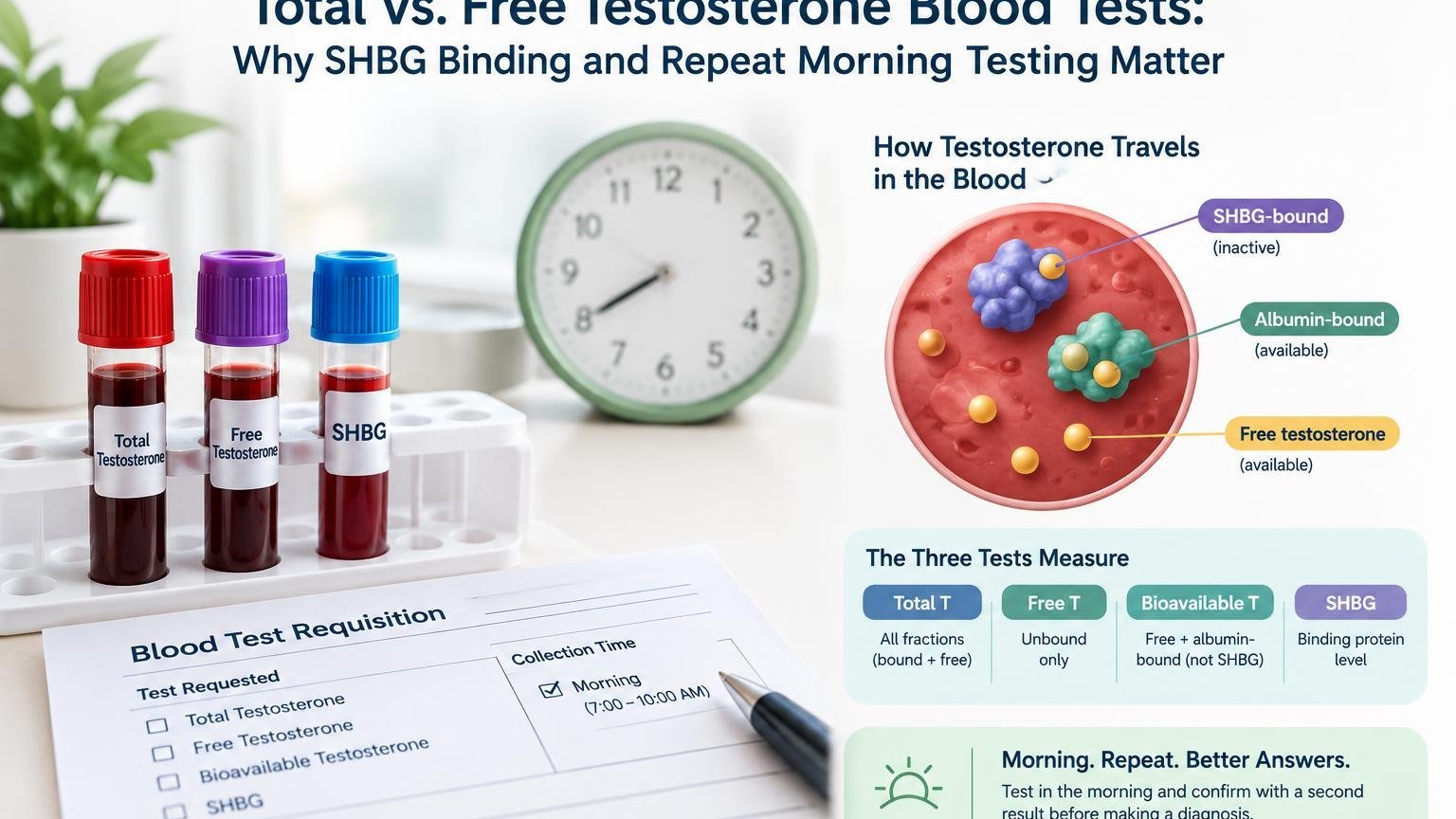
A total testosterone test measures the entire pool of testosterone in the bloodstream: the large share attached to carrier proteins and the small share that floats unbound. Because it combines these fractions, total testosterone is the usual first-line measurement and is described in patient-facing sources as the most commonly performed testosterone test. Free testosterone counts only the unbound portion, while bioavailable testosterone adds free testosterone to the fraction loosely attached to proteins other than sex hormone-binding globulin (SHBG), such as albumin.[1][2][3]
The central interpretive problem is binding. Testosterone attached to SHBG is described as biologically inactive, whereas free and albumin-bound testosterone are considered available to tissues. If SHBG is high, more of the total pool is held in the inactive fraction; if SHBG is low, a larger share may be free. This is why a man can have a total testosterone result inside the laboratory range yet still have symptoms consistent with low free testosterone — the total number does not by itself say how much hormone is unbound.
Guidance cited in the supplied sources recommends a morning total testosterone as the first diagnostic test, followed by a repeat morning test to confirm a low result. That sequence reflects both biological rhythm and measurement noise: testosterone peaks in the morning and falls later in the day, and a single reading can be shifted by sleep, stress, illness, or sampling timing. A repeat morning test is therefore not a formality — it separates a transient dip from a persistent pattern before any treatment decision.
Why This Matters
Testosterone testing is common, but its results are easy to misread. Total testosterone includes both bound and free hormone, so a value that looks reassuring can still hide a low free fraction in a man whose SHBG is elevated. Conversely, a low total in a man with low SHBG may overstate the degree of deficiency. The Endocrine Society guideline cited in the supplied material diagnoses male hypogonadism only when symptoms and signs of low testosterone co-occur with levels that are unequivocally and consistently low, and it recommends against routinely screening men in the general population.
That framing matters for anyone considering testosterone therapy. The decision is not driven by a single number but by symptoms, repeated morning measurements, and an understanding of why the numbers look the way they do. The same guideline advises checking free testosterone when total testosterone is near the lower limit of normal or when a condition alters SHBG, using equilibrium dialysis or an accurate formula. In other words, the free fraction is a targeted follow-up tool, not a routine replacement for the total test.
How Testosterone Travels in Blood
Testosterone circulates in two broad forms. Bound testosterone is attached to carrier proteins, principally SHBG and albumin. Free testosterone is not attached to any serum protein. Bioavailable testosterone is the sum of free testosterone plus testosterone bound to proteins other than SHBG, such as albumin. The practical consequence is that the total test captures everything, while the free and bioavailable tests attempt to capture the fractions the body can more readily use.
SHBG is made mostly in the liver and binds both testosterone and estrogen. Its concentration changes with common conditions: low SHBG can accompany an underactive thyroid, type 2 diabetes or insulin resistance, obesity, overuse of steroid medicines or anabolic steroids, and Cushing syndrome. High SHBG can accompany liver disease, an overactive thyroid, some eating disorders and, in women, estrogen-containing medicines. These associations mean that SHBG is not a fixed background variable — it can move the free fraction up or down even when total testosterone is unchanged.
This is the mechanism behind the apparent paradox of a “normal” total with low free testosterone. A total test cannot distinguish bound from free hormone, so it cannot reveal how much is held in the SHBG-bound, biologically inactive fraction. When SHBG is high, a larger proportion of the total pool is bound and less is free; when SHBG is low, the opposite can occur. Neither pattern is visible from the total number alone.
What the Three Tests Measure
| Measure | What It Counts | Interpretation |
|---|---|---|
| Total testosterone | Free, SHBG-bound, albumin-bound and other bound fractions combined | First-line measurement; does not show how much is unbound |
| Free testosterone | The unbound fraction only | Reflects hormone not attached to carrier proteins; may be low when total is normal but SHBG is high |
| Bioavailable testosterone | Free testosterone plus testosterone bound to proteins other than SHBG, such as albumin | Captures the fraction considered more readily available to tissues |
| SHBG | Sex hormone-binding globulin concentration | High SHBG leaves less free hormone; low SHBG leaves more; measured when total is borderline or binding may be altered |
The table is a guide to the logic, not a set of diagnostic thresholds. Laboratory reference ranges vary by method and population, and the supplied sources do not provide a single universal cut-off. What they do provide is the structure: total testosterone for the initial screen, free or bioavailable testosterone when binding is in question, and SHBG as the explanatory variable that links the two.
Why the Morning Matters
Testosterone is secreted in a daily rhythm. One supplied consumer source, citing a Journal of Clinical Endocrinology and Metabolism study, describes a 24-hour pattern in men in which testosterone peaks in the morning and falls by 20–25% in the evening. Another source recommends sampling between 7:00 and 10:00 AM, citing a Journal of Andrology study reporting a morning peak and decline through the day. These are secondary citations — the primary studies were not supplied — but they align with the broader clinical advice to collect the sample in the morning because levels are highest then.
The practical implication is that an afternoon sample may understate a man's morning baseline. A result that looks low could reflect timing rather than a persistent deficiency. That is one reason the cited guideline recommends a morning total testosterone as the first diagnostic test and a repeat morning test to confirm a low result. It is also why the supplied sources repeatedly caution that a single low or high reading does not automatically mean a clinical condition.
The rhythm is not the only source of variability. Acute stress, poor sleep, illness, intense exercise the day before, and some medicines can shift results. The supplied sources mention glucocorticoids, opioids, anabolic therapies, anticonvulsants, steroids, barbiturates, and opiates as possible influences. They also note that food can transiently affect testosterone, although fasting requirements vary between providers. The common thread is that standardization — same time of day, similar preparation, and a confirmatory repeat — matters more than any single draw.
What the Evidence Shows on Repeat Testing
The supplied evidence converges on a two-step pattern. First, an abnormal initial result should prompt a repeat test to confirm it. Second, the confirmatory test should be drawn in the morning, ideally on a different day. One provider's service page states that UK regulation requires two blood tests showing low testosterone — a basic test and a comprehensive test — taken on different days and before 11 AM. That is a provider's description of a regulatory requirement, not independently verified in the supplied text, but it illustrates the repeat-and-standardize principle.[4]
The cited Endocrine Society guideline goes further, recommending diagnosis only when symptoms and signs of low testosterone co-occur with unequivocally and consistently low levels. It also recommends against routinely screening men in the general population. These two positions are consistent: testing is for symptomatic men, and the result must be persistent rather than a one-off. Once low testosterone is confirmed, the guideline recommends measuring luteinizing hormone and follicle-stimulating hormone to distinguish a testicular cause from a pituitary or hypothalamic one.
Calculated Free Testosterone and the Free Androgen Index
Free testosterone can be measured directly or estimated. The cited guideline accepts equilibrium dialysis measurement or an accurate formula. One supplied source reports that a 1999 study in the Journal of Clinical Endocrinology & Metabolism found calculated free testosterone (from total testosterone and SHBG) came out almost identical to equilibrium dialysis, except during pregnancy. That supports formula-based estimation in routine non-pregnant adult contexts, but it is a secondary report of a single older study rather than a definitive validation across all populations.
The free androgen index is a simpler shortcut: total testosterone divided by SHBG, multiplied by 100. It is quick to calculate but has a documented weakness. The same 1999 study found that the index's relationship to measured free testosterone shifted as SHBG levels changed, and concluded it was not a reliable stand-in for the testosterone available to tissues. In practice, the index should be read alongside measured values rather than substituted for them.
Interpretation and Limitations
Several limitations are important. First, the supplied sources are consumer explainers and commercial service pages, not primary research. The studies they cite — including the diurnal-rhythm, age-related-decline, and free-androgen-index studies — were not provided in full, so their designs, sample sizes, and populations cannot be evaluated here. Second, the guideline statements are secondary reports; the underlying Endocrine Society document was not supplied. Third, reference ranges and assay methods vary between laboratories, and the sources do not provide a single universal threshold for low total or low free testosterone.
There are also evidentiary gaps. The claim that venous lab-drawn blood offers the highest accuracy than at-home collection is a general assertion; no comparative accuracy data were supplied. The regulatory requirement described by one provider — two low tests before starting therapy — is not independently verified in the packet. And the assertion that SHBG-bound testosterone is biologically inactive is a simplification; binding is better understood as a gradient of availability than a binary switch. These caveats do not overturn the core principles, but they should temper confidence in any single number.
Finally, an abnormal result does not necessarily mean a condition requiring treatment. The supplied sources state that a single low or high reading does not automatically establish a clinical condition, and that an abnormal result does not always indicate a condition needing treatment. That is a reason to repeat and contextualize, not a reason to ignore symptoms that persist.
Research and Clinical Outlook
The most useful near-term questions are practical rather than speculative. How should free testosterone be estimated when SHBG is altered — measured by equilibrium dialysis or calculated by formula — and in which populations does the choice change management? How much of the variability between repeat morning tests reflects true biological change versus assay and sampling noise? And how should monitoring be structured once therapy begins? One provider describes a schedule of venous tests at six weeks, six months, twelve months, then annually, but that is a single service's practice rather than a guideline.
A second line of inquiry concerns safety and patient selection. The cited guideline advises against starting testosterone therapy in men with breast or prostate cancer, a prostate nodule, or a PSA above certain levels without urological evaluation, and recommends assessing prostate cancer risk during the first year of treatment. It also advises against starting therapy in men planning to father a child in the near term. These are clinical decisions that depend on the full picture — symptoms, repeated morning levels, SHBG, and the reason for the low result — rather than on the total testosterone number alone.
Key Takeaways
- Total testosterone counts bound and free hormone together; it is the usual first-line test but cannot show how much is unbound.
- Free testosterone is the unbound fraction; bioavailable testosterone adds the albumin-bound fraction, which is considered more readily available to tissues.
- High SHBG holds more testosterone in the inactive bound fraction and can produce symptoms of low free testosterone despite a normal total; low SHBG does the reverse.
- The cited guideline recommends a morning total testosterone first, then a repeat morning test to confirm a low result before diagnosing hypogonadism.
- A single abnormal reading does not establish a diagnosis, and an abnormal result does not always mean treatment is needed.
- Free testosterone should be checked when total is near the lower limit of normal or when a condition alters SHBG, using equilibrium dialysis or an accurate formula.
Questions and Answers
What is the difference between total, free and bioavailable testosterone on a blood test?
Total testosterone counts all testosterone in the blood, including hormone bound to SHBG and albumin plus the unbound fraction. Free testosterone counts only the unbound portion. Bioavailable testosterone counts free testosterone plus testosterone loosely bound to proteins other than SHBG, such as albumin. The total test is the usual first-line measurement, but it cannot show how much hormone is unbound and therefore more readily available to tissues.
Can a man have normal total testosterone but low free testosterone because of high SHBG?
Yes. Because total testosterone includes both bound and free fractions, it cannot reveal how much is held in the SHBG-bound, biologically inactive fraction. When SHBG is high, a larger share of the total pool is bound and less remains free, so symptoms consistent with low free testosterone can occur even when the total result is inside the laboratory range. The cited guideline recommends checking free testosterone when total is near the lower limit of normal or when SHBG may be altered.
Why are two morning testosterone tests recommended before diagnosing low testosterone?
Testosterone peaks in the morning and falls later in the day, and a single reading can be shifted by sleep, stress, illness or sampling timing. The cited Endocrine Society guideline recommends a morning total testosterone as the first diagnostic test, followed by a repeat morning test to confirm a low result, and diagnoses hypogonadism only when symptoms co-occur with unequivocally and consistently low levels. One provider describes a UK regulatory requirement for two low tests on different days before 11 AM, though that claim is not independently verified in the supplied material.
What conditions can raise or lower SHBG and affect free testosterone interpretation?
Low SHBG can accompany an underactive thyroid, type 2 diabetes or insulin resistance, obesity, overuse of steroid medicines or anabolic steroids, and Cushing syndrome. High SHBG can accompany liver disease, an overactive thyroid, some eating disorders and, in women, estrogen-containing medicines. Because SHBG shifts the balance between bound and free hormone, these conditions can change free testosterone even when total testosterone is unchanged, which is why SHBG is measured when binding may be altered.
Is calculated free testosterone or the free androgen index as reliable as measured free testosterone?
Calculated free testosterone from total testosterone and SHBG has been reported as almost identical to equilibrium dialysis in a 1999 study, except during pregnancy, and the cited guideline accepts equilibrium dialysis or an accurate formula. The free androgen index is simpler but less reliable: the same 1999 study found its relationship to measured free testosterone shifted as SHBG changed, and concluded it was not a reliable stand-in for tissue-available testosterone.
Does one low testosterone blood test mean I need testosterone therapy?
No. The supplied sources state that a single low or high reading does not automatically establish a clinical condition, and that an abnormal result does not always indicate a condition requiring treatment. The cited guideline bases a diagnosis on symptoms plus unequivocally and consistently low morning levels, confirmed by a repeat test, and then looks for the cause. Whether therapy fits is a clinical decision made from repeated labs, symptoms and health history, not from one number.
Sources and References
- Mike Kocsis. Testosterone Blood Test: What It is, How It Works & Results – Balance My Hormones. 2025
- Total vs. Free Testosterone: Reading a Testosterone Test. 2026
- Sidra Riaz. How to Test Testosterone: Blood Tests, At-Home Options & Results Explained. 2026
- Get Testosterone Replacement Therapy Blood Tests for men and women – Balance My Hormones.
SANYUN Science Center explains published research on men's reproductive and sexual health, connecting scientific evidence with everyday questions while making sources and limitations clear.
Disclaimer: This article is for scientific education and research communication only. It does not provide medical advice, diagnosis, or individualized treatment recommendations, and does not endorse any medication, supplement, device, penile enlargement procedure, or other intervention. Decisions about sexual and reproductive health should be made in consultation with a qualified healthcare professional. Do not delay seeking professional care because of information in this article.
Original Content & Copyright Notice
- This article is prepared for SANYUN Science Center, drawing on published research and publicly available academic literature on men’s sexual and reproductive health. Its editorial explanations and presentation are developed for this platform.
- Copyright in the original editorial content, selection, and arrangement is reserved by SANYUN Science Center to the extent protected by applicable law. Referenced research, quotations, and third-party materials remain subject to the rights of their respective owners. This notice does not claim ownership of scientific facts or third-party research.
- Except where permitted by applicable law or an applicable license, prior written permission is required to reproduce, republish, translate, adapt, redistribute, or commercially reuse protected content. Attribution alone does not grant permission for such reuse.
- For permitted quotation or authorized reuse, clearly identify the source and retain a link to the original article.
- Source: SANYUN Science Center
- Original URL: Retain the original article URL on science.san-yun.com.
- Copyright Holder: SANYUN Science Center, for its own protected editorial content.
- Quotation, excerpts, or authorized reuse must not distort the scientific meaning, omit material limitations or disclaimers, or imply unverified medical claims, product efficacy, or endorsement by SANYUN Science Center.



