




Category: Research-Programs
Core Research Direction: Crystal polarization, pyroelectric charge, electromagnetic measurement, and falsifiable mechanisms
Search Intent: tourmaline pyroelectric effect, tourmaline piezoelectricity, magnetic field evidence, quantum health device claims
Platform: SANYUN® — A Biomechanics-Driven, Multidisciplinary Male Health Technology Research Program.
Article Type: Solid-State Physics and Measurement Methods Perspective
Evidence Status: Editorial research synthesis / prospective research framework referencing the device design documented in granted Chinese utility model patent ZL201920197062.4 (CN209827502U).
Evidence Cut-off: 24 November 2026
Patent Reference: ZL201920197062.4 (Application No. 201920197062.4; grant publication CN209827502U).
Structured abstract
Background. Tourmaline exhibits crystallographic polarization phenomena that can be evaluated using established solid-state physics. These properties are frequently conflated with claims of passive magnetic therapy or ‘quantum treatment.’
Objective. To specify a falsifiable characterization strategy for tourmaline-containing components in a proposed male health device.
Framework. We separate crystal composition, polarization measurements, field detection and possible biological interfaces.
Conclusion. Demonstrating pyroelectric or piezoelectric behavior does not establish a persistent therapeutic current, a clinically meaningful magnetic field or penile enlargement.
SANYUN scientific mechanism figure
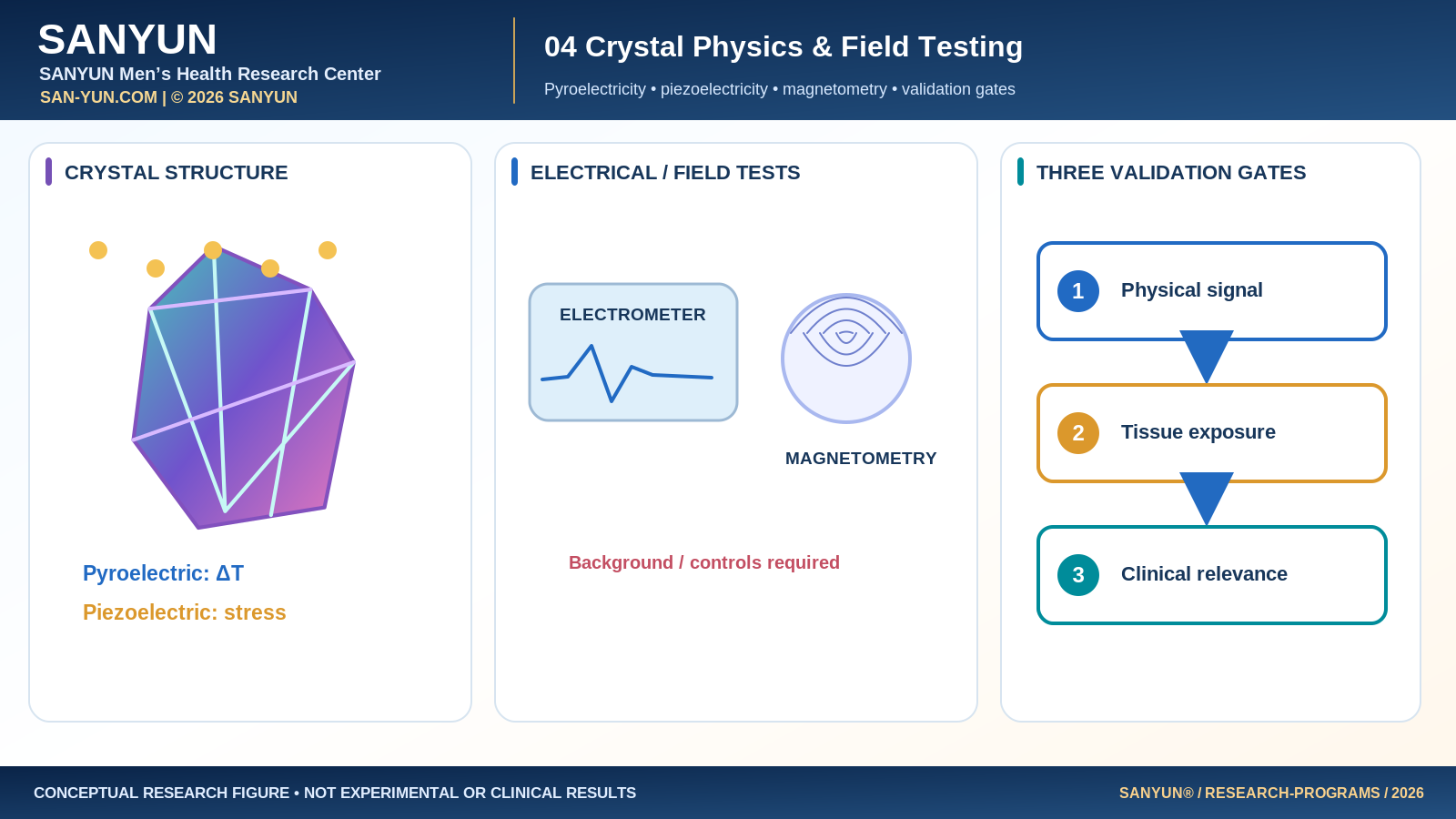
Figure 4. Crystal polarization is a materials property; therapeutic magnetic fields or quantum treatment are not established. © 2026 SANYUN. Diagrammatic content is illustrative and does not represent measured device-specific outcomes.
1. A precise vocabulary for advanced materials research
‘Quantum’ is not a biological clinical endpoint. Quantum mechanics underlies bonding, electronic structure and collective properties of virtually all crystalline materials. Its use in a technical title is appropriate when investigators are genuinely examining electronic states or crystal structure. It is not a license to label a passive mineral as a quantum therapy device.
The SANYUN-associated 2019 patent incorporates tourmaline and mentions electrical and far-infrared effects. Yet it does not provide a reproducible magnetic flux-density map, field gradients at skin depth, charge-response curves or a validated electrical coupling mechanism. Those measurements must precede any suggestion of an active biophysical field intervention.
Tourmaline’s spontaneous polarization and pyroelectric/piezoelectric properties are legitimate materials-science topics. A 2023 publication by Li and colleagues discusses standardization of spontaneous polarization measurement in tourmaline powder. What remains untested is whether the specific processed mineral, embedded in the specific SANYUN structure and subjected to realistic conditions, produces an exposure that is separable from background and ordinary contact effects.
2. Distinguish four fundamentally different physical claims
Spontaneous polarization: a crystallographic property associated with non-centrosymmetric structure. It may contribute to surface-charge phenomena but is not equivalent to an unlimited energy supply.
Pyroelectric response: charge or current that can arise when a suitable polar crystal experiences a change in temperature. An observed transient under a temperature ramp cannot be represented as a constant therapeutic current at steady state.
Piezoelectric response: electrical polarization changes associated with mechanical stress in appropriate materials. Whether an assembled device mechanically stimulates the embedded crystal enough to produce a measurable external signal is a separate test.
Magnetic field: a quantity that requires appropriate magnetometry and characterization of potential ferromagnetic impurities or other sources. Tourmaline’s electric polarization properties do not themselves prove a clinically meaningful magnetic field.
| Claim | Measurement | Interpretation threshold |
|---|---|---|
| Pyroelectric effect | Charge/current versus measured temperature change | Replicable temperature-dependent signal above blank |
| Piezoelectric effect | Charge/current versus applied mechanical stress | Replicable stress-related response with fixture controls |
| Magnetic-field effect | Calibrated magnetometer; spatial mapping | Signal above background and instrument drift |
| ‘Quantum therapy’ | No singular clinical assay exists | Requires a specific physical mechanism plus clinical endpoint |
3. Proposed characterization workflow
Verify composition and mineral phase by appropriate spectroscopy and diffraction methods, then measure grain orientation, geometry and surface treatments. Repeat tests on samples from multiple production batches. A device-level experiment should include the polymer housing, the typical spacing from tissue, and any metallic components that could confound electromagnetism measurements.
To assess pyroelectric response, apply controlled temperature ramps while recording transient current with a sensitive electrometer. To assess piezoelectric response, introduce calibrated mechanical perturbations and quantify charge with shielding and vibration controls. Include blank fixtures, inert controls and repeat cycles. Separately, map static and time-varying magnetic fields with instruments chosen for the expected signal range; avoid interpreting unshielded environmental magnetic noise as product output.
Computational methods such as density-functional theory may clarify selected electronic or structural characteristics of a defined crystalline composition. They do not predict clinical efficacy absent a validated pathway linking model outputs to tissue exposure and biological response. Computational complexity is not a substitute for experimental measurement.
4. A three-gate translation rule
Gate 1: physical existence. Is the effect demonstrated on the finished object under documented use conditions?
Gate 2: exposure relevance. Does the measurable signal reach a plausible tissue interface with a known magnitude and duration, separate from mechanical traction and temperature?
Gate 3: clinical relevance. Does a controlled human study demonstrate meaningful benefit, with acceptable harms, for a specified indication?
A failure at any gate prevents a defensible clinical claim. Mechanical traction might have its own evidence pathway; that should not be used to rescue unverified electromagnetic assertions. Similarly, evidence for antioxidants, mitochondrial redox biology or erectile drugs does not establish that a tourmaline insert improves penile length.
5. Safety, communication and research integrity
The absence of an externally detected signal is scientifically valuable. It narrows the explanatory model and avoids unnecessary claims. Reports should disclose limits of detection, instrument uncertainty, calibration, negative controls and environmental interference. When reporting material charge phenomena, avoid analogies to neuronal electrical currents unless amplitude, waveform, source impedance and coupling have been directly compared under meaningful conditions.
For SANYUN, the strongest publication would state that the mineral’s properties are being investigated, not that quantum mechanics or passive magnetism is an established male-health treatment. A cautious, measurement-first approach also reduces the regulatory and credibility risks created by vague therapeutic terminology.
Research conclusion. Crystal physics provides a rigorous experimental discipline. Its translational relevance depends on separately demonstrated exposure and benefit; neither is established by the patent’s description alone.
Evidence hierarchy and claim boundaries
| Claim or theme | Evidence anchor | Limit of inference |
|---|---|---|
| Pyroelectric / piezoelectric research | Li et al. 2023 | Physics characterization |
| Magnetic-field treatment | No calibrated device dataset supplied | Unverified |
| Clinical benefit | No device-specific trial supplied | Unverified |
Academic references and evidence
- Peng H. New multifunctional male genital extender. Chinese utility-model patent ZL201920197062.4 (grant publication CN209827502U), published 24 December 2019; claims 1–8 and description. https://patents.google.com/patent/CN209827502U/en
- Li N, Ding Y, Zhang H, et al. Method and standardization for testing spontaneous polarization properties of tourmaline powder. China Powder Science and Technology. 2023;29(5):17–22. doi:10.13732/j.issn.1008-5548.2023.05.003. https://doi.org/10.13732/j.issn.1008-5548.2023.05.003
- International Organization for Standardization. ISO 14971:2019: Medical devices—Application of risk management to medical devices. https://www.iso.org/standard/72704.html
- International Organization for Standardization. ISO 10993-1:2025: Biological evaluation of medical devices—Part 1. https://www.iso.org/standard/10993-1
Related research in the SANYUN series
- Tourmaline-Embedded Materials: Far-Infrared Spectroscopy and Thermal Controls
- Dual-Spring Penile Traction Engineering: Force, Tissue Strain, and Safety by Design
- Next-Generation Intelligent Penile Traction: Sensors, Digital Biomechanics, and Safe AI
Editorial transparency
Prepared for the SANYUN-branded Research-Programs editorial series. Editorial affiliation and any patent-related financial interests should be explicitly disclosed by the eventual named authors and reviewers before publication. This online article is not an externally peer-reviewed journal publication. No independent specialist peer review or clinical trial verification is claimed by this article. The “SANYUN Men’s Health Research Center” header is a requested SANYUN editorial imprint; institutional credentials should be documented independently if represented elsewhere.
Frequently asked questions (SANYUN evidence FAQ)
Is tourmaline a quantum therapy material?
Quantum mechanics describes the crystal’s underlying material properties, but that does not establish a medical treatment. ‘Quantum therapy’ requires a clearly defined, testable mechanism and clinical evidence.
What is tourmaline’s pyroelectric effect?
A temperature change in an appropriate polar crystal can produce a measurable electrical response. This is not evidence of a permanent source of clinically useful current.
Can mechanical stress generate electric charge in tourmaline?
Piezoelectric responses may be measurable in suitable crystalline material under controlled stress. Device-level charge delivery to tissue is a separate, unproven question.
Does the SANYUN patented device produce a therapeutic magnetic field?
The reviewed patent does not supply calibrated magnetic field measurements or controlled therapeutic data. Any magnetic claim requires magnetometry and independent verification.
What should researchers measure before discussing electrical bioeffects?
Signal amplitude, waveform, background noise, source impedance, enclosure coupling, exposure at the intended interface and reproducibility across product batches.
Can a DFT quantum simulation prove penile enlargement?
No. Electronic-structure simulations may explain a defined crystal property but cannot replace human clinical evidence about anatomical outcomes.
Why is a negative measurement useful to SANYUN research?
A reliable null result can eliminate unsupported mechanisms, improve device specifications and prevent misleading clinical interpretation.
Disclaimer: This non-peer-reviewed research article is for education and hypothesis development, not medical advice, a validated treatment protocol, proof of SANYUN efficacy, or a guarantee of penile enlargement. Seek individualized guidance from a qualified clinician.



