




Category: Reproductive Care
Core Research Direction: Whether varicocele repair before TESE improves reproductive outcomes (testicular sperm retrieval, ejaculated sperm recovery, clinical pregnancy with ICSI) in infertile men with non-obstructive azoospermia and clinical varicocele, and how strong that evidence is
Search Intent: In men with non-obstructive azoospermia and a clinical varicocele, does repairing the varicocele before testicular sperm extraction improve the chances of finding sperm and achieving a clinical pregnancy, and how much confidence do the available observational studies support?
Platform: SANYUN Science Center
Evidence reviewed through: 2026-11-24
Executive Summary
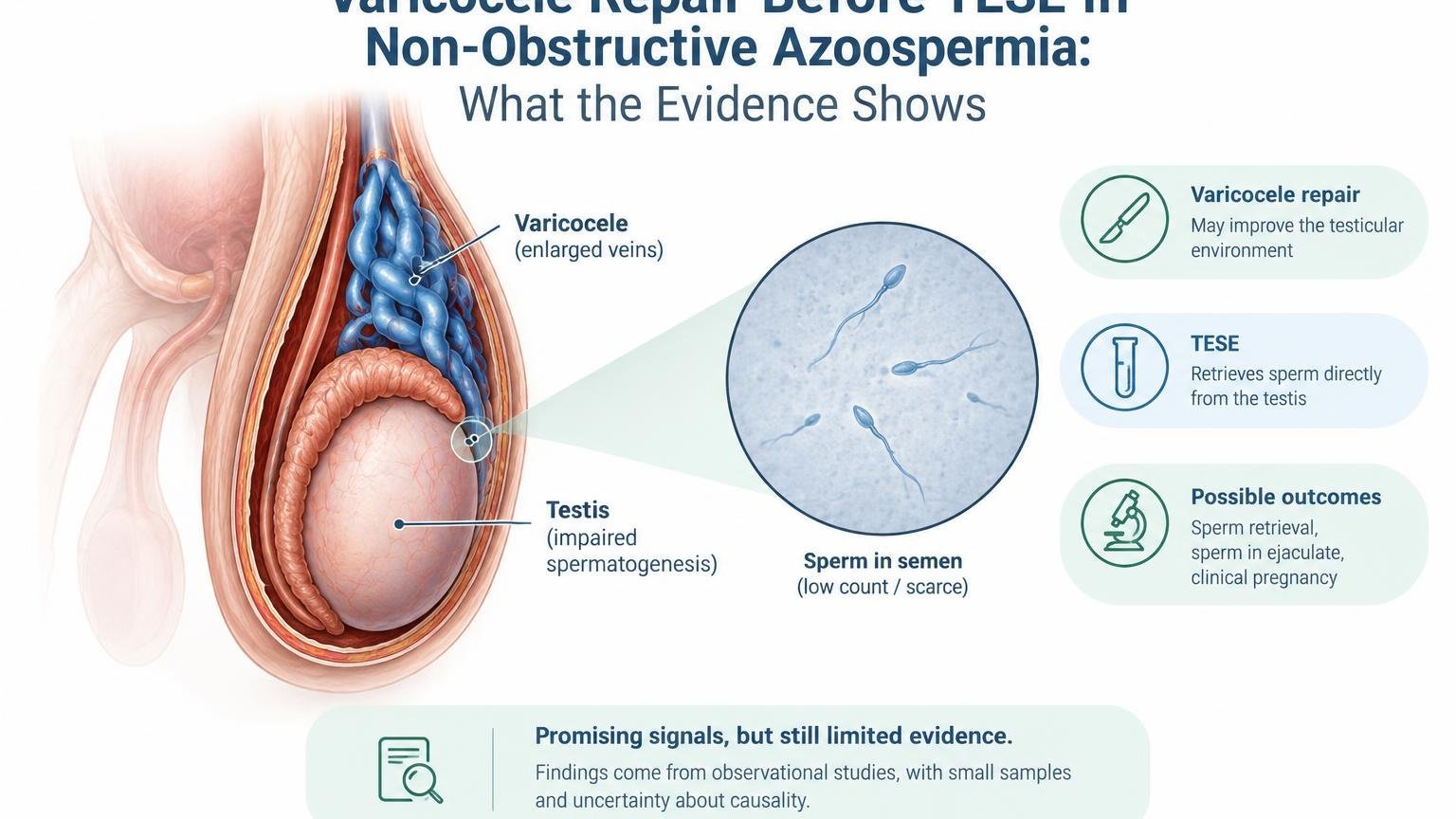
For men with non-obstructive azoospermia (NOA) and a clinical varicocele, a common question is whether repairing the varicocele before testicular sperm extraction (TESE) improves the chances of finding sperm or achieving pregnancy. A 2026 systematic review and meta-analysis of five observational controlled studies reports that varicocele repair was associated with higher odds of surgical sperm retrieval, sperm appearance in the ejaculate, and clinical pregnancy with intracytoplasmic sperm injection (ICSI). However, the evidence comes entirely from non-randomized studies with small pooled samples, and some results were sensitive to removal of a single study.[1]
The review's authors note that the role of varicocele repair in NOA remains controversial in current guidelines. The American Urological Association and American Society for Reproductive Medicine guidelines recommend varicocelectomy for infertile men with palpable varicoceles and abnormal semen parameters but exclude azoospermic cases, a recommendation labeled expert opinion. This review therefore addresses a genuine evidence gap, but its findings should be interpreted as hypothesis-generating rather than practice-changing.
Why This Matters
NOA is a severe form of male infertility caused by impaired sperm production rather than a physical blockage, and it accounts for about two-thirds of azoospermia cases. Management generally involves microsurgical TESE combined with ICSI, but success depends on finding sperm in the testis. Varicocele is present in approximately 4% to 14% of men with NOA, and any benefit from varicocelectomy may relate to testicular histopathology. Identifying a reversible contributor could allow some men to avoid or simplify invasive procedures.
The practical stakes are high: TESE is invasive, ICSI is costly, and outcomes are uncertain. If varicocele repair genuinely improves sperm retrieval or allows sperm to appear in the ejaculate, it could change counseling and treatment sequencing. For broader context on how male infertility guidelines handle varicocele and azoospermia, see the review of Australia's first evidence-based male infertility guidelines.
Biological and Clinical Mechanism
A varicocele is an enlargement of the spermatic vein plexus that is thought to raise scrotal temperature and impair testicular function. In men with NOA, the testes already show impaired spermatogenesis, so the additional insult of a varicocele could plausibly worsen the microenvironment. The review discusses improved sperm DNA integrity after repair as a possible mechanism contributing to better fertilization and embryo development, but this is offered as an explanatory hypothesis drawn from cited literature, not directly tested in the meta-analysis.
Prior reports cited in the review describe sperm recovery in the ejaculate after varicocelectomy in 20.8% to 55% of NOA patients, a wide range that likely reflects differences in patient selection and histopathology. The European Association of Urology working group similarly reports sperm restoration in the ejaculate in 20.8% to 55% of cases and improved sperm retrieval rate after repair. These observational ranges suggest that some men may respond, but they do not establish how many would have responded without surgery.
What the Evidence Shows
The review searched Scopus and PubMed up to November 2023 and identified 1,847 records. Five observational controlled studies comparing varicocele repair with no treatment met inclusion criteria. All five were non-randomized. The pooled analyses included 269 men who underwent repair before TESE and 364 who did not for the sperm retrieval outcome, 92 repaired and 148 non-repaired men for sperm appearance in the ejaculate, and 101 repaired and 83 non-repaired men for clinical pregnancy with ICSI.
| Outcome | Studies and participants | Pooled effect (95% CI) | Interpretation and caveats |
|---|---|---|---|
| Surgical sperm retrieval at TESE | 5 studies; 269 repaired vs 364 non-repaired | OR 2.17 (1.17–4.01), p=0.01 | Statistically significant association favoring repair; sensitivity analysis showed one study changed the pooled estimate; funnel plot suggested publication bias. |
| Sperm appearance in ejaculate | 3 studies; 92 repaired vs 148 non-repaired | OR 7.8 (3.59–16.94), p<0.001 | Large association but only three observational studies; wide confidence interval; funnel plot suggested publication bias. |
| Clinical pregnancy with ICSI | 3 studies; 101 repaired vs 83 non-repaired | OR 2.18 (1.03–4.60), p=0.04 | Statistically significant but confidence interval close to null; removing one study altered the pooled estimate. |
| Live birth | Insufficient comparative studies for meta-analysis | Not pooled | Review could not meta-analyze live birth because fewer than two comparative studies existed. |
For surgical sperm retrieval, the pooled odds ratio was 2.17 (95% CI 1.17–4.01, p=0.01). For sperm appearance in the ejaculate, the odds ratio was 7.8 (95% CI 3.59–16.94, p<0.001). For clinical pregnancy with ICSI, the odds ratio was 2.18 (95% CI 1.03–4.60, p=0.04). These are associations from observational data; they do not prove that repair causes the improvement, because men who undergo repair may differ systematically from those who do not.
The review's findings are not uniformly consistent with prior syntheses. A previous meta-analysis by Esteves and colleagues found higher sperm retrieval after repair but no significant difference in clinical pregnancy (OR 2.19, 95% CI 0.99–4.83) or live birth (OR 2.07, 95% CI 0.92–4.65). Another meta-analysis by Kirby and colleagues found no significant improvement in live birth among men undergoing TESE with IVF/ICSI (OR 2.208, 95% CI 0.994–4.904, p=0.052), although there was a strong trend. These discrepancies may reflect differences in included study designs and populations.
Interpretation and Limitations
The most important limitation is the observational design of all five included studies. Without randomization, confounding by indication is likely: men selected for repair may have had less severe testicular damage, different varicocele grades, or other favorable characteristics. The review also found evidence of publication bias in funnel plots for sperm retrieval and sperm appearance, and sensitivity analyses showed that removing a single study changed the pooled estimate for sperm retrieval and for clinical pregnancy. These fragility signals mean the pooled odds ratios should be viewed as imprecise.
The pooled samples are small, particularly for pregnancy (101 repaired vs 83 non-repaired men) and sperm appearance (92 vs 148). The confidence interval for clinical pregnancy (1.03–4.60) barely excludes the null, and a small change in events could alter significance. Live birth, the outcome most relevant to couples, could not be meta-analyzed. Testicular histopathology, which may modify the effect of repair, also could not be pooled because the two studies that reported it compared different patterns.
Current guidelines do not endorse varicocele repair for azoospermic men. The AUA/ASRM recommendation excludes azoospermic cases and is based on expert opinion rather than trial evidence. The EAU acknowledges improved sperm retrieval after repair in NOA but the review notes that the role of repair remains controversial. Clinicians should therefore present the option as investigational or individualized, not as established standard care. For a deeper look at genetic and diagnostic testing in azoospermia, see the review of AZF microdeletions and CFTR testing.
Research Outlook
What is needed is a randomized controlled trial or a prospectively designed study with standardized eligibility, varicocele grading, repair technique, and histopathological characterization. Such a study should report live birth and cumulative pregnancy outcomes, not only clinical pregnancy, and should prespecify subgroup analyses by histopathology. Until then, the observational evidence supports the biological plausibility of benefit but cannot establish causality or quantify the absolute benefit for an individual man.
The review authors frame their findings as highlighting a potentially beneficial impact of repair in men with NOA and clinical varicocele. That language is appropriately cautious. For now, the decision to repair before TESE should be shared, individualized, and grounded in a clear discussion of uncertainty, including the possibility that repair delays TESE without improving outcomes.
Key Takeaways
- A 2026 meta-analysis of five observational controlled studies found higher odds of sperm retrieval, sperm appearance in ejaculate, and clinical pregnancy with ICSI after varicocele repair before TESE in men with NOA and clinical varicocele.
- The evidence is entirely observational, with small pooled samples, signs of publication bias, and sensitivity to removal of single studies; it cannot prove causation.
- Live birth could not be meta-analyzed, and prior meta-analyses disagree about pregnancy and live birth benefits.
- Current AUA/ASRM guidance excludes azoospermic men from varicocele repair recommendations, and the EAU notes controversy; repair before TESE remains an individualized, evidence-limited decision.
Questions and Answers
What is varicocele repair before TESE in non-obstructive azoospermia?
It is a surgical treatment to correct a varicocele—an enlarged spermatic vein—performed before testicular sperm extraction (TESE), a procedure to retrieve sperm directly from the testis in men with non-obstructive azoospermia (NOA). The rationale is that reducing varicocele-related testicular stress might improve sperm production or retrieval. However, the role of repair in NOA remains controversial in guidelines, and it is not standard care.
Does varicocele repair improve sperm retrieval in men with NOA?
A 2026 meta-analysis of five observational studies pooling 269 repaired and 364 non-repaired men found higher odds of surgical sperm retrieval after repair (OR 2.17, 95% CI 1.17–4.01). This is a statistical association, not proof of causation, and sensitivity analysis showed the result changed when one study was removed. The evidence is therefore promising but fragile.
How strong is the evidence that varicocele repair improves pregnancy in NOA?
The evidence is weak to moderate at best. It comes from three small observational studies pooling 101 repaired and 83 non-repaired men, with a clinical pregnancy odds ratio of 2.18 (95% CI 1.03–4.60). The confidence interval barely excludes the null, removing one study changed the estimate, and live birth could not be meta-analyzed. Prior meta-analyses found no significant pregnancy or live birth benefit, so uncertainty remains substantial.
Could varicocele repair help sperm appear in the ejaculate for men with non-obstructive azoospermia?
The same 2026 meta-analysis reported a large association: in three studies with 92 repaired and 148 non-repaired men, repair was linked to higher odds of sperm appearing in the ejaculate (OR 7.8, 95% CI 3.59–16.94). However, only three observational studies contributed, the confidence interval is wide, and publication bias was suspected. This finding needs confirmation before it can guide decisions.
What are the limitations of the 2026 varicocele repair meta-analysis?
All five included studies were observational, not randomized, so confounding by indication is possible. Pooled samples were small, funnel plots suggested publication bias for two outcomes, and sensitivity analyses showed that single studies influenced the sperm retrieval and pregnancy estimates. Live birth and histopathology could not be pooled because too few comparative studies existed. These limitations mean the results are hypothesis-generating rather than definitive.
What do guidelines say about varicocele repair for azoospermic men?
The American Urological Association and American Society for Reproductive Medicine recommend varicocelectomy for infertile men with palpable varicoceles and abnormal semen parameters but exclude azoospermic cases, a recommendation based on expert opinion. The European Association of Urology reports improved sperm retrieval after repair in NOA but acknowledges controversy. Therefore, repair before TESE is not standard guideline care and should be discussed as an individualized, evidence-limited option.
Sources and References
- Çayan, S.; Pinggera, G. M.; Alipour, H.; Altay, B.; Shah, R.; Giulioni, C.; Agarwal, A.. The Effects of Varicocele Repair on Testicular Sperm Retrieval, Sperm Recovery in the Ejaculate and Clinical Pregnancy Rates in Non-Obstructive Azoospermic Men with Clinical Varicocele: A Systematic Review and Meta-Analysis. World J Mens Health. 2026 44(3):593-607 DOI: 10.5534/wjmh.250065.
SANYUN Science Center explains published research on men's reproductive and sexual health, connecting scientific evidence with everyday questions while making sources and limitations clear.
Disclaimer: This article is for scientific education and research communication only. It does not provide medical advice, diagnosis, or individualized treatment recommendations, and does not endorse any medication, supplement, device, penile enlargement procedure, or other intervention. Decisions about sexual and reproductive health should be made in consultation with a qualified healthcare professional. Do not delay seeking professional care because of information in this article.
Original Content & Copyright Notice
- This article is prepared for SANYUN Science Center, drawing on published research and publicly available academic literature on men’s sexual and reproductive health. Its editorial explanations and presentation are developed for this platform.
- Copyright in the original editorial content, selection, and arrangement is reserved by SANYUN Science Center to the extent protected by applicable law. Referenced research, quotations, and third-party materials remain subject to the rights of their respective owners. This notice does not claim ownership of scientific facts or third-party research.
- Except where permitted by applicable law or an applicable license, prior written permission is required to reproduce, republish, translate, adapt, redistribute, or commercially reuse protected content. Attribution alone does not grant permission for such reuse.
- For permitted quotation or authorized reuse, clearly identify the source and retain a link to the original article.
- Source: SANYUN Science Center
- Original URL: Retain the original article URL on science.san-yun.com.
- Copyright Holder: SANYUN Science Center, for its own protected editorial content.
- Quotation, excerpts, or authorized reuse must not distort the scientific meaning, omit material limitations or disclaimers, or imply unverified medical claims, product efficacy, or endorsement by SANYUN Science Center.



