




Category: Reproductive Care
Core Research Direction: Patient-facing explanation of vasectomy as permanent male contraception in Singapore: what the procedure does, how techniques differ, recovery and post-vasectomy semen testing, reversibility limits, effects on hormones and sexual function, and what the clinic-based sources do and do not establish
Search Intent: What does a vasectomy involve, why is it not immediately effective, and what are its reversibility and sexual-function tradeoffs?
Platform: SANYUN Science Center
Evidence reviewed through: 2026-11-15
Executive Summary
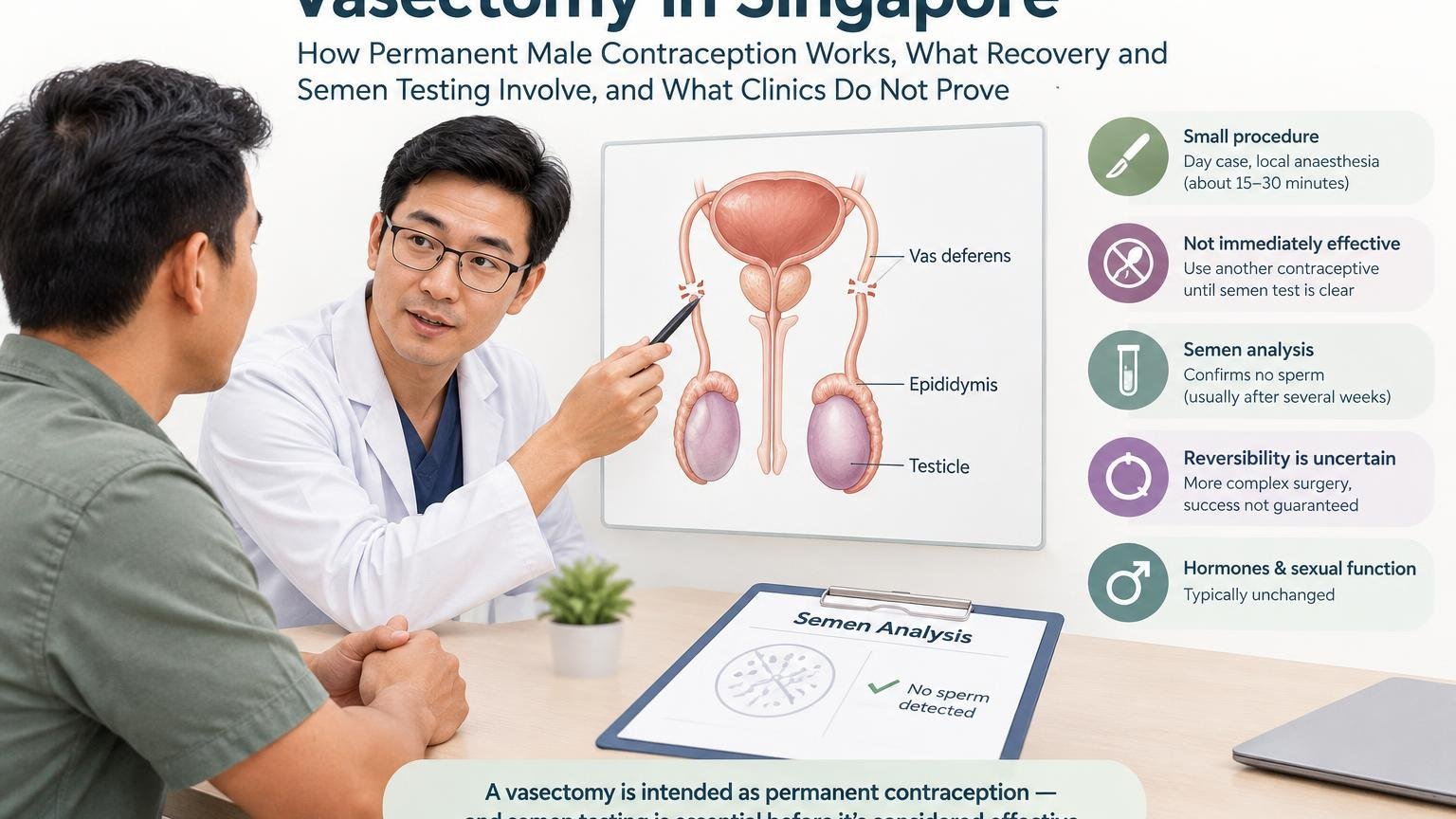
A vasectomy is a small surgical procedure intended as permanent male contraception. It works by cutting, sealing or blocking the vas deferens, the paired tubes that carry sperm from the testicles toward the urethra, so that sperm can no longer mix with semen. Ejaculation still happens, but the ejaculate is not expected to contain sperm capable of causing pregnancy. In Singapore, clinic-based patient pages describe the procedure as a short day-case operation, usually under local anaesthesia, performed by urologists or trained surgeons in private clinics and hospitals, typically taking 15 to 30 minutes. These are practice descriptions, not findings from controlled studies, and they should be read as patient-education material rather than independent evidence.[1][2]
The most important practical point is that vasectomy is not immediately effective. Sperm can remain in the reproductive tract for several weeks or ejaculations after the procedure, so pregnancy may still be possible until a post-vasectomy semen analysis shows no sperm and the doctor has reviewed the result. Clinics commonly advise using another contraceptive method during this interval. The sources differ on timing: one patient page advises about three months or a test around 8 to 12 weeks, while another mentions typically 12 weeks or 20 ejaculations. These figures describe usual local practice rather than a single validated protocol, so the operating clinic's instructions should take priority.[3]
The clinic sources consistently state that vasectomy does not usually change testosterone levels, libido, erection or orgasm, and that most men continue to ejaculate with only minimal change in semen volume because sperm make up a very small fraction of seminal fluid. They also acknowledge a small chance of spontaneous reconnection of the vas deferens, which is why the follow-up semen test is treated as essential. Reversal is described as a more complex microsurgical operation whose success is not guaranteed and tends to fall as years pass after vasectomy; one source gives a 40% to 90% success range, but does not define success, provide a time window or cite outcome data, so that range should be attributed to the source rather than treated as a reliable estimate.
Why This Matters
Vasectomy sits at an unusual intersection of surgery, family planning and sexual health. It is often presented as simpler and lower-risk than female sterilisation, and the Singapore clinic pages frame it as a shared contraceptive decision rather than a woman's responsibility alone. That framing matters because the practical value of vasectomy depends less on the operation itself than on correct counselling: understanding that it is intended to be permanent, that it does not protect against sexually transmitted infections, that it is not effective until semen testing confirms clearance, and that reversal is a separate, uncertain procedure.
The sources also show how patient education can blur evidence. One clinic page cites Singapore's total fertility rate as 0.97 in the last quarter of 2024 to contextualise contraceptive demand, but gives no official statistical reference in the text. Another states that vasectomy is 'nearly 100% effective' without defining the measure. These claims may be broadly consistent with clinical experience, yet they are not presented with study designs, sample sizes or citations. For readers, the practical lesson is to separate what a clinic describes as usual practice from what published comparative evidence would be needed to establish.
Biological and Clinical Mechanism
The testicles produce sperm and testosterone. Sperm travel through the epididymis and then the vas deferens toward the urethra, where they mix with fluid from the prostate and seminal vesicles to form semen. A vasectomy interrupts this pathway by cutting, tying, sealing or blocking each vas deferens. Because testosterone travels through the bloodstream rather than the vas deferens, hormone production is not expected to change. Because most semen volume comes from the prostate and seminal vesicles, ejaculation and semen volume are usually preserved, although the source describes volume change as minimal rather than absent.
Sperm that can no longer leave the body are generally absorbed. The clinical consequence is that the ejaculate becomes azoospermic, or free of sperm, but only after the existing sperm in the tract have been cleared. That lag explains the need for continued contraception and for a follow-up semen analysis. The sources do not quantify how many ejaculations are needed for clearance in every man, nor do they describe laboratory thresholds in detail; they present semen testing as a routine confirmation step rather than a precise biological assay.
How Techniques Differ
Singapore clinic pages describe three overlapping ways of performing or finishing a vasectomy. Conventional vasectomy uses one or two small scalpel incisions in the scrotal skin, lifts out each vas deferens, cuts and seals the ends, and usually closes the skin with dissolvable stitches. No-scalpel vasectomy uses a small puncture made with a pointed instrument after the vas is felt and held under the skin; the opening is stretched rather than cut and may not need stitches. Open-ended vasectomy describes how the cut ends are managed: the end leading toward the prostate is sealed, while the testicular end is left unsealed.
The claimed advantages of no-scalpel access include less bleeding and bruising, lower infection risk, less discomfort afterwards and quicker return to normal activities. The source frames these as associations suggested by studies but does not name the studies, report effect sizes or describe comparison groups. The claimed rationale for open-ended vasectomy is mechanistic: sealing both ends may allow sperm to build up and raise pressure in the tube, and leaving the testicular end open may ease that pressure and may lower the chance of post-vasectomy pain syndrome. This is explicitly hedged as a possible mechanism, not a demonstrated pain benefit.
What the Evidence Shows on Recovery and Aftercare
The clinic sources describe vasectomy as a day procedure with mild, temporary after-effects. Common advice includes resting for one or two days, avoiding heavy lifting or strenuous activity for about a week, wearing supportive underwear and using ice packs for mild swelling. One source reports that mild discomfort and swelling usually resolve within a week and that most men can return to work within one to two days. Another reports that many men with desk jobs return within two to three days, while physically demanding work may take about a week. These are general practice descriptions without cited data, and the numerical difference between them illustrates how recovery advice varies by source and by individual.
| Practical issue | What the clinic sources describe | What remains uncertain |
|---|---|---|
| Typical procedure time | 15 to 30 minutes under local anaesthesia in Singapore; sometimes described as about 20 to 30 minutes depending on technique. | No cited audit or trial confirms these durations across clinics. |
| Return to work | One source says most men return within 1 to 2 days; another says 2 to 3 days for desk jobs and about a week for physical work. | The sources do not define work type, healing criteria or measured outcomes. |
| Post-vasectomy semen test timing | About 8 to 12 weeks in one source; typically 12 weeks or 20 ejaculations in another; about three months of continued contraception is commonly advised. | No single validated protocol is presented, and timing may depend on clinic policy and individual factors. |
| Sexual function and hormones | Testosterone, libido, erection and orgasm are not usually affected; ejaculation continues and semen volume changes only minimally. | Source statements are general and not backed by cited comparative studies; individual experience may vary. |
| Reversal | Described as more complex microsurgery whose success is not guaranteed and tends to decline with years since vasectomy; one source gives a 40% to 90% range. | The range has no defined success measure, time frame or citation, so it should not be used as a personal prognosis. |
Post-vasectomy semen analysis is a laboratory test in which a semen sample is examined under a microscope for sperm. The sources say it is usually arranged after a set number of weeks or ejaculations, and that the man should keep using another contraceptive method until the result shows no sperm and the doctor has reviewed it. This is the central safety step in the patient pathway. The sources do not describe what threshold defines success, how many samples are needed, or what happens if motile sperm persist, so the clinic's written aftercare instructions are the relevant operational detail.
Reversibility, Sexual Function and Safety Claims
Vasectomy is intended as long-term contraception. The sources warn that reversal may not be possible, outcomes vary and the chance of success tends to fall as years pass. One source gives a 40% to 90% success range but does not define whether success means return of sperm, pregnancy or live birth, nor does it state the time window or population. That makes the range clinically vague. The safer message is that vasectomy should be chosen as though it were permanent, and that anyone who might want biological children later should discuss that uncertainty before proceeding.
On sexual function, the sources state that vasectomy does not usually affect testosterone levels, sex drive, erection or the sensation of orgasm. They explain that hormone production continues in the testicles and that most semen fluid comes from other glands. They also note that ejaculation still occurs without sperm, and that in rare cases vasectomy can cause chronic pain, described as a rare complication. The sources give no frequency for post-vasectomy pain syndrome, no diagnostic criteria and no comparative data on open-ended versus sealed techniques, so the pain discussion remains a hypothesis-generating rationale rather than a quantified risk.
The prostate cancer question is addressed in one source, which states that large studies have not shown a clear causal link, that some epidemiological associations may reflect biases such as increased screening in men who have had vasectomies, and that more recent meta-analyses and Mendelian randomisation studies do not support a direct causal relationship. The source does not name those analyses or report their estimates. For readers, the prudent interpretation is that current clinic-level summaries do not support a causal warning, while the underlying epidemiological literature should be checked directly if this is a specific concern.
Interpretation and Limitations
All four sources are clinic-affiliated patient-education pages, not peer-reviewed trials or independent evidence syntheses. They describe typical practice and commonly repeated clinical statements, but they do not report study designs, sample sizes, follow-up periods or outcome definitions for most claims. Numerical statements such as procedure duration, return-to-work times, semen-test timing and reversal success should therefore be treated as practice descriptions rather than measured effects. The sources occasionally conflict, as with return-to-work times, and they do not provide the kind of comparative data needed to say whether no-scalpel vasectomy is definitively less painful than conventional vasectomy or whether open-ended vasectomy reduces chronic pain.
There are also gaps in what the sources do not discuss. They do not cover pre-procedure counselling standards, age or family-completion criteria, cost, insurance, sexually transmitted infection protection, or the management of persistent post-vasectomy pain. They do not quantify failure rates beyond 'very small' or 'nearly 100%', and they do not describe how many men need repeat semen testing. These omissions matter because patients making a permanent decision need to know both the typical pathway and the limits of the evidence behind it. The sources are useful for understanding what a clinic will usually do; they are not sufficient to establish comparative safety or long-term outcomes.
Research Outlook
Better patient decisions would be supported by independent, prospectively collected data on semen clearance after different vasectomy techniques, on the incidence and definition of post-vasectomy pain syndrome, and on reversal outcomes reported with consistent definitions. The clinic sources point toward these questions rather than answering them. Until such data are available in an accessible form, the most reliable approach is to treat the consultation and written aftercare instructions as the individualised plan, and to ask the surgeon directly about success definitions, repeat testing, pain risk and what would happen if sperm persisted after the procedure.
Key Takeaways
- A vasectomy blocks the vas deferens so sperm cannot mix with semen; ejaculation continues, but the ejaculate is not expected to contain sperm that can cause pregnancy.
- It is not immediately effective. Sperm can remain for several weeks or ejaculations, so another contraceptive method is usually advised until semen analysis shows no sperm and the doctor reviews the result.
- Clinic sources describe a semen test around 8 to 12 weeks or typically after 12 weeks or 20 ejaculations, but the operating clinic's own protocol should guide timing.
- No-scalpel and open-ended techniques differ in access and in how the cut ends are managed; claimed advantages are presented as associations or hypotheses, not as quantified comparative outcomes.
- Vasectomy is intended to be permanent. Reversal is more complex microsurgery and success is not guaranteed; the 40% to 90% range in one source is undefined and should not be treated as a personal prognosis.
- Hormones, libido, erection and orgasm are not usually affected according to the sources, but these are general patient-education statements rather than cited comparative findings.
Questions and Answers
How does a vasectomy prevent pregnancy if ejaculation still happens?
A vasectomy cuts, seals or blocks the vas deferens, the tubes that carry sperm from the testicles toward the urethra. Sperm can no longer mix with semen, so ejaculation still occurs but the ejaculate is not expected to contain sperm capable of causing pregnancy. The testicles continue producing testosterone, and most semen fluid comes from the prostate and seminal vesicles, so hormone levels and semen volume are usually not markedly changed according to the clinic sources.
Why is a semen analysis needed after vasectomy before stopping other contraception?
Sperm can remain in the reproductive tract for several weeks or ejaculations after vasectomy, so pregnancy may still be possible during that interval. Doctors usually advise continuing another contraceptive method until a post-vasectomy semen analysis shows no sperm and the result has been reviewed. Clinic sources give typical testing times of about 8 to 12 weeks or 12 weeks or 20 ejaculations, but the exact timing depends on the clinic's protocol and individual factors.
What is the difference between no-scalpel and open-ended vasectomy?
No-scalpel vasectomy refers to how the surgeon reaches the vas deferens: a small puncture is made with a pointed instrument rather than a scalpel incision. Open-ended vasectomy refers to how the cut ends are managed: the prostate-side end is sealed, while the testicular end is left open, with a proposed mechanism of reducing pressure and possibly lowering post-vasectomy pain risk. The claimed advantages are described as associations or hypotheses; the sources do not provide comparative outcome data.
Can a vasectomy be reversed successfully in Singapore?
Reversal is described as a more complex microsurgical procedure that reconnects the vas deferens, and success is not guaranteed. The chance tends to decline as years pass after vasectomy. One clinic source gives a 40% to 90% success range, but does not define what success means, provide a time window or cite outcome data. Vasectomy should therefore be chosen as a permanent decision, and anyone considering future reversal should discuss that uncertainty before the procedure.
Does vasectomy affect testosterone, libido or sexual performance?
According to the clinic sources, vasectomy does not usually change testosterone levels, sex drive, the ability to get an erection or the sensation of orgasm. The testicles continue to produce testosterone, which travels through the bloodstream rather than the vas deferens. Most men continue to ejaculate, and semen volume usually changes only minimally. These are general patient-education statements rather than findings from cited comparative studies, and individual experiences may vary.
What are the main limitations of clinic websites as evidence about vasectomy?
Clinic websites describe usual practice but rarely report study designs, sample sizes, follow-up periods or outcome definitions. Numerical claims such as return-to-work times and reversal success ranges are not cited, and sources can conflict, as with the reported 1 to 2 days versus 2 to 3 days for returning to desk work. They are useful for understanding the typical pathway and aftercare but cannot establish comparative safety, pain risk reduction or long-term outcomes without independent published data.
Sources and References
- Vasectomy Singapore: A Couple's Guide to Safety & Shared Decisions.
- Dr Jay Lim. Vasektomi – Dr Jay Lim Ahli Urologi.
- Dr Tan Teck Wei. Types of Vasectomy in Singapore: Techniques Explained.
SANYUN Science Center explains published research on men's reproductive and sexual health, connecting scientific evidence with everyday questions while making sources and limitations clear.
Disclaimer: This article is for scientific education and research communication only. It does not provide medical advice, diagnosis, or individualized treatment recommendations, and does not endorse any medication, supplement, device, penile enlargement procedure, or other intervention. Decisions about sexual and reproductive health should be made in consultation with a qualified healthcare professional. Do not delay seeking professional care because of information in this article.
Original Content & Copyright Notice
- This article is prepared for SANYUN Science Center, drawing on published research and publicly available academic literature on men’s sexual and reproductive health. Its editorial explanations and presentation are developed for this platform.
- Copyright in the original editorial content, selection, and arrangement is reserved by SANYUN Science Center to the extent protected by applicable law. Referenced research, quotations, and third-party materials remain subject to the rights of their respective owners. This notice does not claim ownership of scientific facts or third-party research.
- Except where permitted by applicable law or an applicable license, prior written permission is required to reproduce, republish, translate, adapt, redistribute, or commercially reuse protected content. Attribution alone does not grant permission for such reuse.
- For permitted quotation or authorized reuse, clearly identify the source and retain a link to the original article.
- Source: SANYUN Science Center
- Original URL: Retain the original article URL on science.san-yun.com.
- Copyright Holder: SANYUN Science Center, for its own protected editorial content.
- Quotation, excerpts, or authorized reuse must not distort the scientific meaning, omit material limitations or disclaimers, or imply unverified medical claims, product efficacy, or endorsement by SANYUN Science Center.



