




Category: Premature Ejaculation
Core Research Direction: How pharmacological (dapoxetine), behavioral, and physiotherapeutic strategies compare for prolonging intravaginal ejaculatory latency time in premature ejaculation, including combination therapy, and what current consensus and guideline evidence says about evidence quality and applicability
Search Intent: For men with premature ejaculation, does combining dapoxetine with behavioral or physiotherapy training prolong intravaginal ejaculatory latency time more than either approach alone, and how strong is the evidence?
Platform: SANYUN Science Center
Evidence reviewed through: 2026-11-26
Executive Summary
Premature ejaculation (PE) is a common ejaculatory disorder with substantial effects on quality of life and relationships, and intravaginal ejaculatory latency time (IELT) remains the most widely used objective outcome in treatment trials. Current evidence compares three broad strategies: the short-acting selective serotonin reuptake inhibitor (SSRI) dapoxetine, behavioral training, and physiotherapeutic approaches such as pelvic floor muscle training, biofeedback, acupuncture, yoga, and exercise. The quality of this evidence is uneven. A 2026 systematic review and meta-analysis of six clinical trials with 416 participants found that dapoxetine at 30 mg produced a small but statistically significant IELT advantage over physiotherapy, with a mean difference of −0.80 seconds (95% confidence interval −1.53 to −0.06; P=.03) and high heterogeneity (I2=83%). That pooled estimate is not a clinically meaningful comparison of seconds; it reflects heterogeneous effect measures across heterogeneous trials. Qualitative synthesis in the same review suggested that combined pharmacological and physiotherapeutic approaches produced the largest IELT improvements, but this was a narrative inference rather than a pooled effect estimate. Two randomized trials from a single country examined dapoxetine combined with behavioral training, finding combination therapy outperformed either component alone in the populations studied, but both were single-center, modest in size, and reported at abstract level without effect sizes or confidence intervals. The 2027 AUA/SMSNA guideline amendment revised its statement on non-pharmacological therapies for PE to reflect new evidence that some of these therapies may be effective, added an expert-opinion statement on PDE5 inhibitors, and emphasized shared decision-making as the fundamental principle of management. Taken together, the evidence supports dapoxetine as an effective on-demand pharmacological option with modest average benefits and tolerability limitations, supports behavioral and physiotherapeutic approaches as safe alternatives with plausible but less precisely quantified benefits, and suggests combination therapy may yield larger improvements than either approach alone while remaining insufficiently characterized for broad clinical recommendations.[1][2][3]
Why This Matters
Ejaculatory disorders including PE are common and substantially affect men's quality of life and relationships. Reported lifetime experience of PE is high, with one review citing that approximately 75% of men will experience PE at some point, although this figure depends heavily on definition and ascertainment. The clinical definition itself matters for interpreting trials: the 2026 physiotherapy review operationalizes PE as IELT of 1 minute or less, while the International Society of Sexual Medicine distinguishes lifelong PE, where ejaculation occurs within about 1 minute from first sexual experiences, from acquired PE, where a clinically significant reduction to about 3 minutes or less develops after a period of normal function. These distinctions affect who was studied and to whom results may apply.
Treatment selection is not straightforward. Dapoxetine is widely approved in Europe but not in the United States, and despite demonstrated efficacy in prolonging IELT and improving perceived control, adherence is limited by adverse effects and high discontinuation. Physiotherapy offers a lower-risk alternative but requires time, training, and access to skilled practitioners, and its evidence base is smaller. Clinicians and patients need a realistic understanding of what each approach can and cannot deliver, and of how weak or heterogeneous the comparisons remain.
Biological and Clinical Mechanism
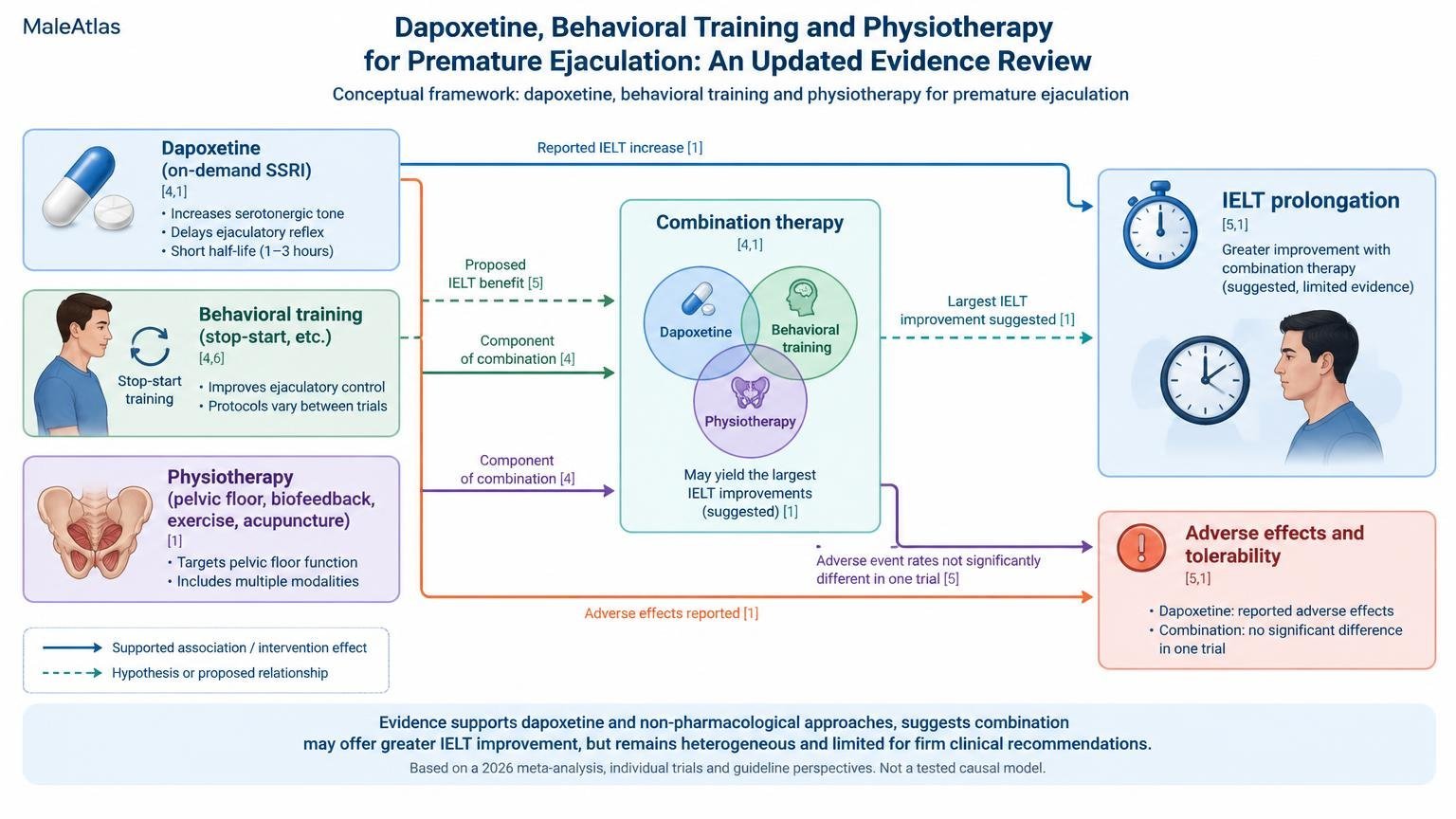
Dapoxetine is a short-acting SSRI that inhibits serotonin reuptake and, according to the physiotherapy review, also interacts with norepinephrine and dopamine reuptake transporters. By increasing serotonergic tone, it is thought to delay the ejaculatory reflex, prolonging IELT. Its short half-life supports on-demand dosing one to three hours before sexual activity, which distinguishes it from daily SSRI regimens used in some other contexts. Behavioral training, including the stop-start technique, aims to improve ejaculatory control through repeated interrupted stimulation, though the exact protocol varies between trials and is often incompletely described. Physiotherapeutic approaches target pelvic floor muscle function, based on the rationale that weakness or hypertonicity of pelvic floor muscles involved in sexual function may contribute to ejaculatory disorder; interventions include pelvic floor muscle strengthening, biofeedback, electrostimulation, acupuncture, yoga, and structured exercise.
What the Evidence Shows
The most informative quantitative comparison comes from a 2026 systematic review and meta-analysis that searched PubMed, PEDro, and Scopus for clinical trials published between 2014 and 2024 comparing physiotherapy with pharmacological treatment in men with PE. Six studies with 416 participants entered the meta-analysis. The pooled mean difference in IELT was −0.80 seconds favoring dapoxetine 30 mg (95% confidence interval −1.53 to −0.06; P=.03), with high heterogeneity (I2=83%). The authors characterized this as a large effect size by standardized mean difference criteria and concluded dapoxetine 30 mg was significantly more effective than physiotherapy for prolonging IELT in men with lifelong PE. However, the absolute difference of less than one second is not clinically meaningful in isolation, and the high heterogeneity indicates substantial variability in trial populations, interventions, and effect measures.
Individual trials within the review illustrate this variability. In the trial by Pastore and colleagues, dapoxetine-treated men starting at an average IELT of 37.2 seconds increased to 168.2 ± 36.6 seconds with 30 mg and 193.2 ± 43.8 seconds with 60 mg at 6 weeks; after 12 weeks, 62.5% of patients (5 of 8) in the 30 mg subgroup and 72% (5 of 7) in the 60 mg subgroup had IELT increases greater than 180 seconds. In Kilinc and colleagues, moderate physical activity raised IELT from 39.3 seconds to 188.6 seconds, minimal activity only from 33.8 seconds to 50.3 seconds, and dapoxetine from 36.8 seconds to 181.7 seconds. In Mantovani and colleagues, 75% improved at 3 months and 25% at 6 months with dapoxetine; 25% at both time points with pelvic floor training alone; and 75% at 3 months and 50% at 6 months with combined therapy. These are single small trials with varying designs and should not be pooled mentally into a single expectation.
The review's qualitative synthesis suggested that combined therapeutic approaches yielded the most significant IELT improvements. In Yilmaz and colleagues, the increase in IELT for the combined therapy group was statistically significant compared with the other groups (P<.001). In Mantovani and colleagues, combined therapy showed a numerically larger proportion improved at 6 months than dapoxetine alone, although the trial was excluded from the meta-analysis because IELT was not measured with a stopwatch and standard deviations were unavailable. These findings support combination therapy as a plausible strategy but do not provide a precise pooled estimate of its advantage.
Two randomized trials from China directly examined dapoxetine combined with behavioral training. In the first, 200 men with PE who lived apart from partners long-term and had irregular sexual activity were randomized into four groups of 50: behavioral training alone, dapoxetine before intercourse alone, behavioral training plus on-demand dapoxetine, and behavioral training plus dapoxetine before training and before intercourse. IELT, PEDT, CGIC, and adverse events were assessed at 8, 16, and 24 weeks. IELT and PEDT improved in all arms, and the arm receiving behavioral training plus dapoxetine before training and before intercourse showed significantly greater IELT prolongation, PEDT reduction, and CGIC than the other arms. Adverse event rates did not differ significantly between arms. The authors concluded combination therapy was more clinically effective than either component alone in this population.[4][5]
The second trial randomized 60 men with lifelong PE to dapoxetine alone or dapoxetine plus stop-start training (30 per group), assessing IELT and CIPE at 4 and 8 weeks. The available abstract does not report outcome results, so this trial cannot support quantitative statements about the size of any combination benefit. Its design, however, reflects the same hypothesis that behavioral training adds to pharmacological treatment.[6]
| Strategy or comparison | Evidence source and design | Main reported finding | Interpretation and limitations |
|---|---|---|---|
| Dapoxetine 30 mg versus physiotherapy | 2026 systematic review and meta-analysis of six trials, 416 participants | Mean difference in IELT −0.80 seconds favoring dapoxetine (95% CI −1.53 to −0.06; P=.03); I2=83% | Statistically significant but absolute difference not clinically meaningful; high heterogeneity; small included trials |
| Dapoxetine plus behavioral training versus either alone | Single-center randomized trial, 200 men with irregular sexual activity | Combined arm showed significantly greater IELT, PEDT, and CGIC improvements; adverse events did not differ significantly | Abstract-level reporting without effect sizes or confidence intervals; specific population limits generalizability |
| Dapoxetine plus stop-start training versus dapoxetine alone | Randomized trial, 60 men with lifelong PE | Outcome results not available in abstract text | Cannot support quantitative conclusions; design reflects combination hypothesis |
| Combined therapy versus single modality | Qualitative synthesis within 2026 review | Suggests combined approach yields largest IELT improvements | Narrative inference, not pooled effect estimate |
Interpretation and Limitations
Several limitations temper these conclusions. The 2026 meta-analysis included only six trials, with sample sizes ranging from 18 to 120 participants, and its authors cautioned that scarcity and heterogeneity make definitive conclusions difficult. The pooled difference of less than one second, despite reaching statistical significance, should not be presented as a clinically important advantage; its interpretation depends on the standardized effect size, which the authors described as large, but the high heterogeneity (I2=83%) means the pooled estimate may not represent any single trial. The review also noted a discrepancy between the 466 men described in the characteristics summary and the 416 included in the meta-analysis.
The randomized trial of 200 men with irregular sexual activity was single-center and reported only abstract-level results, without effect sizes, confidence intervals, or detailed descriptions of the behavioral training protocol or dapoxetine dosing. Its population, men in long-term separated couples with irregular sexual activity, may respond differently from men in regular relationships, and the finding that adverse event rates did not differ significantly across arms should be interpreted cautiously given the sample size and reporting. The trial of 60 men with lifelong PE provides no outcome data in the available abstract. Neither trial was included in the 2026 meta-analysis, which focused on physiotherapy versus pharmacological comparisons.
Methodological quality of the physiotherapy trials was mixed: three were rated high, one medium, and two low on the PEDro scale, with blinding items scoring lowest. This is expected when comparing physical interventions with drugs, but it means that performance and detection biases cannot be excluded. The long-term durability of any approach is uncertain. SSRI discontinuation rates of 70.6% to 89.6% after the first year, cited in the review, highlight that efficacy in short trials does not guarantee adherence or persistence in practice. Physiotherapy may be safer but requires ongoing engagement and access to trained practitioners, and its comparative effectiveness against dapoxetine remains imprecisely estimated.
Guideline and Consensus Context
The Fifth International Consultation on Sexual Medicine produced a review synthesizing etiology, epidemiology, evaluation, and management of PE and delayed ejaculation, with evidence-based recommendations on definition, classification, and treatment. The 2027 AUA/SMSNA guideline amendment searched MEDLINE and Embase for studies published between January 1, 2020 and December 19, 2024, identifying 727 abstracts, 89 meeting inclusion criteria, and 25 studies assessed for quality. It revised its statement on non-pharmacological therapies for PE to reflect new evidence that some of these therapies may be effective, added an expert-opinion statement on PDE5 inhibitors, and supported new statements on daily or on-demand clomipramine and glans hyaluronic acid injection with caveats about informed consent and trained clinician use. The panel emphasized shared decision-making as the fundamental precept in managing ejaculatory disorders regardless of treatment option.
Notably, the guideline amendment does not provide a direct head-to-head recommendation favoring combination therapy over monotherapy for IELT prolongation; its revisions reflect broader evidence on non-pharmacological therapies and new pharmacological options. The consensus review similarly frames treatment within a biopsychosocial evaluation rather than a single preferred sequence.
Research Outlook
Several evidence gaps remain. Trials directly comparing dapoxetine plus behavioral training with dapoxetine plus physiotherapy, and with each combination alone, are lacking. The 60-participant stop-start trial illustrates the design needed but its results are not available in the abstract, and larger multicenter trials with stopwatch-measured IELT, standardized behavioral protocols, and longer follow-up are needed. The 2026 review's qualitative suggestion that combination therapy yields the largest improvements should be tested in adequately powered randomized trials with consistent outcome definitions and reporting of adverse events and adherence. Until then, clinicians should present combination therapy as a reasonable option supported by plausible mechanisms and limited trial evidence, not as a proven superior strategy.
Key Takeaways
- Dapoxetine 30 mg showed a statistically significant but very small pooled IELT advantage over physiotherapy in a 2026 meta-analysis of six trials with 416 participants; high heterogeneity limits interpretation.
- A single-center randomized trial of 200 men with irregular sexual activity found dapoxetine plus behavioral training improved IELT, PEDT, and CGIC more than either alone, without a significant difference in adverse events, but reporting is abstract-level and the population is specific.
- Qualitative synthesis suggests combination therapy may produce the largest IELT improvements, but this is not a pooled effect estimate and should be treated as hypothesis-generating.
- Physiotherapy appears safe and beneficial, particularly for patients who cannot tolerate pharmacological treatment, but comparative evidence is scarce and heterogeneous.
- The 2027 AUA/SMSNA guideline amendment recognizes some non-pharmacological therapies as potentially effective and emphasizes shared decision-making across all treatment options.
Questions and Answers
How does dapoxetine compare with physiotherapy for prolonging IELT in premature ejaculation?
A 2026 systematic review and meta-analysis of six trials with 416 participants found dapoxetine 30 mg produced a small but statistically significant IELT advantage over physiotherapy, with a mean difference of −0.80 seconds (95% CI −1.53 to −0.06; P=.03). However, high heterogeneity (I2=83%) and the very small absolute difference limit clinical interpretation. Physiotherapy remains a reasonable alternative, especially for patients who cannot tolerate medication.
Does combining dapoxetine with behavioral training improve premature ejaculation more than either alone?
One single-center randomized trial of 200 men with irregular sexual activity found that dapoxetine plus behavioral training improved IELT, PEDT, and CGIC significantly more than behavioral training alone or dapoxetine alone, without a significant difference in adverse events. However, the trial reported abstract-level results without effect sizes or confidence intervals, and its specific population limits generalizability. A smaller trial of dapoxetine plus stop-start training did not report outcomes in its abstract.
What does the 2026 meta-analysis say about combination therapy for premature ejaculation?
The 2026 meta-analysis pooled six trials comparing physiotherapy with dapoxetine but its qualitative synthesis suggested that combined therapeutic approaches yielded the most significant IELT improvements. This was a narrative inference, not a pooled effect estimate, and the authors cautioned that scarcity and heterogeneity of trials limit definitive conclusions. Combination therapy therefore appears promising but is not established as superior by robust quantitative evidence.
How strong is the evidence for physiotherapy as a treatment for premature ejaculation?
Physiotherapy evidence comes from a limited number of small trials with mixed methodological quality: three rated high, one medium, and two low on the PEDro scale. The 2026 review found physiotherapy safe and beneficial, with significant IELT improvements in some trials, but the authors noted scarcity and heterogeneity of comparative studies. Physiotherapy is best viewed as a promising alternative, particularly for patients who cannot tolerate pharmacological treatment, rather than a proven equivalent to dapoxetine.
What are the limitations of trials comparing dapoxetine, behavioral training and physiotherapy for premature ejaculation?
Key limitations include small sample sizes (individual trials ranged from 18 to 120 participants in the meta-analysis), high heterogeneity (I2=83%), single-center designs, abstract-level reporting without effect sizes or confidence intervals in some trials, and difficulty blinding participants and assessors in physiotherapy trials. Discontinuation rates of 70.6% to 89.6% after the first year on SSRIs also mean short-term efficacy may not translate into long-term adherence. These factors make definitive comparisons difficult.
What do current guidelines say about treatment options for premature ejaculation?
The 2027 AUA/SMSNA guideline amendment revised its statement on non-pharmacological therapies to reflect new evidence that some may be effective, added an expert-opinion statement on PDE5 inhibitors, and supported new statements on clomipramine and glans hyaluronic acid injection with caveats about informed consent and trained clinician use. It emphasizes shared decision-making as the fundamental principle across all treatment options. The Fifth International Consultation on Sexual Medicine similarly provides evidence-based recommendations on definition, classification, and treatment.
Conceptual framework: Conceptual framework summarizing relationships between dapoxetine, behavioral training, physiotherapy, combination therapy, IELT prolongation and adverse effects in premature ejaculation. Solid arrows indicate supported associations or intervention effects; dashed arrows indicate proposed or hypothesis-level relationships. Evidence comes from heterogeneous trials and a 2026 meta-analysis; the framework is not a tested causal model and does not imply proven superiority of any strategy.
Academic References & Evidence
- Esther M Medrano-Sánchez; Ana López-del-Castillo; Maud Boisseau; Juan C Fernández-Domínguez; Esther Díaz-Mohedo. Effectiveness of physiotherapy in male premature… : The Journal of Sexual Medicine. The Journal of Sexual Medicine. 2026 23(5) DOI: 10.1093/jsxmed/qdag096.
- Contemporary consensus and emerging directions in premature and delayed ejaculation: recommendations from the 5th International Consultation on Sexual Medicine.. Sexual medicine reviews PMID: 42855438.
- Disorders of Ejaculation: AUA/SMSNA Guideline (2027) | Journal of Urology. Journal of Urology DOI: 10.1097/JU.0000000000005378.
- 刘冬梅; 陈小勇; 何国宝; 雒金丽. 盐酸达泊西汀联合行为训练治疗无规律性生活早泄患者的研究. 中国性科学 31(10)
- 盐酸达泊西汀联合行为训练治疗无规律性生活早泄患者的研究-论文-万方医学网. 中国性科学
- 高晶晶; 张子房; 杜俊华; 高攀; 彭党委; 张耀; 张贤生. 单一使用盐酸达泊西汀与联合“动停”行为学训练在治疗原发性早泄中的临床研究. 中国男科学杂志 38(6)
SANYUN Science Center explains published research on men's reproductive and sexual health, connecting scientific evidence with everyday questions while making sources and limitations clear.
Disclaimer: This article is for scientific education and research communication only. It does not provide medical advice, diagnosis, or individualized treatment recommendations, and does not endorse any medication, supplement, device, penile enlargement procedure, or other intervention. Decisions about sexual and reproductive health should be made in consultation with a qualified healthcare professional. Do not delay seeking professional care because of information in this article.
Original Content & Copyright Notice
- This article is prepared for SANYUN Science Center, drawing on published research and publicly available academic literature on men’s sexual and reproductive health. Its editorial explanations and presentation are developed for this platform.
- Copyright in the original editorial content, selection, and arrangement is reserved by SANYUN Science Center to the extent protected by applicable law. Referenced research, quotations, and third-party materials remain subject to the rights of their respective owners. This notice does not claim ownership of scientific facts or third-party research.
- Except where permitted by applicable law or an applicable license, prior written permission is required to reproduce, republish, translate, adapt, redistribute, or commercially reuse protected content. Attribution alone does not grant permission for such reuse.
- For permitted quotation or authorized reuse, clearly identify the source and retain a link to the original article.
- Source: SANYUN Science Center
- Original URL: Retain the original article URL on science.san-yun.com.
- Copyright Holder: SANYUN Science Center, for its own protected editorial content.
- Quotation, excerpts, or authorized reuse must not distort the scientific meaning, omit material limitations or disclaimers, or imply unverified medical claims, product efficacy, or endorsement by SANYUN Science Center.



