




Category: Erectile Dysfunction
Core Research Direction: Current evidence on erectile dysfunction treatment: the strength and quality of evidence behind pharmacological and non-pharmacological interventions (as summarized in a 2026 umbrella review), contextualized within the cardiovascular-risk framing of ED and the clinical management of refractory implants and PDE5-inhibitor nonresponse.
Search Intent: How reliable is the evidence base for the many treatments now available for erectile dysfunction, and what should that mean for how clinicians and patients interpret claims that a given intervention works?
Platform: SANYUN Science Center
Evidence reviewed through: 2026-11-22
Executive Summary
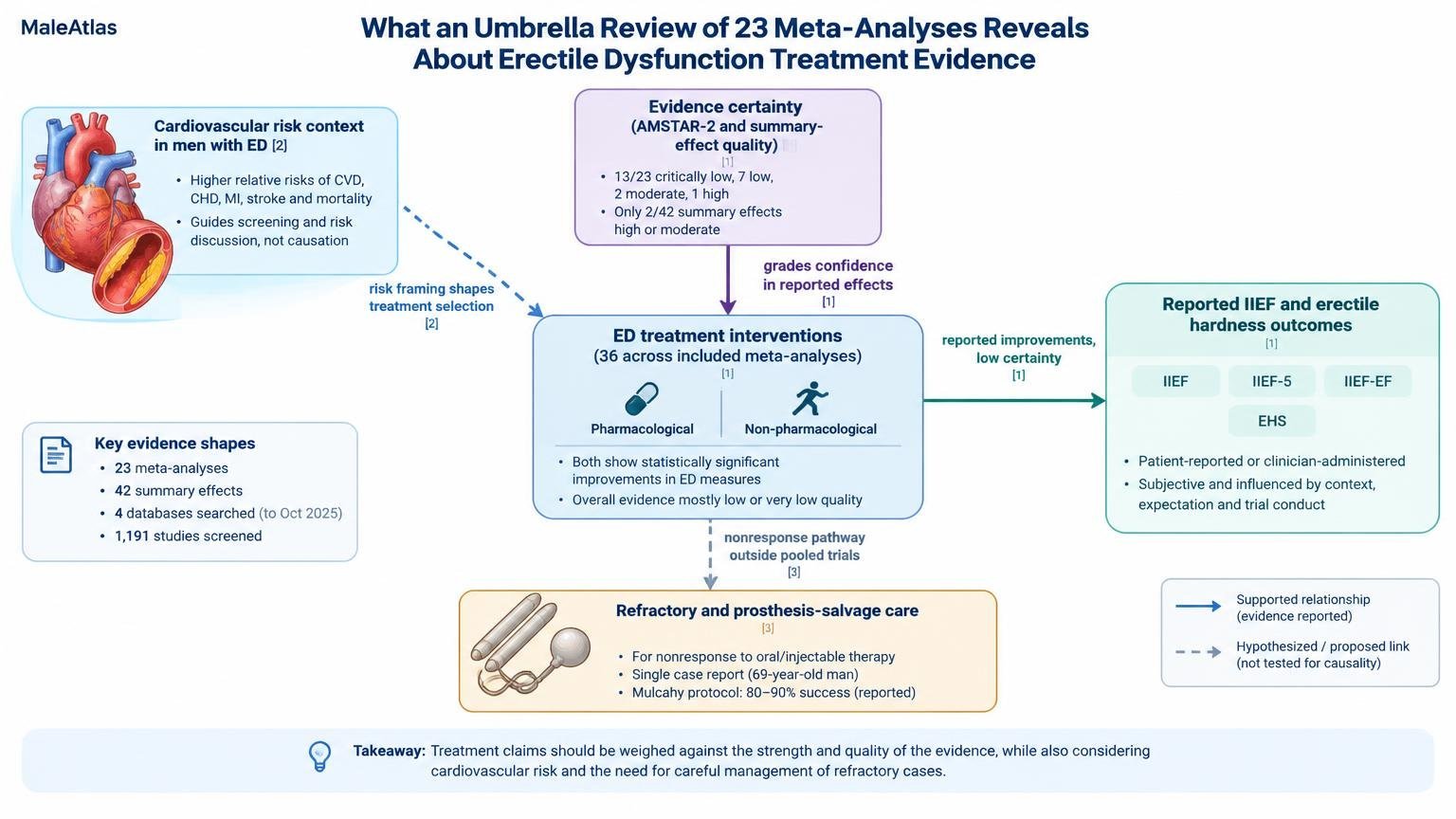
A 2026 umbrella review of 23 meta-analyses covering 36 erectile dysfunction interventions found that both pharmacological and non-pharmacological treatments produced statistically significant improvements on validated erectile-function scales — yet the review graded most of the underlying evidence as low or very low quality. That combination is the central tension in the current literature: direction of benefit is reasonably consistent, but confidence in magnitude, durability and comparative ranking is not.[1]
The review searched four major databases for studies published up to October 2025. From 1,191 screened studies it extracted 23 published meta-analyses yielding 42 summary effects across the International Index of Erectile Function (IIEF), its five-item (IIEF-5) and erectile-function (IIEF-EF) versions, and the erectile hardness score (EHS). Quality appraisal using AMSTAR-2 rated 13 of 23 meta-analyses (56.5 percent) critically low, seven (30.5 percent) low, two (8.7 percent) moderate and one (4.3 percent) high. At the summary-effect level, only two of 42 were rated high or moderate, while 20 (47.6 percent) were low and 20 (47.6 percent) very low.
The practical message is not that erectile dysfunction treatments do not work. It is that a statistically significant pooled result in a low-quality meta-analysis is weaker support than the same result in a well-conducted one, and that the confidence a clinician or patient can place in any specific claim varies widely. The review authors call for better-designed single-treatment trials and high-quality head-to-head meta-analyses.
Why This Matters
Erectile dysfunction is common and its treatment marketplace is crowded. That scale creates commercial pressure to promote interventions faster than the evidence can mature. The same clinical context also situates ED within cardiovascular medicine: a secondary physician-authored guide, citing a 2021 umbrella review, reports that men with ED have higher relative risks of cardiovascular disease, coronary heart disease, myocardial infarction, stroke and all-cause mortality. Those figures are observational associations reported secondhand, so they support screening and risk discussion rather than proving causation or treatment benefit.[2]
That cardiovascular framing changes what 'working' means. The 2024 Princeton IV Consensus advises clinicians to treat men with ED as at risk for cardiac events until proven otherwise, and reviews potential cardioprotective effects of PDE5 inhibitors rather than established ones. A treatment decision is therefore also a cardiovascular-risk conversation, and reading a treatment claim in isolation from that context risks both over-treatment and missed prevention.
| Reported outcome | Relative risk | 95% CI or note |
|---|---|---|
| Cardiovascular disease | 1.45 | 95% CI 1.36–1.54 |
| Coronary heart disease | 1.50 | Reported with P<0.001 |
| Cardiovascular mortality | 1.50 | Reported with P<0.001 |
| Myocardial infarction | 1.55 | Reported with P<0.001 |
| Stroke | 1.36 | Reported with P<0.001 |
| All-cause mortality | 1.25 | Reported with P<0.001 |
These are relative risks, not absolute risks, and they describe associations in men who already have ED. They do not establish that treating ED changes cardiac outcomes, nor do they tell a clinician how much any individual's risk rises. Their practical value is in prompting blood pressure, glucose, lipid and atherosclerotic risk assessment in men presenting with ED — especially younger men without an obvious cause.
How the Evidence Was Assembled
Umbrella reviews sit at the top of the evidence hierarchy in name only. They inherit every weakness of the meta-analyses they summarize and every weakness of the trials inside those meta-analyses. The 2026 review is a useful case study because it quantified that inheritance rather than hiding it, reporting the quality distribution at both the meta-analysis level and the summary-effect level.
The review used IIEF-derived instruments and the erectile hardness score as endpoints. Both are patient-reported or clinician-administered scales, which makes them sensitive to expectation, relationship context and trial conduct. The authors explicitly note the subjective nature of these outcome indicators as a reason for caution, alongside limited patient numbers across the contributing evidence.
Two design features limit what the review can establish. First, it did not, in the summary supplied, report pooled effect sizes for individual interventions, so it cannot tell a reader how large a benefit any given treatment produces. Second, pooling 36 interventions across 42 summary effects makes substantial heterogeneity likely, which complicates any single certainty verdict. The review tells a reader how much to trust the direction of benefit; it does not resolve magnitude or comparative ranking.
Biological and Clinical Context for the Certainty Gap
PDE5 inhibitors work by blocking the enzyme that degrades cyclic GMP, the molecule mediating smooth-muscle relaxation and blood flow into the penis. They do not cause erections on their own; sexual stimulation is still required. This mechanism is well described, but mechanistic plausibility and demonstrated clinical benefit are different claims, and the umbrella review concerns the latter.
A proposed explanation for why ED often precedes cardiac symptoms is the artery-size hypothesis: penile arteries are roughly 1 to 2 mm in diameter versus 3 to 4 mm for coronary arteries, so atherosclerotic change may become symptomatic in the smaller vessel first. This is framed as a hypothesis, not a directly tested mechanism in the supplied material, and it should not be presented as established fact.
Clinical experience also shows that PDE5 inhibitor 'failure' is often not pharmacological failure. Incorrect timing, dosing after a high-fat meal, inadequate stimulation, too few attempts, suboptimal dose titration and unrecognized hypogonadism are all common contributors described in the secondary guide. Distinguishing these from true nonresponse is part of interpreting the evidence fairly, because a trial that enrolled poorly characterized nonresponders measures something different from one that enrolled confirmed nonresponders.
What the Evidence Shows by Intervention
Across the 36 interventions summarized, both pharmacological and non-pharmacological approaches produced statistically significant improvements in ED measures. That is the strongest positive statement the umbrella review supports. The full quality distribution, however, means the effect sizes attached to those improvements carry wide uncertainty, and the review authors describe the reliability of the evidence as poor.
For low-intensity shockwave therapy, a 2025 Cochrane review of 21 randomized trials (1,357 men) found the intervention may improve short-term IIEF-EF scores by roughly 3.9 points and long-term scores by 5.3 points versus sham, with low certainty of evidence. The same review noted several included studies were industry-funded, mainly by device makers. This is a good illustration of the umbrella review's broader point: a positive point estimate and low certainty can coexist.
For testosterone, TRAVERSE enrolled 5,246 hypogonadal men with preexisting or high cardiovascular risk and found transdermal testosterone noninferior to placebo for major adverse cardiac events (HR 0.96, 95% CI 0.78–1.17) over a mean 21.7 months. Atrial fibrillation, acute kidney injury and pulmonary embolism were more common with testosterone. These findings address cardiac safety, not erectile efficacy as standalone therapy, and the absolute event rates are not given in the supplied summary.
For sleep apnea, a 2018 study of 150 men newly diagnosed with moderate to severe obstructive sleep apnea reported an ED prevalence of 51 percent. A 2023 meta-analysis of 8 studies and 457 patients reported higher post-treatment IIEF-5 scores with sildenafil than with CPAP (37.7 versus 27.3), with authors suggesting combination therapy may add benefit. A 2021 Cochrane review rated the CPAP versus no-CPAP evidence as very uncertain and found sildenafil may slightly improve erectile function versus CPAP at 12 weeks. Each of these addresses a different question, so they should not be read as mutually confirming.
The intervention-level table below summarizes the evidence shape for several treatment areas. The columns describe the design and reported outcome, not a comparative ranking, because the supplied summary does not provide per-intervention effect sizes or head-to-head comparisons.
| Intervention area | Evidence shape | Reported outcome | Main limitation |
|---|---|---|---|
| Any of 36 ED interventions (umbrella level) | 23 meta-analyses; 42 summary effects | Statistically significant improvements for pharmacological and non-pharmacological interventions | Predominantly low or very low quality; limited patient numbers; subjective endpoints |
| Low-intensity shockwave therapy | 21 RCTs; 1,357 men; versus sham | IIEF-EF roughly +3.9 points short-term and +5.3 points long-term | Low certainty; several industry-funded studies |
| Testosterone in hypogonadal men | TRAVERSE; 5,246 men; mean 21.7 months | MACE HR 0.96 (95% CI 0.78–1.17) versus placebo | Safety-focused; more atrial fibrillation, acute kidney injury and pulmonary embolism |
| Sildenafil versus CPAP in OSA | Meta-analysis of 8 studies; 457 patients | Post-treatment IIEF-5 37.7 versus 27.3 | Combination benefit suggested, not tested in that comparison |
| Semaglutide for weight loss in non-diabetic men | TriNetX database; 3,094 men aged 18–50 | New ED or PDE5i prescription 1.47 vs 0.32 percent; testosterone deficiency 1.53 vs 0.80 percent | Observational; cannot establish causation; low absolute rates |
Refractory Cases and the Limits of Trial Evidence
Men whose ED is refractory to oral and injectable therapy fall outside much of the evidence summarized above. A single case report describes a 69-year-old man with hypertension, dyslipidemia, poorly controlled insulin-dependent diabetes and prior transurethral resection of the prostate who had ED refractory to oral and injectable therapy and received a three-component penile prosthesis via an infrapubic approach.[3]
Eleven months later he presented with wound drainage without swelling, and exudate culture grew Candida glabrata. He was treated with intravenous fluconazole for five days followed by two weeks of oral voriconazole plus micafungin, with partial clinical improvement but persistent positive cultures. A replacement with a malleable implant was then performed using the Mulcahy Salvage protocol via the infrapubic approach.
At one-year follow-up the patient had satisfactory wound healing, HbA1c of 6.6 percent and a functioning malleable prosthesis, and declined a definitive three-component device. The Mulcahy protocol, described in 1996, proposes immediate exchange after vigorous irrigation with antiseptic and antimicrobial solutions to eliminate biofilm and prevent fibrosis and shortening; reported success rates range between 80 and 90 percent, although no standardized validated protocol currently exists.
This is one patient, and a fungal infection is an unusual presentation that may not reflect typical bacterial prosthesis salvage. It illustrates a technique and a clinical pathway; it does not demonstrate comparative effectiveness. It should be read alongside, not instead of, the body of evidence the umbrella review graded.
Interpretation and Limitations
The most defensible interpretation of the umbrella review is that direction of benefit is reasonably consistent but magnitude and comparative ranking are not secure. A statistically significant pooled result answers whether an effect is unlikely to be zero under the model's assumptions; it does not answer whether the effect is large enough to matter to a patient, and it does not survive a critically low quality rating intact.
Several limitations temper the review itself. The supplied summary does not provide per-intervention effect sizes or confidence intervals, so specific quantitative claims cannot be grounded in it. Quality ratings apply to included meta-analyses rather than to every underlying trial. The review covered literature only up to October 2025, so newer trials are outside its scope. And the decision to pool across 36 interventions means heterogeneity is likely substantial.
The cardiovascular figures carry their own caveats. They are reported secondhand from a secondary clinical guide rather than from the primary review, and the relative risks are observational associations. They support screening and risk conversations; they do not prove that treating ED alters cardiac outcomes, and the Princeton IV cardioprotective framing for PDE5 inhibitors remains potential rather than established.
Safety statements also deserve precision. PDE5 inhibitors are absolutely contraindicated with nitrate medications and recreational nitrites because the combination can cause severe, potentially fatal hypotension. A 2025 analysis of 53,517 FDA Adverse Event Reporting System reports from 2004 to 2024 found the labeled side effects for all four agents plus some unlabeled nervous-system, cardiovascular and eye signals that require further study; spontaneous reporting generates hypotheses, not causal conclusions.
Research Outlook
The umbrella review's own recommendation is the clearest research agenda: well-designed studies of single treatments, and high-quality meta-analyses that compare treatments with each other rather than only against placebo or sham. Intertreatment comparison is where patients and clinicians actually need guidance, and it is where the current literature is weakest.
GLP-1 receptor agonist effects on erectile function appear to depend on baseline metabolic and gonadal status. In obese men with functional hypogonadism, GLP-1-based drugs can raise testosterone, and one pilot study found tirzepatide also improved erectile function scores. By contrast, a 2024 TriNetX analysis of 3,094 non-diabetic, non-hypogonadal men aged 18 to 50 taking semaglutide for weight loss found higher rates of new ED diagnosis or PDE5 inhibitor prescription (1.47 versus 0.32 percent) and testosterone deficiency (1.53 versus 0.80 percent) than matched men never prescribed semaglutide. Absolute rates were low and the design cannot establish causation.
A 2026 narrative review found GLP-1 receptor agonists show promising results in men while case reports suggest possible sexual side effects with tirzepatide, and its authors call the overall evidence inconsistent. That is a fair summary of a literature in which population, indication and outcome definitions differ substantially between studies. It also mirrors the umbrella review's broader conclusion: a diverse treatment landscape is not the same as a reliable evidence base.
Key Takeaways
- The 2026 umbrella review screened 1,191 studies, extracted 23 meta-analyses and identified 42 summary effects across 36 interventions, concluding that the evidence base is predominantly low or very low quality.
- Quality was uneven at both levels: 13 of 23 meta-analyses (56.5 percent) were critically low on AMSTAR-2, and only two of 42 summary effects were rated high or moderate.
- Statistically significant improvements were reported for both pharmacological and non-pharmacological interventions, but limited patient numbers and subjective IIEF and erectile hardness endpoints warrant caution.
- Cardiovascular framing is clinically central: reported relative risks for cardiovascular disease, coronary heart disease, myocardial infarction, stroke and mortality are elevated in men with ED, and consensus guidance treats men with ED as at cardiac risk until proven otherwise.
- Refractory and infected prosthesis management rests on case-level and technique-level evidence, such as a single reported Mulcahy salvage case, not on comparative trials.
Questions and Answers
What did the 2026 umbrella review of erectile dysfunction treatments find?
It found that both pharmacological and non-pharmacological interventions showed statistically significant improvements in erectile dysfunction, but that the underlying evidence was predominantly of low or very low quality. From 1,191 studies it extracted 23 meta-analyses and 42 summary effects across 36 interventions, and concluded that evidence reliability is poor despite a diverse treatment landscape.
How is the quality of erectile dysfunction treatment evidence graded?
The umbrella review applied AMSTAR-2 to included meta-analyses: 13 of 23 (56.5 percent) were critically low quality, seven (30.5 percent) low, two (8.7 percent) moderate and one (4.3 percent) high. At the summary-effect level, only two of 42 were rated high or moderate quality, while 20 (47.6 percent) were low and 20 (47.6 percent) very low.
Does a statistically significant result in the 2026 umbrella review mean an erectile dysfunction treatment is well proven?
No. Statistical significance indicates an effect is unlikely to be zero under the model's assumptions; it does not establish that the effect is large, durable or free of bias. The 2026 umbrella review reported significant improvements alongside predominantly low or very low quality ratings, limited patient numbers and subjective IIEF and EHS endpoints, so significance and certainty must be read separately.
What does the evidence say about low-intensity shockwave therapy for erectile dysfunction?
A 2025 Cochrane review of 21 randomized trials involving 1,357 men found low-intensity shockwave therapy may improve short-term IIEF-EF scores by roughly 3.9 points and long-term scores by 5.3 points versus sham, with low certainty of evidence. Several included studies were industry-funded, mainly by device makers, which further limits confidence.
How strong is the evidence linking erectile dysfunction to cardiovascular risk?
A secondary guide citing a 2021 umbrella review reports increased relative risks for cardiovascular disease (RR 1.45, 95% CI 1.36–1.54), coronary heart disease (RR 1.50), myocardial infarction (RR 1.55), stroke (RR 1.36) and all-cause mortality (RR 1.25). These are observational associations reported secondhand, so they support screening and risk discussion rather than proving causation or treatment benefit.
What evidence supports salvage of an infected penile prosthesis?
The evidence level is a single case report, not a comparative trial. The Mulcahy Salvage protocol, described in 1996, proposes immediate implant exchange after vigorous antiseptic and antimicrobial irrigation to prevent fibrosis and shortening, with reported success rates of 80 to 90 percent but no standardized validated protocol. The reported case involved a Candida glabrata infection in one man, which illustrates technique rather than proving comparative effectiveness.
Conceptual framework: Conceptual framework. Certainty grades apply to reported treatment outcomes across 36 interventions; cardiovascular risk framing and refractory prosthesis care are contextual. Supported edges reflect reported associations or quality gradings; links from cardiovascular framing to treatment selection and from pooled trials to refractory care are proposed, not tested causal pathways.
Academic References & Evidence
- Current treatment for erectile dysfunction: an umbrella review of systematic reviews and meta-analyses. 2026 DOI: 10.6084/m9.figshare.31562993.v1.
- Erectile Dysfunction. 2026
- Mulcahy Salvage and Penile Prosthesis Replacement via Infrapubic Approach.
SANYUN Science Center explains published research on men's reproductive and sexual health, connecting scientific evidence with everyday questions while making sources and limitations clear.
Disclaimer: This article is for scientific education and research communication only. It does not provide medical advice, diagnosis, or individualized treatment recommendations, and does not endorse any medication, supplement, device, penile enlargement procedure, or other intervention. Decisions about sexual and reproductive health should be made in consultation with a qualified healthcare professional. Do not delay seeking professional care because of information in this article.
Original Content & Copyright Notice
- This article is prepared for SANYUN Science Center, drawing on published research and publicly available academic literature on men’s sexual and reproductive health. Its editorial explanations and presentation are developed for this platform.
- Copyright in the original editorial content, selection, and arrangement is reserved by SANYUN Science Center to the extent protected by applicable law. Referenced research, quotations, and third-party materials remain subject to the rights of their respective owners. This notice does not claim ownership of scientific facts or third-party research.
- Except where permitted by applicable law or an applicable license, prior written permission is required to reproduce, republish, translate, adapt, redistribute, or commercially reuse protected content. Attribution alone does not grant permission for such reuse.
- For permitted quotation or authorized reuse, clearly identify the source and retain a link to the original article.
- Source: SANYUN Science Center
- Original URL: Retain the original article URL on science.san-yun.com.
- Copyright Holder: SANYUN Science Center, for its own protected editorial content.
- Quotation, excerpts, or authorized reuse must not distort the scientific meaning, omit material limitations or disclaimers, or imply unverified medical claims, product efficacy, or endorsement by SANYUN Science Center.



