




Category: Reproductive Care
Core Research Direction: Whether regular exercise (particularly moderate aerobic) improves semen parameters and fertility outcomes in men, and the proposed oxidative-stress/inflammation mechanisms, as synthesized by one systematic review and meta-analysis of exercise interventions
Search Intent: Does regular exercise actually improve sperm quality and fertility outcomes in men, and how strong is that evidence?
Platform: SANYUN Science Center
Evidence reviewed through: 2026-11-15
Executive Summary
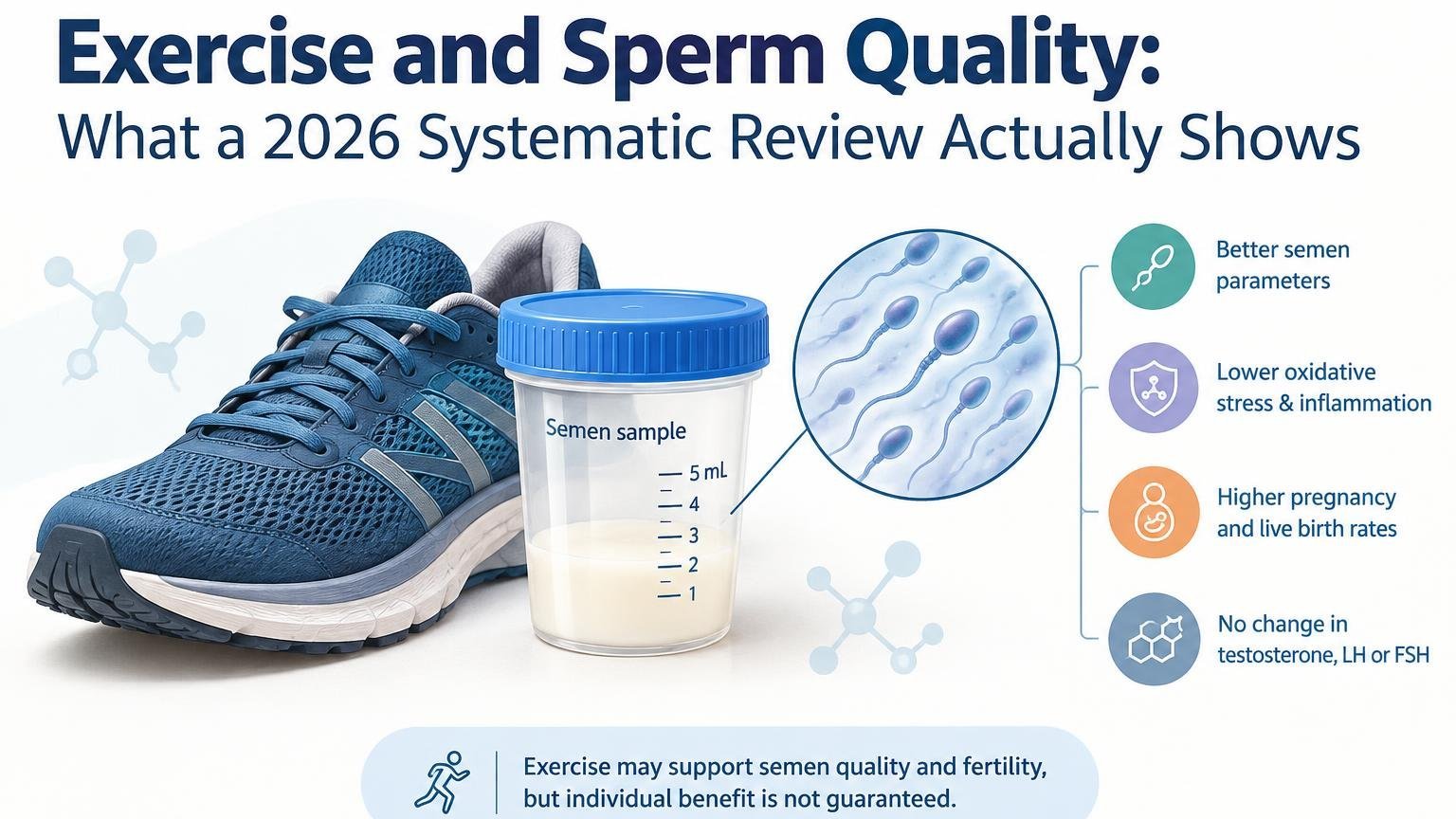
A systematic review and meta-analysis published in the Journal of Men's Health in July 2026 examined whether exercise interventions — aerobic, resistance and combined — improve male fertility indices. The authors reported that exercise was associated with improved ejaculate volume, sperm count, motility, morphology and sperm DNA integrity, higher seminal total antioxidant capacity, lower seminal reactive oxygen species, malondialdehyde and pro-inflammatory cytokines, and higher pregnancy and live birth rates than control. Testosterone, luteinizing hormone and follicle-stimulating hormone showed no considerable change.[1]
The authors' stated rationale was that existing reports on exercise and sperm quality are conflicting and that the precise influence on male fertility indices needed clarification. Their conclusion is deliberately hedged: they describe moderate aerobic exercise as a promising non-pharmacological strategy in male infertility management and call for more clinical trials to optimise exercise protocols. The available summary does not report how many trials or participants were pooled, nor effect sizes, confidence intervals or heterogeneity statistics — an important limitation for anyone trying to judge the size or reliability of the reported benefits.[2]
Why Exercise and Sperm Quality Remains Contested
Male fertility contributes to the quality of life of couples, and the review notes a reported declining trend in sperm quality alongside conflicting evidence about whether exercise counteracts it. That conflict is why the synthesis exists: when small studies disagree, a systematic review can weigh them together, but it cannot make the underlying trials larger, longer or better controlled than they were.
The review was prospectively registered on PROSPERO (CRD42024622166), which signals a pre-specified plan rather than guaranteeing the quality of the included evidence. The manuscript was submitted in December 2025, accepted in March 2026 and published in the July 2026 issue, so it should be read as a current synthesis rather than an older review being recirculated. A practical implication follows: the useful question is not simply whether exercise is good or bad for fertility, but which type, intensity and duration of activity produce benefit, and in whom.[3]
Readers who want a broader orientation on how activity characteristics have been studied in relation to semen quality may find a companion review of exercise type, intensity and infertility useful context. For interpreting laboratory results themselves, a guide to semen analysis interpretation against reference limits explains why a single parameter rarely settles a fertility question.
The Proposed Mechanism: Oxidative Stress and Inflammation
Sperm are unusually vulnerable to oxidative damage because their membranes are rich in polyunsaturated fatty acids and their cytoplasm carries limited antioxidant machinery. Semen normally contains antioxidants that keep reactive oxygen species within a useful signalling range, but a shift toward oxidants can damage sperm membranes and DNA. The review's proposed mechanism is that moderate aerobic exercise moves this balance favourably: in the pooled data, seminal total antioxidant capacity rose while reactive oxygen species, malondialdehyde — a commonly used marker of lipid peroxidation — and pro-inflammatory cytokines fell.
This is a mechanistic interpretation of aggregated data, not a demonstration of cause and effect in any individual. It is consistent with the parallel improvement in sperm DNA integrity, a biologically meaningful endpoint because sperm DNA damage has been linked in the wider literature to poorer assisted-conception outcomes. But the review does not establish that the oxidative changes caused the semen improvements — only that they moved together across the pooled studies.
What the Evidence Shows
The direction of effect was favourable across most fertility indices the authors examined, with a notable exception in the hormonal outcomes. The table below organises the reported findings by outcome domain; it reflects what the review reports, not a new analysis of individual participant data.
| Outcome domain | Reported direction of effect | Biological or clinical relevance |
|---|---|---|
| Ejaculate volume, sperm count, motility, morphology | Improved with exercise | A broad, multi-parameter shift rather than a single isolated change |
| Sperm DNA integrity | Improved with exercise | Biologically relevant endpoint for fertilisation and embryo development |
| Seminal oxidative stress markers | Higher total antioxidant capacity; lower reactive oxygen species and malondialdehyde | Supports the proposed antioxidant mechanism |
| Seminal inflammatory markers | Lower pro-inflammatory cytokines | Consistent with reduced inflammatory signalling in semen |
| Pregnancy and live birth rates | Higher in exercise groups than controls | The most patient-relevant outcome reported |
| Testosterone, LH, FSH | No considerable change | Benefits may not depend on raising gonadotropins or testosterone |
The hormone result deserves emphasis because it cuts against a common assumption. If exercise improved semen quality mainly by raising testosterone, the pooled data should have shown a hormonal signal. Instead, testosterone, LH and FSH were essentially unchanged while semen parameters and pregnancy rates moved favourably. That pattern is more consistent with a local, semen-level mechanism — oxidative and inflammatory balance — than with a purely endocrine one.
The variation by exercise type and duration is part of the result, not a footnote. The review reports that moderate aerobic exercise showed the beneficial effects, while the overall set of interventions included resistance and combined modalities. This implies that not all exercise prescriptions are interchangeable for reproductive purposes, and that duration matters.
Interpretation and Limitations
A systematic review and meta-analysis sits high in the evidence hierarchy when its inputs are strong, but its conclusions are only as good as the trials it pools. The available abstract-level text does not state how many trials or participants were included, nor does it report effect sizes, confidence intervals or heterogeneity statistics. Without those numbers, a reader cannot judge how precise the pooled estimates are, how much the included studies disagreed, or how large a change in semen parameters an individual might realistically expect. This gap is the single most important limitation when translating the findings into expectations.
Pregnancy and live birth outcomes are especially prone to confounding in this literature. Couples pursuing fertility care differ in age, cause of infertility, treatment use and co-interventions, and exercise groups may also differ in diet, weight change or general health engagement. The review reports higher rates in exercise groups, but the available summary does not supply absolute rates or the number of couples contributing to that comparison, so the practical size of any benefit is unknown. These are interpretive caveats about observational and heterogeneous trial data, not findings reported by the review itself.
Finally, the authors' own conclusion is cautious: they describe moderate aerobic exercise as promising and call for more clinical trials to optimise protocols. That wording matters. Promising is not the same as proven, and the call for protocol optimisation signals that the field has not settled on dose, frequency or duration. Null hormone findings should likewise not be over-interpreted, since they can reflect short study durations or varied exercise dosing across trials.
A separate study-level detail worth noting is how semen outcomes are reported in practice. Two samples from the same man can vary, and reference limits are guidance rather than a verdict, which is why a companion explainer on semen analysis reproducibility and a guide to WHO reference values can help readers place any single result in context.
Research Outlook
The most useful next steps follow directly from what this review could not deliver. Randomised trials with pre-specified exercise doses, adequate duration, blinded semen analysis and pregnancy outcomes as primary endpoints would clarify whether the pooled associations hold under controlled conditions. Future syntheses that report effect sizes and heterogeneity would also help clinicians translate findings into realistic expectations.
A second gap concerns populations. The review pooled men across varied fertility and health contexts but, in the available summary, does not stratify results by baseline semen quality, body composition or infertility diagnosis. Whether exercise helps most in men with oxidative-stress-related impairment, or whether benefits are broader, remains a question for stratified analyses rather than a settled answer.
For now, the reasonable summary is that regular moderate aerobic activity is associated with better semen parameters and a more favourable seminal oxidative and inflammatory profile, with no evident hormonal change across the pooled data. That is encouraging and consistent with the proposed mechanism, but it does not guarantee a reproductive benefit for any individual couple, and it should not displace proper fertility evaluation.
Key Takeaways
- A 2026 systematic review and meta-analysis reported that exercise improved ejaculate volume, sperm count, motility, morphology and sperm DNA integrity.
- Exercise raised seminal total antioxidant capacity and lowered reactive oxygen species, malondialdehyde and pro-inflammatory cytokines, supporting a proposed oxidative-stress and inflammation mechanism.
- Pregnancy and live birth rates were higher in exercise groups than controls, but absolute rates and contributing study numbers are not given in the available summary.
- Testosterone, LH and FSH did not change considerably, suggesting the reproductive signal may be local to the semen rather than endocrine.
- Moderate aerobic exercise was the pattern associated with benefit; effects varied by exercise type and duration, and the authors call for more clinical trials to optimise protocols.
Questions and Answers
How does exercise affect sperm quality according to the 2026 systematic review?
The review reported improvements in ejaculate volume, sperm count, motility, morphology and sperm DNA integrity after exercise interventions that included aerobic, resistance and combined modalities. It also described moderate aerobic exercise as the pattern showing benefit. These are pooled results across heterogeneous studies, and the available summary does not provide effect sizes or confidence intervals, so the size of any individual benefit remains uncertain.
What oxidative stress mechanism might link exercise to better semen parameters?
Sperm membranes are vulnerable to oxidative damage, and semen depends on a balance between reactive oxygen species and antioxidants. The review reported that exercise increased seminal total antioxidant capacity and reduced reactive oxygen species, malondialdehyde and pro-inflammatory cytokines. The authors propose this reduced oxidative and inflammatory burden as the route to better sperm quality. It is a mechanistic interpretation of pooled data, not proof of causation in individual men.
Did exercise change testosterone, LH or FSH in the 2026 meta-analysis of sperm quality?
No considerable effect was found on testosterone, luteinizing hormone or follicle-stimulating hormone. This is notable because it suggests the semen improvements were not simply driven by higher testosterone. However, a null hormone result can also reflect short study durations or varied exercise dosing across trials, and the available summary does not report the underlying estimates, so it should not be over-interpreted.
Does exercise improve pregnancy and live birth rates for couples?
The review reported that pregnancy and live birth rates were higher in exercise groups than in controls. This is the most patient-relevant outcome in the synthesis. But the available summary does not give absolute rates, denominators or how many studies contributed, and couples in exercise groups may differ in other health behaviours. The finding is encouraging but not a guarantee of conception for any individual couple.
How strong is the evidence that exercise improves male fertility?
A systematic review and meta-analysis is a strong design in principle, and this one was prospectively registered. But its strength depends on the included trials, and the available text does not report the number of studies or participants, effect sizes, confidence intervals or heterogeneity. The authors themselves call for more clinical trials to optimise exercise protocols, so the evidence is best described as promising rather than definitive.
What type and amount of exercise is linked to better sperm quality?
The review reports that effects varied by exercise type and duration, with moderate aerobic exercise showing the beneficial effects. It does not, in the available summary, specify an optimal frequency, session length or total weekly volume, and the authors call for further trials to optimise protocols. Men should therefore treat moderate aerobic activity as a general direction rather than a precise prescription.
Sources and References
- Roland Eghoghosoa Akhigbe; Blessing Monica Akindele; Cecilia Adedeji Adegbola; Ayoola Abimbola Oladipo; Olaoluwa Ayoade Afolabi; Precious Jesutofunmi Ashonibare; Deborah Tolulope Mosadomi; Victory Jesutoyosi Ashonibare; Adetomiwa Ezekiel Adetomiwa; Lois Bisola Osuntola; Feyikemi Funmilayo Araba; Tunmise Maryanne Akhigbe. Exercise improves sperm quality and pregnancy outcome by attenuating oxidative stress: a systematic review and meta-analysis. Journal of Men's Health. 2026 22(7):10-36 DOI: 10.22514/jomh.2026.056.
- Exercise improves sperm quality and pregnancy outcome by attenuating oxidative stress: a systematic review and meta-analysis – DOAJ.
- Roland Eghoghosoa Akhigbe; Blessing Monica Akindele; Cecilia Adedeji Adegbola; Ayoola Abimbola Oladipo; Olaoluwa Ayoade Afolabi; Precious Jesutofunmi Ashonibare; Deborah Tolulope Mosadomi; Victory Jesutoyosi Ashonibare; Adetomiwa Ezekiel Adetomiwa; Lois Bisola Osuntola; Feyikemi Funmilayo Araba; Tunmise Maryanne Akhigbe. Vol.22,Issue 7,July 2026. Journal of Men's Health. 2026 22(7) DOI: 10.22514/jomh.2026.056.
SANYUN Science Center explains published research on men's reproductive and sexual health, connecting scientific evidence with everyday questions while making sources and limitations clear.
Disclaimer: This article is for scientific education and research communication only. It does not provide medical advice, diagnosis, or individualized treatment recommendations, and does not endorse any medication, supplement, device, penile enlargement procedure, or other intervention. Decisions about sexual and reproductive health should be made in consultation with a qualified healthcare professional. Do not delay seeking professional care because of information in this article.
Original Content & Copyright Notice
- This article is prepared for SANYUN Science Center, drawing on published research and publicly available academic literature on men’s sexual and reproductive health. Its editorial explanations and presentation are developed for this platform.
- Copyright in the original editorial content, selection, and arrangement is reserved by SANYUN Science Center to the extent protected by applicable law. Referenced research, quotations, and third-party materials remain subject to the rights of their respective owners. This notice does not claim ownership of scientific facts or third-party research.
- Except where permitted by applicable law or an applicable license, prior written permission is required to reproduce, republish, translate, adapt, redistribute, or commercially reuse protected content. Attribution alone does not grant permission for such reuse.
- For permitted quotation or authorized reuse, clearly identify the source and retain a link to the original article.
- Source: SANYUN Science Center
- Original URL: Retain the original article URL on science.san-yun.com.
- Copyright Holder: SANYUN Science Center, for its own protected editorial content.
- Quotation, excerpts, or authorized reuse must not distort the scientific meaning, omit material limitations or disclaimers, or imply unverified medical claims, product efficacy, or endorsement by SANYUN Science Center.



