




Category: Penis Enlargement
Core Research Direction: Evidence base for penile size complaints and penis-enlargement surgery: what current EAU guideline communications say about the experimental status of girth/length enhancement procedures, the diagnostic importance of history and penile measurement, and the limits of the supporting evidence
Search Intent: How much reliable evidence supports surgical penis enlargement, and what do urology guidelines advise for men asking for longer or thicker penises?
Platform: SANYUN Science Center
Evidence reviewed through: 2026-11-20
Executive Summary
Men who ask for a longer or thicker penis are increasingly encountering a field in which surgical supply has outpaced surgical evidence. In an official European Association of Urology (EAU) podcast, panel members Paolo Capogrosso and Marco Falcone describe a new guideline chapter on penile abnormalities and penis dysmorphophobia — persistent distress about perceived penile size or appearance — and state plainly that most surgical procedures for penile girth or length enhancement are experimental and should be approached with caution, against a reported increase in surgery requests. The same discussion emphasises a full medical history and precise penile measurements, and states that the chapter's aim is to provide evidence-based treatment to patients with penile size complaints and to raise awareness of these conditions.[1]
This is a guideline-communication summary rather than a systematic review of enlargement surgery itself. The 2025 EAU sexual and reproductive health guideline summary reports an updated systematic review of research published 2021–2024 in Medline, EMBASE and Cochrane Libraries, and grades recommendation strength on benefit–harm trade-offs, evidence quality and patient values — but the abstract covers hypogonadism, erectile dysfunction, premature ejaculation and Peyronie's disease, not cosmetic size enhancement. The 2026 update discussion reports removal of ineffective treatments and new conservative options for penile curvature, again without enlargement efficacy data. The practical conclusion is narrow but important: demand is reported to be rising, evidence is described as lacking, and the core clinical response is careful assessment rather than a promised centimetre gain.[2][3]
Why This Matters
Penile size dissatisfaction is not a trivial cosmetic preference. The guideline discussion frames it partly as penis dysmorphophobia, which places perceived size and appearance within a distress-driven presentation rather than a purely anatomical one. That framing matters because the clinical question changes: the task is not simply to add length or girth, but to understand what is driving the request, whether the perception matches measured anatomy, and whether the man's concern is better addressed by information, psychological support or treatment of another condition.
The demand-side context is equally important. The EAU podcast describes an increase in surgery requests while stating that most girth or length enhancement procedures are experimental. When demand rises faster than evidence, commercial pressure can fill the gap with techniques, devices and claims that have not been tested in the way guideline panels require. For readers, the useful distinction is between a procedure being offered and a procedure being established.
The Diagnostic Core: History and Precise Measurement
The most concrete clinical recommendation in the source material is also the least technological: take a full medical history and conduct precise penile measurements. A full history can identify what the man has read, what he expects, whether his concern is lifelong or recent, whether it is linked to a partner's comment or to another sexual problem, and whether there are symptoms of conditions that affect penile appearance or function. None of these domains is quantified in the podcast, but the emphasis is consistent with how guideline panels approach unclear presentations: define the problem before treating it.
Precise measurement serves a similar gatekeeping role. It converts a subjective complaint into a documented observation, allows comparison with reference anatomy, and can reveal that perceived smallness does not match measured size. The source does not specify a measurement protocol, device, temperature, erection status or reference thresholds; those details belong to fuller guideline text and clinical training. What can be said from the packet is that measurement is treated as a core step, not an optional extra, and that a measurement performed casually or for marketing purposes should not be mistaken for a clinical assessment.
What the Evidence Shows — and What It Does Not
The strongest directly relevant statement in the packet is a classification: most surgical procedures for penile girth or length enhancement are experimental and should be approached with caution. In guideline language, experimental is not a synonym for impossible or forbidden. It signals that the procedure has not met the evidentiary bar for routine recommendation — typically because of limited comparative data, uncertain durability, inconsistent outcome measurement or unresolved safety questions. The source does not list which procedures fall inside or outside that description, nor does it provide complication rates, satisfaction rates or effect sizes.
It is important not to over-read the packet. The 2025 guideline summary documents a systematic review of new research from 2021–2024, but its scope is hypogonadism, erectile dysfunction, premature ejaculation and Peyronie's disease; the penile-size chapter is described in the podcast, not analysed in that abstract. The 2026 update discussion reports removal of ineffective treatments and limited high-quality evidence in some sexual-health areas, but again does not supply enlargement outcomes. The packet therefore supports a statement about how EAU communicators characterise the field, not a numerical estimate of how well any particular enlargement operation works.[4]
| Topic | What the EAU communication states | Interpretation and limits |
|---|---|---|
| Guideline scope for size concerns | A new chapter addresses penile abnormalities and penis dysmorphophobia. | Signals formal recognition of size-related distress; the packet does not reproduce the full recommendations. |
| Status of enhancement surgery | Most surgical procedures for penile girth or length enhancement are experimental and should be approached with caution. | A categorical expert-panel statement, not a procedure-by-procedure outcome analysis; no effect sizes or complication rates are supplied. |
| Initial clinical assessment | Full medical history and precise penile measurements are emphasised. | Supported as a recommended step; the packet gives no data on measurement accuracy or on how often measurement changes management. |
| Guideline evidence base | The 2025 summary reports an updated systematic review of research published 2021–2024 in Medline, EMBASE and Cochrane Libraries. | Applies to the hypogonadism, erectile dysfunction, premature ejaculation and Peyronie's disease sections; not a systematic review of cosmetic enlargement. |
| Recommendation grading | Strength reflects benefit–harm trade-offs, quality and reliability of evidence, and patient preferences and values. | Explains why expert caution can accompany weak evidence; it does not by itself prove harm or ineffectiveness. |
| 2026 update direction[5] | Removal of ineffective treatments and updated conservative management, including hyaluronic acid for Peyronie's disease. | Concerns penile curvature and other sexual-health sections; no penile-enlargement efficacy data are reported. |
How Guideline Panels Decide — and Why 'Experimental' Carries Weight
The 2025 EAU summary describes a transparent grading logic: recommendation strength reflects the balance of desirable and undesirable consequences, the quality and reliability of available evidence, and the diversity of patient preferences and values. This helps explain how a panel can be cautious without declaring a procedure useless. If evidence is sparse, harms are uncertain and patient values vary widely, a strong recommendation for routine use is difficult to justify. A cautious or experimental designation then protects patients from being sold certainty that the literature cannot supply.
The 2026 update discussion adds a related theme: the panel removes ineffective treatments and updates conservative management when evidence changes. Removal of ineffective treatments is a useful reminder that guideline bodies are willing to subtract as well as add. The same discussion, however, emphasises limited high-quality evidence in several areas, including testosterone therapy in prostate cancer survivors and treatment options for ejaculation disorders. That broader pattern of evidence scarcity supports caution about assuming that any offered enhancement technique has been rigorously validated, even though the packet does not quantify the enlargement literature.
Interpretation and Limitations
The central limitation is source type. The most direct statements about penile enlargement come from an EAU podcast description and discussion, not from a full guideline document with graded recommendations, and not from a systematic review of enlargement surgery. Podcast summaries are useful for orientation but cannot substitute for the underlying text. The reported increase in surgery requests is not quantified, the experimental classification is not broken down by procedure, and no comparative outcomes, complication rates or durability data are provided. Statements about the 2025 systematic review apply to the conditions listed in that abstract, not to cosmetic size enhancement.
A second limitation is the distinction between Peyronie's disease and size dissatisfaction. The 2025 guideline summary and the Italian commentary describe surgery for penile deformity that negatively affects sexual function, with prosthesis implantation for concomitant erectile dysfunction. That is reconstructive surgery for a defined condition, not cosmetic enlargement. A reader should not transfer favourable statements about Peyronie's surgery to girth or length enhancement, nor should the caution about experimental enhancement be read as a judgment on medically indicated deformity surgery.
Finally, the word experimental does not resolve the clinical conversation. It tells us that the evidence base is insufficient for routine recommendation; it does not tell an individual man what will happen to him. Decisions in this area require a proper assessment, a clear explanation of uncertainty, and attention to the distress that may be driving the request. The packet supports the importance of that assessment but does not provide a validated treatment algorithm for size dissatisfaction.
Research Outlook
The 2026 update discussion describes ongoing guideline work across sexual and reproductive health, including removal of ineffective treatments and revised conservative strategies. For penile size complaints, the logical next steps are the ones the current evidence base lacks: standardised measurement, clearly defined outcomes that include satisfaction and function as well as dimensions, adequate follow-up, and transparent reporting of complications. The packet does not state that such studies are underway for enlargement surgery specifically, so this is a reasonable research direction rather than a documented programme.
Until that evidence exists, the guideline communication offers a defensible position: take the complaint seriously, assess it properly, measure precisely, and be candid that most enhancement procedures remain experimental. That position respects both the man's concern and the limits of what medicine can currently promise.
Key Takeaways
- EAU guideline communicators describe most surgical procedures for penile girth or length enhancement as experimental and advise caution, against a reported increase in surgery requests.
- A new guideline chapter addresses penile abnormalities and penis dysmorphophobia, with the stated aim of providing evidence-based treatment for size complaints and raising awareness.
- Full medical history and precise penile measurement are emphasised as core assessment steps, not optional extras.
- The 2025 EAU systematic review covers hypogonadism, erectile dysfunction, premature ejaculation and Peyronie's disease; the packet does not provide an equivalent outcome review of cosmetic enlargement.
- Surgery for Peyronie's disease deformity is a separate clinical context and should not be conflated with cosmetic length or girth enhancement.
Questions and Answers
What do EAU guidelines say about penile enlargement surgery?
EAU guideline communicators state that most surgical procedures for penile girth or length enhancement are experimental and should be approached with caution, against a reported increase in surgery requests. They also describe a new chapter on penile abnormalities and penis dysmorphophobia aimed at evidence-based treatment and awareness. This is a guideline-communication summary, not a procedure-by-procedure outcome review, and no effect sizes are supplied.
Why is precise penile measurement important in men with size concerns?
The EAU discussion emphasises full history-taking and precise penile measurements as core assessment steps. Measurement converts a subjective complaint into a documented observation and can show whether perceived smallness matches measured anatomy. The packet does not specify a measurement protocol or reference thresholds, so measurement should be understood as a clinical starting point rather than a verdict, and casual marketing measurements are not equivalent.
How strong is the evidence that penile enhancement surgery works?
The packet does not provide a quantitative evidence grade for enlargement surgery. It reports that EAU panel members describe most girth or length enhancement procedures as experimental, and that guideline recommendation strength depends on benefit–harm trade-offs, evidence quality and patient values. Because the direct statements come from podcast summaries rather than a systematic review of enlargement outcomes, the appropriate conclusion is that evidence is described as lacking, not that a measured effect has been established or refuted.
Is surgery for Peyronie's disease the same as cosmetic penis enlargement?
No. The 2025 EAU guideline summary says surgery for Peyronie's disease should be offered when penile deformity negatively affects sexual function, with penile prosthesis implantation for concomitant erectile dysfunction. That is reconstructive surgery for a defined condition, not cosmetic length or girth enhancement. Findings about Peyronie's surgery should not be transferred to enlargement procedures, and the caution about experimental enhancement does not condemn medically indicated deformity surgery.
What are the limitations of the evidence discussed in this review?
The main limitations are source type and scope. The most direct enlargement statements come from EAU podcast descriptions, not the full graded guideline text or a systematic review of enlargement surgery. The increase in requests is not quantified, procedures are not individually classified, and no complication or durability data are given. The 2025 systematic review described in the packet covers hypogonadism, erectile dysfunction, premature ejaculation and Peyronie's disease, not cosmetic enlargement.
What should a man with penile size concerns expect from a clinical assessment?
Based on the EAU communication, he should expect a full medical history and precise penile measurement rather than an immediate surgical pitch. The history can clarify the nature and duration of the concern and any related symptoms, while measurement provides an objective reference point. The packet does not define a treatment pathway or guarantee any outcome, and it stresses caution about experimental enhancement procedures. Persistent distress may warrant discussion of psychological as well as anatomical factors.
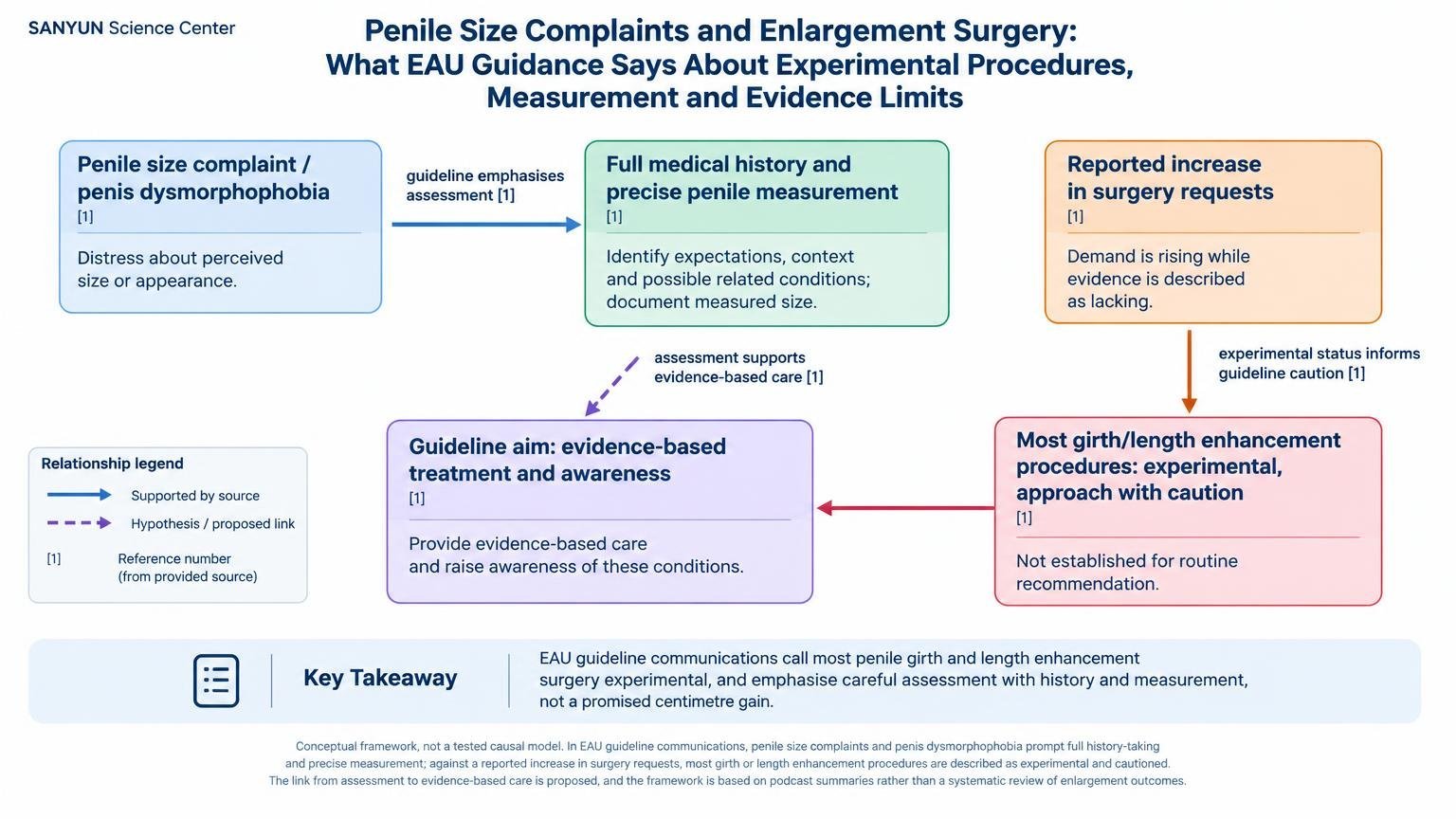
Conceptual framework: Conceptual framework, not a tested causal model. In EAU guideline communications, penile size complaints and penis dysmorphophobia prompt full history-taking and precise measurement; against a reported increase in surgery requests, most girth or length enhancement procedures are described as experimental and cautioned. The link from assessment to evidence-based care is proposed, and the framework is based on podcast summaries rather than a systematic review of enlargement outcomes.
Academic References & Evidence
- Paolo Capogrosso; Marco Falcone. Dr. Capogrosso and Dr. Falcone talk about new sexual and reproductive EAU Guidelines – EAU Podcast.
- Andrea Salonia; Paolo Capogrosso; Luca Boeri; Andrea Cocci; Giovanni Corona; Marij Dinkelman-Smit; Marco Falcone; Christian Fuglesang Jensen; Murat Gül; Arif Kalkanli; Ates Kadioğlu; Juan I Martinez-Salamanca; L Afonso Morgado; Giorgio I Russo; Ege Can Serefoğlu; Paolo Verze; Suks Minhas. European Association of Urology Guidelines on Male Sexual and Reproductive Health: 2025 Update on Male Hypogonadism, Erectile Dysfunction, Premature Ejaculation, and Peyronie's Disease. European Urology. 2025 88(1):76-102 DOI: 10.1016/j.eururo.2025.04.010.
- 2026 update on EAU Guidelines for Sexual & Reproductive Health – EAU Podcast.
- Salonia A; Capogrosso P; Boeri L; Cocci A; Corona G; Dinkelman-Smit M; Falcone M; Jensen CF; Gül M; Kalkanli A; Kadioğlu A; Martinez-Salamanca JI; Afonso Morgado L; Russo GI; Serefoğlu EC; Verze P; Minhas S. Disturbi sessuali e riproduttivi maschili: le linee guida dell'Associazione Europea di Urologia – Disturbi sessuali maschili – Alessandra Graziottin. Eur Urol. 2025 88(1):76-102 DOI: 10.1016/j.eururo.2025.04.010. PMID: 40340108.
- 2026 update on EAU Guidelines for Sexual & Reproductive Health.
SANYUN Science Center explains published research on men's reproductive and sexual health, connecting scientific evidence with everyday questions while making sources and limitations clear.
Disclaimer: This article is for scientific education and research communication only. It does not provide medical advice, diagnosis, or individualized treatment recommendations, and does not endorse any medication, supplement, device, penile enlargement procedure, or other intervention. Decisions about sexual and reproductive health should be made in consultation with a qualified healthcare professional. Do not delay seeking professional care because of information in this article.
Original Content & Copyright Notice
- This article is prepared for SANYUN Science Center, drawing on published research and publicly available academic literature on men’s sexual and reproductive health. Its editorial explanations and presentation are developed for this platform.
- Copyright in the original editorial content, selection, and arrangement is reserved by SANYUN Science Center to the extent protected by applicable law. Referenced research, quotations, and third-party materials remain subject to the rights of their respective owners. This notice does not claim ownership of scientific facts or third-party research.
- Except where permitted by applicable law or an applicable license, prior written permission is required to reproduce, republish, translate, adapt, redistribute, or commercially reuse protected content. Attribution alone does not grant permission for such reuse.
- For permitted quotation or authorized reuse, clearly identify the source and retain a link to the original article.
- Source: SANYUN Science Center
- Original URL: Retain the original article URL on science.san-yun.com.
- Copyright Holder: SANYUN Science Center, for its own protected editorial content.
- Quotation, excerpts, or authorized reuse must not distort the scientific meaning, omit material limitations or disclaimers, or imply unverified medical claims, product efficacy, or endorsement by SANYUN Science Center.



