




Category: Reproductive Care
Core Research Direction: Post-vasectomy semen analysis (PVSA) under the 2026 AUA Vasectomy Guideline: timing, success criteria for lab-based versus mail-in testing, and management of persistent sperm
Search Intent: After a vasectomy, when should semen testing be done, what result counts as success, and what happens if sperm are still present?
Platform: SANYUN Science Center
Evidence reviewed through: 2026-11-16
Executive Summary
A vasectomy is not confirmed successful by the procedure itself. The 2026 American Urological Association (AUA) vasectomy guideline keeps a simple core message: patients should provide at least one semen sample to confirm that the vas has sealed, and contraception should continue until that sample meets defined criteria.[1]
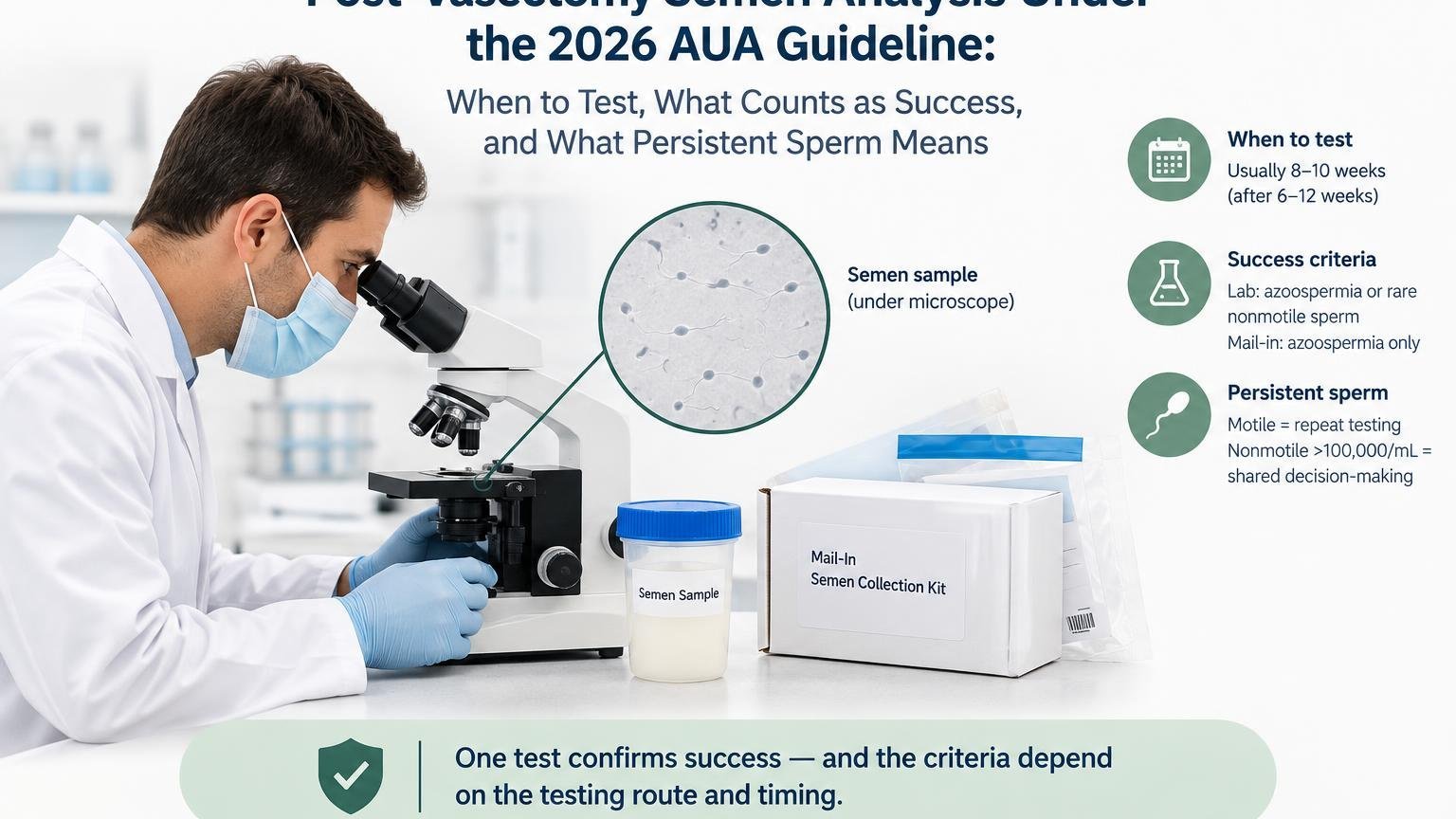
For standard laboratory testing, a fresh, uncentrifuged specimen examined in real time clears a man if it shows no sperm at all (azoospermia) or only rare nonmotile sperm. In that situation, a single analysis is enough and no repeat test is required. Any motile sperm, even one, counts as a failed test and calls for repeat analysis.[2]
Timing is a trade-off. Testing too early raises the chance of leftover sperm; testing too late means longer use of backup contraception. Eight to 10 weeks after the procedure is described as a practical window within a broader 6- to 12-week range, but the guideline does not mandate an exact date.
Mail-in and home-based tests are now an accepted option and may help men actually complete follow-up. Their pass mark is stricter, however: only azoospermia confirms success, and any sperm detected, motile or not, counts as a failed result.
Why This Matters
Vasectomy is intended as permanent contraception. The gap between the operation and a confirmed result is the period in which an unplanned pregnancy remains possible if contraception is dropped too soon. Post-vasectomy semen analysis (PVSA) is the checkpoint that closes this gap, which is why follow-up adherence matters as much as surgical technique.
The 2026 guideline represents a broad overhaul after roughly a decade of new evidence, and its authors identified changing PVSA practice, including the growth of mail-in testing, as one of two headline themes alongside patient counseling.
For patients, the practical question is narrow but important: when do I test, what result lets me stop using condoms or other contraception, and what if sperm are still there? For clinicians, the added question is whether a home kit's result can be trusted at the same threshold as a laboratory analysis.
How Clearance Is Judged: Laboratory Versus Mail-In Testing
The difference between laboratory and mail-in testing is not cosmetic. A laboratory can examine a fresh sample quickly, which allows it to detect whether any sperm are moving. Motility is the key marker: even a single motile sperm signals that the pathway is not fully occluded, so the man is not yet considered sterile.
Two processing details sit inside the laboratory standard. In an uncentrifuged sample evaluated within 2 hours of collection, contraception may be discontinued after complete azoospermia or no more than 100,000 rare nonmotile sperm per mL. If the sample is evaluated more than 2 hours after collection, complete azoospermia is needed before contraception is stopped.
Mail-in kits cannot reliably preserve and assess motility in the same way, so the guideline commentary treats any detected sperm as failure. That is a conservative rule built around assay limits, not evidence that mail-in testing is dangerous. It does mean a mail-in result showing a small number of nonmotile sperm does not clear a man, even though an equivalent laboratory result might.
| Testing route | Clearance standard | Repeat testing |
|---|---|---|
| Standard laboratory PVSA | Azoospermia or only rare nonmotile sperm on a fresh, uncentrifuged sample examined in real time | Not required once this standard is met; one analysis suffices |
| Laboratory sample evaluated within 2 hours | Complete azoospermia or ≤100,000 rare nonmotile sperm per mL | Depends on whether the standard is met |
| Laboratory sample evaluated after more than 2 hours | Complete azoospermia required to stop contraception | Depends on whether azoospermia is confirmed |
| Mail-in or home-based PVSA | Azoospermia only; any sperm, motile or nonmotile, is a failed result | Failed results require further evaluation and repeat testing |
| Any motile sperm on laboratory PVSA | Failed or positive result | Repeat analysis until azoospermia or rare nonmotile sperm is achieved |
Timing: Why 8 to 10 Weeks Is a Practical Target, Not a Rule
After vasectomy, sperm already stored beyond the sealed segment must be cleared through ejaculation, and the tract must heal. Testing very early therefore risks finding residual sperm that would have disappeared. Testing very late extends the period of alternative contraception for no added safety benefit.
The guideline permits PVSA as early as 8 weeks after the procedure, and many clinicians aim for about 8 to 10 weeks to balance accuracy against convenience. The broader range discussed runs from 6 to 12 weeks, but no precise window is mandated.
This is a practice pattern rather than a laboratory law. A man whose test is scheduled slightly outside the 8- to 10-week window has not automatically received a meaningless result; the timing question is best settled with the treating clinician, who can weigh how the sample was handled and when it was examined.
When Sperm Persist: Motile Versus Nonmotile Findings
Persistent motile sperm is the more serious scenario. Repeat testing is required, and if motile sperm are still present at 6 months, clinicians should counsel the patient about repeat vasectomy. At that point, with the recommended pre-sample ejaculation completed, any motile sperm, whether rare or not, suggests the man is not sterile and the risk of unintended pregnancy is not trivial.
Persistent nonmotile sperm above 100,000 per mL is handled differently. Here the guideline calls for shared decision-making rather than a single mandated step, with options including repeat vasectomy, continued contraception, or further semen evaluations.
That difference reflects biology as much as policy. Motile sperm can travel; nonmotile sperm at low concentration in a properly handled sample are much less likely to indicate a patent pathway, which is why the laboratory standard tolerates a small number of rare nonmotile sperm in the first place.
What Else the 2026 Guideline Changes
The update is broader than PVSA. It strongly recommends combining mucosal cautery with fascial interposition, and it discourages ligation and excision of a short vas segment alone because of higher failure rates.
Several routine practices are no longer expected. Histologic evaluation of excised vas segments is not required because it does not change clinical outcomes, and routine antibiotic prophylaxis is not recommended for uncomplicated vasectomy, though it may be considered in selected higher-risk patients.
The guideline also addresses long-term safety concerns that patients often raise. No causal association has been established between vasectomy and prostate cancer, high-grade prostate cancer, prostate cancer mortality, cardiovascular disease, or kidney stones, and counseling should make clear that later health problems reflect baseline risk factors rather than the procedure.
On reversibility, the message is deliberately cautious. Fertility restoration is possible but not guaranteed, through vasectomy reversal or sperm retrieval with intracytoplasmic sperm injection. The strongest preoperative predictors of reversal success are the duration of the obstructive interval, patient age, and female partner age, and surgeons offering reversal should have microsurgical expertise in both vasovasostomy and vasoepididymostomy.
Limitations and How to Read This Evidence
This explainer rests on two 2026 Urology Times sources: a guideline FAQ feature and an expert video commentary by a guideline vice chair. Neither is a primary study, and neither reports its own outcome data. Statements about success criteria and timing are therefore guideline-level recommendations and expert interpretation, not new experimental findings.
Some claims are stated without supporting quantities. The suggestion that mail-in testing may improve adherence is not accompanied by a numerical estimate, and the magnitude of pregnancy risk with persistent motile sperm is described qualitatively rather than measured. Complication frequencies for bleeding, infection, epididymitis, and chronic scrotal pain are also not provided.
The 100,000 per mL threshold and the 2-hour processing boundary are criteria from summarized guidance. They depend on how a sample is collected, transported, and examined, so they should not be applied loosely to a result whose handling is unknown. A test result is only as meaningful as the conditions under which it was produced.
Research Outlook
The open questions are practical rather than theoretical. How much do mail-in kits actually improve completion of follow-up compared with laboratory testing? Which testing interval minimizes both residual-sperm false alarms and prolonged contraception? And how should persistent nonmotile sperm be managed when patients and clinicians weigh repeat procedures against continued contraception?
Because the current guidance leans on expert consensus in places, future studies that compare testing strategies head-to-head would sharpen the advice. Until then, the safest reading is that one properly handled test can confirm success, but only within the route-specific criteria and timing that generated the result.
Key Takeaways
- At least one semen sample is needed to confirm vasectomy success, and contraception should continue until the result meets the relevant criteria.
- A standard laboratory sample showing azoospermia or only rare nonmotile sperm clears a man after a single analysis; any motile sperm means a failed test and repeat testing.
- Testing at 8 to 10 weeks is a practical target within a broader 6- to 12-week range, but the guideline does not mandate an exact window.
- Mail-in tests must show azoospermia to count as success; any sperm, motile or nonmotile, is treated as failure because of assay limitations.
- Motile sperm at 6 months warrants discussion of repeat vasectomy, while persistent nonmotile sperm above 100,000 per mL calls for shared decision-making.
Questions and Answers
What is post-vasectomy semen analysis and why is it needed?
Post-vasectomy semen analysis is a laboratory or mail-in check of semen after the vas deferens has been sealed. It confirms that the pathway is occluded before a man stops using other contraception. The 2026 AUA guideline says patients should provide at least one sample, because the procedure alone does not prove success.
When should semen be tested after a vasectomy according to the 2026 AUA guideline?
The guideline allows testing as early as 8 weeks, and many clinicians aim for about 8 to 10 weeks to balance accuracy against convenience. A broader 6- to 12-week range is discussed, but no exact window is mandated. Earlier testing is more likely to find residual sperm; later testing means longer use of backup contraception.
What sperm result counts as a successful vasectomy on a standard laboratory test?
On a fresh, uncentrifuged sample examined in real time, a man is cleared if there is complete azoospermia or only rare nonmotile sperm. In that case one analysis is enough and no repeat test is required. Any motile sperm, even a single one, is a failed result and requires repeat testing.
Why do mail-in semen tests after vasectomy have stricter success criteria?
Mail-in tests are accepted and may improve follow-up completion, but they cannot assess a fresh sample the same way a laboratory can. For that reason only azoospermia confirms success, and any sperm detected, motile or nonmotile, is considered a failed result. The rule reflects assay limitations rather than a judgment that home testing is unsafe.
What happens if motile sperm are still present six months after a vasectomy?
Persistent motile sperm requires repeat testing, and at 6 months, assuming the recommended ejaculation before sampling was followed, clinicians should discuss repeat vasectomy. Any motile sperm at that point suggests the man is not sterile and that pregnancy risk is not insignificant. The exact size of that risk is not quantified in the available guidance commentary.
How are persistent nonmotile sperm above 100,000 per mL managed after vasectomy?
The guideline calls for shared decision-making rather than a single fixed step. Options include repeat vasectomy, continued contraception, or additional semen evaluations. This differs from the motile-sperm pathway, where repeat vasectomy discussion is more clearly indicated at 6 months. The threshold comes from summarized guidance and depends on proper sample handling.
Sources and References
- Akanksha Mehta. 2026 AUA Vasectomy Guideline: Key updates and clinical FAQs | Urology Times. 2026
- Akanksha Mehta. When should post-vasectomy semen analysis be performed? | Urology Times. 2026
SANYUN Science Center explains published research on men's reproductive and sexual health, connecting scientific evidence with everyday questions while making sources and limitations clear.
Disclaimer: This article is for scientific education and research communication only. It does not provide medical advice, diagnosis, or individualized treatment recommendations, and does not endorse any medication, supplement, device, penile enlargement procedure, or other intervention. Decisions about sexual and reproductive health should be made in consultation with a qualified healthcare professional. Do not delay seeking professional care because of information in this article.
Original Content & Copyright Notice
- This article is prepared for SANYUN Science Center, drawing on published research and publicly available academic literature on men’s sexual and reproductive health. Its editorial explanations and presentation are developed for this platform.
- Copyright in the original editorial content, selection, and arrangement is reserved by SANYUN Science Center to the extent protected by applicable law. Referenced research, quotations, and third-party materials remain subject to the rights of their respective owners. This notice does not claim ownership of scientific facts or third-party research.
- Except where permitted by applicable law or an applicable license, prior written permission is required to reproduce, republish, translate, adapt, redistribute, or commercially reuse protected content. Attribution alone does not grant permission for such reuse.
- For permitted quotation or authorized reuse, clearly identify the source and retain a link to the original article.
- Source: SANYUN Science Center
- Original URL: Retain the original article URL on science.san-yun.com.
- Copyright Holder: SANYUN Science Center, for its own protected editorial content.
- Quotation, excerpts, or authorized reuse must not distort the scientific meaning, omit material limitations or disclaimers, or imply unverified medical claims, product efficacy, or endorsement by SANYUN Science Center.



