




Category: Premature Ejaculation
Core Research Direction: Premature ejaculation: temporal stability of symptoms, the causal role of anxiety/depression, and comparative evidence on psychobehavioral and physiotherapeutic versus pharmacological treatment
Search Intent: How stable are premature ejaculation symptoms over time, do anxiety and depression cause them, and how does non-pharmacological treatment (psychobehavioral or physiotherapy) compare with SSRIs such as dapoxetine?
Platform: SANYUN Science Center
Evidence reviewed through: 2026-11-24
Executive Summary
Premature ejaculation (PE) is usually framed as a stable, lifelong or acquired pattern of ejaculating before, on, or shortly after penetration, with personal or interpersonal distress. Prevalence figures diverge sharply depending on how PE is defined. About 25% of men in one population sample report ejaculating before they wish to, whereas roughly 4% are estimated to meet current diagnostic criteria; a separate narrative review puts the figure at up to 30% of sexually active men. The gap reflects the difference between a common experience and a diagnosed disorder.[1][2]
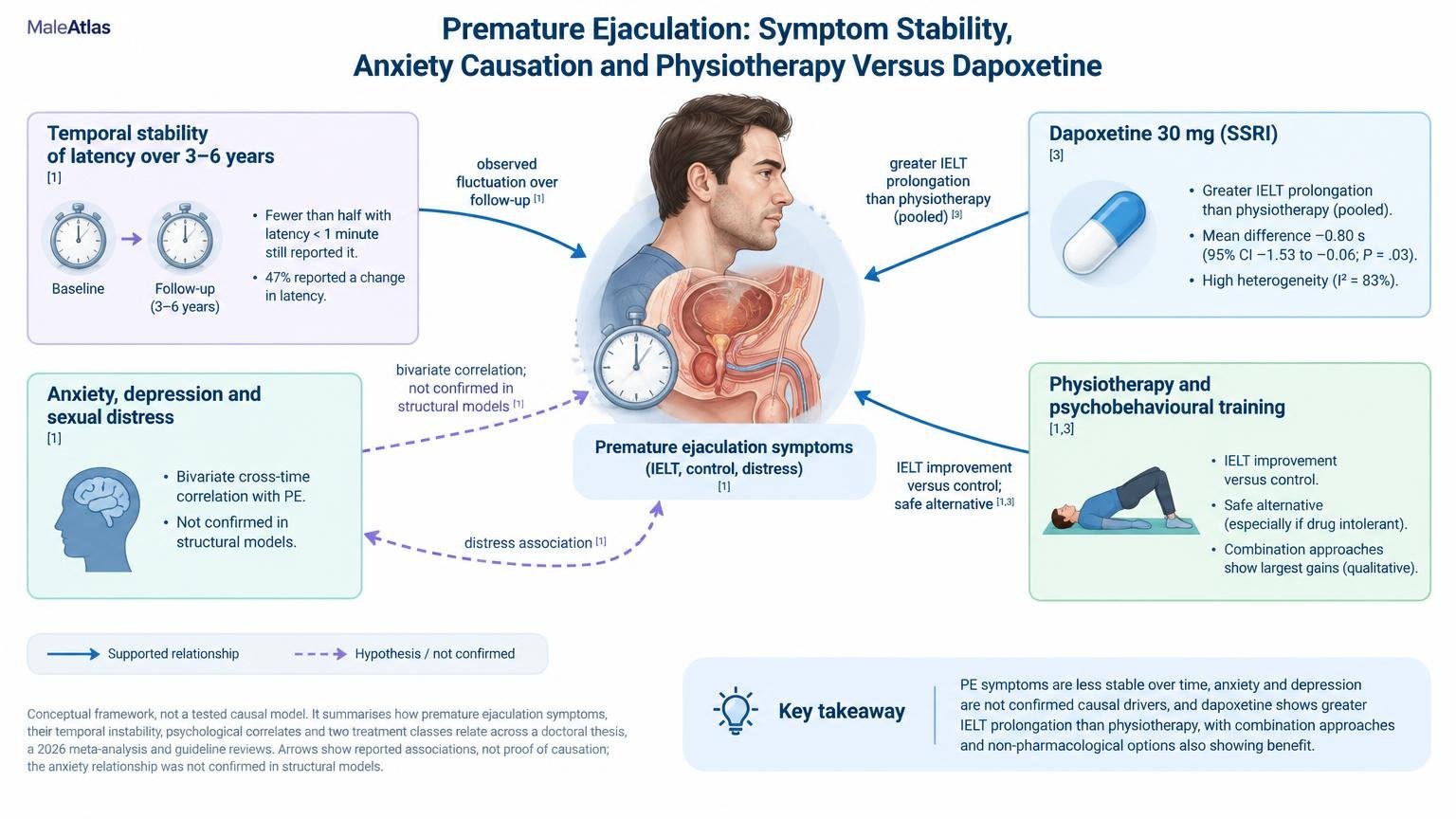
Two strands of newer evidence complicate the older clinical picture. First, longitudinal data suggest PE symptoms are less fixed than once assumed: among men reporting latency under 1 minute at baseline, fewer than half still did six years later, and 47% reported a change in latency between measurement points. Second, longitudinal models in the same programme did not confirm that anxiety, depression or sexual distress drive PE over time, even though cross-sectional correlations exist.
For treatment, a 2026 systematic review with meta-analysis of six trials (416 participants in the pooled analysis) found dapoxetine 30 mg more effective than physiotherapy at prolonging intravaginal ejaculatory latency time (IELT), with a pooled mean difference of −0.80 s (95% CI −1.53 to −0.06; P=.03) and high heterogeneity (I2=83%). The same review positioned physiotherapy as a safe alternative and suggested combined approaches produced the largest gains in qualitative synthesis, while guideline bodies have revised non-pharmacological recommendations to acknowledge that some such therapies may be effective.[3][4]
Why This Matters
PE is described in one narrative review as the most common male sexual dysfunction, and it is associated with anxiety, low self-esteem, sexual distress, relationship difficulties and reduced quality of life. Because it is a taboo subject for many men, it is often unreported, which makes accurate epidemiology and clear thresholds especially important for clinicians and patients deciding whether a problem warrants assessment.
The practical stakes are high because the two dominant assumptions—that latency is a stable trait and that anxiety is a primary cause—shape treatment. If symptoms fluctuate, a single snapshot may misdiagnose or overtreat. If anxiety is largely a correlate rather than a driver, then anxiety-focused therapy may not be the right first target for most men. Conversely, if pharmacological treatment works but is abandoned at high rates, then tolerability and combined strategies deserve more attention.
Definitions, Measurement and the Instability Problem
PE definitions require a short ejaculatory latency, reduced control, and distress. IELT—time from vaginal intromission to ejaculation—is the standard research measure. Diagnostic latency cutoffs vary: lifelong PE is often defined by IELT under 1 minute, acquired PE by clinically significant reduction, often to about 3 minutes or less, and the ISSM framework separates lifelong from acquired forms. This definitional variability is itself a barrier to comparing studies and to standardising diagnosis.
The longitudinal evidence challenges the idea that latency is a fixed trait. In a population-based sample followed six years, fewer than half of men with baseline latency under 1 minute still reported it at follow-up, and 47% reported a change in latency between measurements. In a small clinical sample of 16 previously diagnosed, untreated men followed three years, only 5 reported latency under 1 minute at both time points, and 63% reported a change.
| Variable | Definition or source detail | Interpretation |
|---|---|---|
| IELT / ELT | Time from vaginal intromission to ejaculation, or self-reported ejaculation latency; standard research outcome | Definitional cutoffs vary (1 minute for lifelong PE; often 3 minutes or less for acquired PE, per the cited review) |
| Temporal stability (population sample) | Fewer than half with latency under 1 minute at baseline still reported it at six years; 47% reported change | Symptoms fluctuate; single measurement risks misclassification |
| Temporal stability (clinical sample) | 5 of 16 untreated diagnosed men had latency under 1 minute at both time points; 63% reported change over three years | Even diagnosed PE may remit or fluctuate without treatment, though the sample is very small |
| Anxiety/depression as predictors | Small-to-moderate bivariate cross-time correlations; structural equation models found no cross-time associations | Correlation does not confirm causation; model specification matters |
| Physical exercise | Most consistent finding: negative association between PE and exercise across population and clinical samples | Small effect size; cross-sectional design cannot establish direction |
| Physiotherapy vs dapoxetine 30 mg | Pooled mean IELT difference −0.80 s (95% CI −1.53 to −0.06; P=.03), I2=83% | Statistically favourable to dapoxetine, but high heterogeneity limits certainty |
| SSRI discontinuation | 70.6% to 89.6% after the first year of treatment | Efficacy and real-world persistence are different questions |
These data come from a doctoral thesis with two longitudinal samples; the abstracts do not report full sample sizes, and the clinical sample is very small. The findings should therefore be read as a signal that PE latency is more variable than older fixed-trait models suggest, not as a definitive estimate of remission rates. The thesis author proposed widening the diagnostic latency criterion to roughly 2–4 minutes to reduce false negatives while retaining distress and control criteria—an interpretive proposal, not a validated cutoff.
Do Anxiety and Depression Cause Premature Ejaculation?
The causal question is clinically important because many treatment pathways assume anxiety drives PE. In the six-year population-based cohort, bivariate analyses found small-to-moderate cross-time correlations: PE correlated with future anxiety, and depression correlated with future PE, while PE and sexual distress correlated reciprocally across time. However, when structural equation models were fitted, no cross-time associations remained between PE and the other variables.
That contrast is a useful lesson in study design. Bivariate correlations ignore shared variance and confounding; a structural model adjusts, at least partly, for the overlap among anxiety, depression and distress. The absence of modelled cross-time effects does not prove that anxiety is irrelevant—measurement error, self-report, and the possibility that effects operate at shorter or longer intervals all matter. But it does weaken the claim that anxiety and depression are major etiological factors in most cases, which the author explicitly concludes.
Other reviews reach different emphases. A 2026 narrative review describes acquired PE as multifactorial, with sympathetic nervous system overactivity and impaired excitation/inhibition balance proposed as a common mechanism, and reports an association between PE and poor mental health. That is a hypothesis-generating synthesis, not causal evidence. A shared underlying factor could generate anxiety, depression and PE together; or distress could follow PE without causing it. The honest reading is that anxiety and depression frequently co-occur with PE and deserve attention, but the longitudinal data do not establish them as principal causes.
The environment also matters: evidence on lifestyle factors found the most consistent association was a negative relationship between PE and physical exercise, robust across population and clinical comparisons in multivariate analyses, though with a small effect size and cross-sectional design. Whether exercise genuinely improves PE requires trials; the thesis author flagged it as a promising candidate for further investigation rather than a treatment recommendation.
What the Evidence Shows on Treatment
The dominant first-line treatment is pharmacological: selective serotonin reuptake inhibitors (SSRIs), sometimes combined with sexological therapy. Dapoxetine, a short-acting SSRI approved in Europe but not the United States, is the most used agent developed for PE and is typically taken 1–3 hours before sexual activity at 30 mg, sometimes 60 mg. SSRIs reliably extend IELT and can improve perceived control and satisfaction, but their real-world value is limited by adverse effects such as nausea and dizziness and by discontinuation rates of 70.6% to 89.6% after the first year.[5]
The 2026 systematic review and meta-analysis asked whether physiotherapy could rival dapoxetine. Six trials with 416 participants in the pooled analysis met inclusion criteria; the individual studies ranged from 18 to 120 participants, the total sample reported in the descriptive table was 466 men, and mean age was 43.35 years (range over 18 to under 58), with an average treatment duration of about 2.5 months. Physiotherapy modalities included pelvic floor muscle strengthening, biofeedback, electrostimulation, acupuncture and yoga-based exercise.
The pooled result favoured dapoxetine 30 mg over physiotherapy: mean difference in IELT −0.80 s (95% CI −1.53 to −0.06; P=.03), with high heterogeneity (I2=83%). The review calls this a large effect under Cohen's criteria in one passage, but the absolute difference of less than a second in pooled units must be interpreted cautiously, particularly when studies measure IELT differently and heterogeneity is substantial. Statistical significance is not the same as a large clinical difference. The review itself cautions that the scarcity and heterogeneity of the trials prevent a definitive conclusion.
The qualitative synthesis is arguably more instructive than the pooled average. Across individual trials, physiotherapy produced meaningful IELT gains without drug side effects, and combination approaches appeared to produce the largest improvements. The review explicitly suggests that a combined therapeutic approach yields the most significant IELT improvements, and positions physiotherapy as a safe, beneficial option for patients intolerant to pharmacological treatment.
The psychobehavioural literature points in a similar direction. In a randomised trial of 50 PE patients assigned to vibrator-assisted start-stop exercises, that regimen plus psychoeducation and physiological-cue training, or a waiting-list control, both active groups improved with large effect sizes versus control and did not differ on the PE outcome. However, the augmented group also improved on most secondary outcomes, including anxiety and sexual distress, suggesting additional psychoeducation added value beyond latency alone.
Guideline positions are shifting accordingly. The 2027 AUA/SMSNA amendment, based on literature searched from January 2020 to December 2024, revised its statement on non-pharmacological therapies to reflect evidence that some may be effective. It also added statements on phosphodiesterase-5 inhibitors, and on daily or on-demand clomipramine and glans hyaluronic acid injection, with explicit caveats that the latter two require informed consent and a trained clinician. The panel underscores shared decision-making as the fundamental principle. The 5th ICSM consensus likewise synthesises evidence across definitions, evaluation and management.
Interpretation and Limitations
The evidence base has important constraints. The longitudinal work comes from a doctoral thesis; abstracts omit full sample sizes, and the clinical sample is only 16 men. The thesis is a collection of articles rather than a single primary study, and its conclusions about causality and diagnostic thresholds are interpretive. The meta-analysis pools small trials with high heterogeneity, and several trials could not be fully pooled because of missing standard deviations or inconsistent measurement.
Methodological quality in the physiotherapy review was mixed: three studies were rated high, one medium and two low on the PEDro scale, with blinding items scoring lowest—an inherent problem for exercise and acupuncture trials. The review reports a total of 466 men in descriptive tables but 416 in the pooled analysis, reflecting different analytic subsets; this should not be read as a contradiction but it does signal how thin the comparative evidence is.
There are also definitional inconsistencies. The review's introduction describes the ISSM definition and lifelong versus acquired PE, but the meta-analysis focuses on lifelong PE, so findings may not transfer to acquired PE, which is more often associated with psychological, physical or comorbid sexual factors. Prevalence estimates vary from roughly 4% meeting diagnostic criteria to up to 30% of sexually active men reporting PE, depending on definition and setting.
- Statistical significance in the pooled IELT difference should not be equated with a clinically large effect, especially with I2=83%.
- The absence of modelled cross-time anxiety effects does not disprove short-term or indirect influences; it mainly undercuts a strong causal claim.
- Physiotherapy trials are difficult to blind, so effect sizes may be inflated by expectancy; the review acknowledges this limitation.
Research Outlook
Several questions remain open. Larger longitudinal cohorts with repeated latency measurement and structured diagnostic interviews would clarify how often PE remits, persists or fluctuates, and whether the proposed 2–4 minute threshold improves classification without inflating diagnoses. Trials that test anxiety-focused and depression-focused interventions specifically in men whose PE co-occurs with mood symptoms would help determine whether treating mood improves ejaculatory outcomes or only distress.
On treatment, the most promising signal is combination: physiotherapy or psychobehavioural training plus pharmacotherapy, with outcomes beyond IELT such as control, distress, partner satisfaction and adherence. Given SSRI discontinuation of 70.6% to 89.6% in the first year, trials designed around tolerability and long-term persistence are as important as short-term latency gains. The revised guideline position on non-pharmacological therapies and the cautious new statements on clomipramine and glans hyaluronic acid injection should be tested in adequately powered studies before they become routine.
Physical exercise also deserves prospective evaluation: the negative association with PE was robust across samples but small and cross-sectional, so it remains a hypothesis rather than a prescription.
Key Takeaways
- PE symptoms are less stable over time than older fixed-trait models imply: fewer than half of men with latency under 1 minute at baseline still reported it six years later in one population cohort.
- Anxiety, depression and sexual distress correlate with PE across time, but structural models found no cross-time associations, weakening claims that they are major causes.
- Dapoxetine 30 mg outperformed physiotherapy for IELT in a 2026 meta-analysis (−0.80 s pooled mean difference), but heterogeneity was high and the clinical magnitude is uncertain.
- Physiotherapy is positioned as a safe alternative and combination therapy appears most promising in qualitative synthesis, consistent with guideline revisions acknowledging some non-pharmacological therapies may work.
- High first-year SSRI discontinuation (70.6% to 89.6%) makes tolerability and shared decision-making central to real-world care.
Questions and Answers
How stable are premature ejaculation symptoms over time?
Less stable than older models assumed. In a population sample followed six years, fewer than half of men reporting ejaculation latency under 1 minute at baseline still did so at follow-up, and 47% reported a change. In a small untreated clinical sample of 16 men, only 5 had latency under 1 minute at both time points over three years.
Do anxiety and depression cause premature ejaculation?
Not clearly. Bivariate analyses in a six-year cohort showed small-to-moderate cross-time correlations between PE and future anxiety, and between depression and future PE. But structural equation models found no cross-time associations, so the data do not establish anxiety or depression as major causes, though they often co-occur and still deserve clinical attention.
Is physiotherapy or dapoxetine more effective for premature ejaculation?
A 2026 meta-analysis of six trials found dapoxetine 30 mg more effective for prolonging IELT, with a pooled mean difference of −0.80 s (95% CI −1.53 to −0.06; P=.03) favouring the drug. Heterogeneity was high (I2=83%), trials were small, and physiotherapy remained a safe option, with combined approaches appearing most promising qualitatively.
What does the 2027 AUA/SMSNA guideline say about non-drug treatment for premature ejaculation?
The amendment revised its statement on non-pharmacological therapies to reflect new evidence that some may be effective. It also added cautious statements on PDE5 inhibitors, clomipramine, and glans hyaluronic acid injection, emphasising informed consent and shared decision-making across all treatment choices.
Why do men stop SSRI treatment for premature ejaculation?
A review reports discontinuation rates of 70.6% to 89.6% after the first year of SSRI treatment, driven by adverse effects such as nausea and dizziness, low perceived efficacy, cost, loss of sexual interest, and discomfort with daily medication. These figures come from cited literature rather than pooled trial data, but they highlight tolerability as a central practical issue.
How strong is the evidence that exercise helps premature ejaculation?
The most consistent lifestyle finding in the thesis was a negative association between PE and physical exercise, observed across population and clinical samples and in multivariate analyses. However, the effect size was small and the design was cross-sectional, so exercise is a hypothesis for prospective trials rather than a confirmed treatment.
Conceptual framework: Conceptual framework, not a tested causal model. It summarises how premature ejaculation symptoms, their temporal instability, psychological correlates, and two treatment classes relate across a doctoral thesis, a 2026 meta-analysis and guideline reviews. Arrows show reported associations, not proof of causation; the anxiety relationship was not confirmed in structural models.
Academic References & Evidence
- Diagnosis, etiology, and psychobehavioral treatment of premature ejaculation. 2019
- Kamil Czerwiak. The impact of psychological factors on ejaculation disorders (premature ejaculation). 2026 104(3):215-221
- Esther M Medrano-Sánchez; Ana López-del-Castillo; Maud Boisseau; Juan C Fernández-Domínguez; Esther Díaz-Mohedo. Effectiveness of physiotherapy in male premature… : The Journal of Sexual Medicine. The Journal of Sexual Medicine. 2026 23(5) DOI: 10.1093/jsxmed/qdag096.
- Disorders of Ejaculation: AUA/SMSNA Guideline (2027) | Journal of Urology. Journal of Urology. 2027 DOI: 10.1097/JU.0000000000005378.
- Contemporary consensus and emerging directions in premature and delayed ejaculation: recommendations from the 5th International Consultation on Sexual Medicine.. Sexual medicine reviews PMID: 42855438.
SANYUN Science Center explains published research on men's reproductive and sexual health, connecting scientific evidence with everyday questions while making sources and limitations clear.
Disclaimer: This article is for scientific education and research communication only. It does not provide medical advice, diagnosis, or individualized treatment recommendations, and does not endorse any medication, supplement, device, penile enlargement procedure, or other intervention. Decisions about sexual and reproductive health should be made in consultation with a qualified healthcare professional. Do not delay seeking professional care because of information in this article.
Original Content & Copyright Notice
- This article is prepared for SANYUN Science Center, drawing on published research and publicly available academic literature on men’s sexual and reproductive health. Its editorial explanations and presentation are developed for this platform.
- Copyright in the original editorial content, selection, and arrangement is reserved by SANYUN Science Center to the extent protected by applicable law. Referenced research, quotations, and third-party materials remain subject to the rights of their respective owners. This notice does not claim ownership of scientific facts or third-party research.
- Except where permitted by applicable law or an applicable license, prior written permission is required to reproduce, republish, translate, adapt, redistribute, or commercially reuse protected content. Attribution alone does not grant permission for such reuse.
- For permitted quotation or authorized reuse, clearly identify the source and retain a link to the original article.
- Source: SANYUN Science Center
- Original URL: Retain the original article URL on science.san-yun.com.
- Copyright Holder: SANYUN Science Center, for its own protected editorial content.
- Quotation, excerpts, or authorized reuse must not distort the scientific meaning, omit material limitations or disclaimers, or imply unverified medical claims, product efficacy, or endorsement by SANYUN Science Center.



