




Category: Erectile Dysfunction
Core Research Direction: An umbrella-review synthesis of the current evidence base for pharmacological and nonpharmacological treatments of erectile dysfunction, with explicit attention to the low certainty of that evidence and to the cardiovascular, hormonal, medication-related and sleep-apnea contexts in which ED presents.
Search Intent: How reliable is the evidence supporting current erectile dysfunction treatments, and what does that evidence landscape mean for how ED should be investigated and discussed with patients?
Platform: SANYUN Science Center
Evidence reviewed through: 2026-11-15
Executive Summary
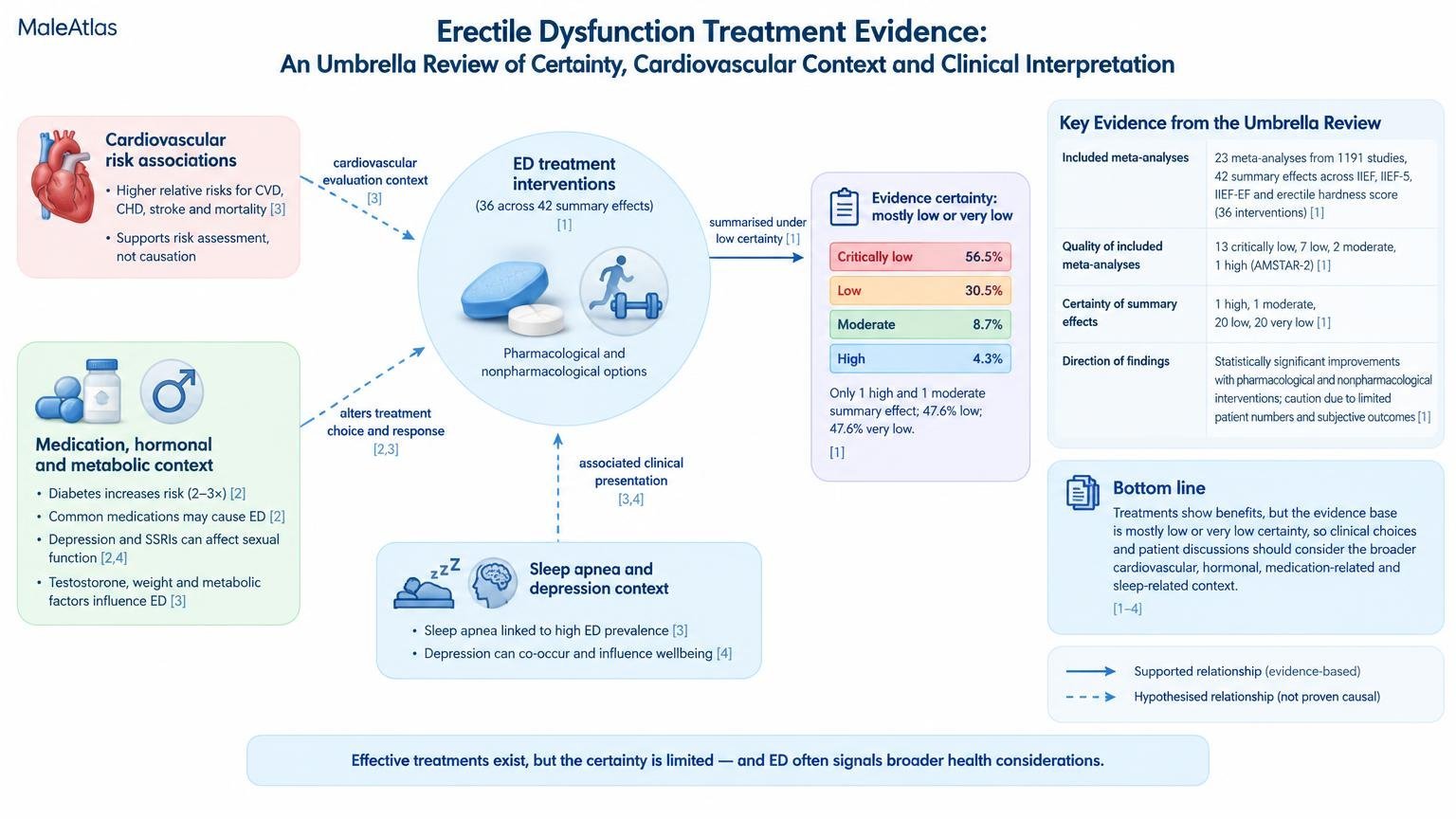
A 2026 umbrella review set out to summarise the effectiveness of current erectile dysfunction treatments and to grade the quality of the evidence behind them. It searched PubMed, Web of Science, the Cochrane Library and Embase for studies published up to October 2025, and extracted 23 published meta-analyses from 1191 identified records. Those meta-analyses yielded 42 summary effects across the International Index of Erectile Function, its five-item and erectile-function domains, and the erectile hardness score, covering 36 interventions.[1]
The headline finding is not that treatments fail. Statistically significant improvements were observed for both pharmacological and nonpharmacological interventions. The problem is the footing beneath those signals. Using AMSTAR-2, 13 of the 23 meta-analyses (56.5%) were rated critically low quality, 7 (30.5%) low, 2 (8.7%) moderate and 1 (4.3%) high. At the level of summary effects, only one was rated high quality and one moderate, while 20 (47.6%) were low and 20 (47.6%) very low. The review's authors conclude that the evidence base is predominantly low or very low quality and caution that limited patient numbers and subjective outcome measures temper the statistically significant results.
This matters because erectile dysfunction is rarely an isolated sexual complaint. NIDDK describes ED as often a symptom of another health problem or health-related factor, involving vascular, nervous and endocrine systems. The same evidence base that supports treatment also carries cardiovascular, hormonal, medication-related and sleep-related context that shapes how ED should be investigated and discussed.[2]
Why This Matters
ED is common, age-related but not age-caused, and treatable at any age according to NIDDK. That combination creates a practical tension. A man may reasonably expect a straightforward treatment path, while the evidence supporting each step is often less certain than the confidence of the prescription suggests. Understanding the certainty landscape is not academic scepticism; it informs how clinicians choose among options, how they counsel about expected benefit, and how they decide when to look beyond the sexual symptom toward cardiovascular and metabolic health.
The cardiovascular context is particularly relevant. A 2021 umbrella review cited in a physician-authored clinical guide reported that men with ED have increased relative risks for cardiovascular disease (RR 1.45, 95% CI 1.36 to 1.54), coronary heart disease (RR 1.50), cardiovascular mortality (RR 1.50), myocardial infarction (RR 1.55), stroke (RR 1.36) and all-cause mortality (RR 1.25), all with P less than 0.001. These are observational associations from meta-analytic pooling, not proof that ED causes cardiac events, and they cannot predict an individual man's risk. They do, however, support treating ED as a prompt for cardiovascular risk assessment rather than a purely sexual concern.[3]
Biological and Clinical Mechanism
An erection depends on coordinated vascular, neural and endocrine function. NIDDK notes that many factors affecting these systems can contribute to or cause ED. PDE5 inhibitors exploit one part of this biology: they block the enzyme that breaks down cyclic GMP, the molecule responsible for smooth-muscle relaxation and blood flow into the penis. They do not cause erections on their own; sexual stimulation is still required. Sildenafil, specifically, supports erections during sexual stimulation and does not increase sexual desire.[4]
Because the mechanism depends on the nitric oxide–cGMP pathway and on systemic blood pressure, safety is inseparable from efficacy. PDE5 inhibitors are absolutely contraindicated with nitrate medications and recreational nitrites known as poppers, because the combination can cause severe, potentially fatal hypotension. This is not a minor precaution; it is a defining boundary of who can safely use the most common first-line drug class.
ED also sits at the intersection of other treatable conditions. Men with diabetes are two to three times more likely to develop ED than men without diabetes, according to NIDDK. Common medication classes, including blood-pressure medicines, antiandrogens, antidepressants, prescribed sedatives, appetite suppressants and ulcer medicines, may cause ED as a side effect. Depression and ED can co-occur and influence wellbeing in both directions, with the strength of the association differing across studies and populations. SSRIs are known to potentially cause sexual side effects including reduced libido, difficulty reaching orgasm and ED, though not everyone experiences them and severity varies.
Sleep apnea adds another underappreciated dimension. A 2018 study of 150 men newly diagnosed with moderate to severe obstructive sleep apnea found an ED prevalence of 51%, meaning roughly one in two of these men also had ED. This is a clinic-based prevalence and does not describe the general population, but it flags a group in which ED may be a marker of fragmented sleep and intermittent hypoxia rather than a primary urological problem.
What the Evidence Shows
The umbrella review's central contribution is a map of certainty rather than a new efficacy claim. Across 36 interventions and 42 summary effects, statistically significant improvements were seen for pharmacological and nonpharmacological treatments alike. Yet the distribution of quality ratings is heavily skewed toward the lower end. This does not mean the treatments are ineffective; it means the evidence is not strong enough to support precise comparative claims or confident routine recommendations for every option. The review's authors explicitly call for further well-designed studies on single treatments and high-quality meta-analyses of intertreatment comparisons.
| Evidence domain | What was reported | Interpretation |
|---|---|---|
| Included meta-analyses | 23 meta-analyses extracted from 1191 studies, yielding 42 summary effects across IIEF, IIEF-5, IIEF-EF and erectile hardness score endpoints covering 36 interventions | A broad but aggregated evidence base; the umbrella review summarises existing syntheses rather than reanalysing individual patient data |
| Quality of included meta-analyses | 13 (56.5%) critically low, 7 (30.5%) low, 2 (8.7%) moderate, 1 (4.3%) high by AMSTAR-2 | Most included syntheses have serious methodological limitations that propagate into confidence about treatment effects |
| Certainty of summary effects | Only one high quality and one moderate; 20 (47.6%) low and 20 (47.6%) very low | The statistical significance of reported improvements should not be read as high-certainty clinical benefit |
| Direction of findings | Statistically significant improvements with both pharmacological and nonpharmacological interventions, with caution due to limited patient numbers and subjective outcomes | Signals are consistent in direction but imprecise in magnitude and vulnerable to measurement limitations |
| Low-intensity shockwave therapy example | 2025 Cochrane review of 21 randomised trials (1,357 men): short-term IIEF-EF improvement of about 3.9 points and long-term 5.3 points versus sham, with low certainty; several trials industry-funded | A concrete illustration of how a statistically positive result can coexist with low certainty and funding concerns |
| Cardiovascular association context | 2021 umbrella review reported RR 1.45 (95% CI 1.36-1.54) for cardiovascular disease, RR 1.50 for coronary heart disease, RR 1.36 for stroke and RR 1.25 for all-cause mortality in men with ED | Observational associations support cardiovascular risk assessment but do not establish causation or individual prediction |
Some specific findings illustrate the pattern. A 2025 Cochrane review of 21 randomised trials involving 1,357 men found that low-intensity shockwave therapy may improve short-term IIEF-EF scores by roughly 3.9 points and long-term scores by 5.3 points versus sham, but rated the evidence as low certainty and noted that several trials were industry-funded by device makers. That is a treatment with a positive statistical signal and a clear caution about how much confidence to place in it.
Hormonal and metabolic contexts show a similar mix of promise and uncertainty. In a 2025 controlled pilot study comparing tirzepatide, lifestyle intervention and transdermal testosterone in men with obesity-associated hypogonadism, tirzepatide produced greater weight loss and IIEF-5 improvement than lifestyle alone and significantly raised total testosterone, luteinizing hormone, follicle-stimulating hormone and sex hormone-binding globulin. The pilot design limits generalisability, and the source does not report sample size or duration.
Testosterone therapy in hypogonadal men has clearer cardiovascular safety data, though still with caveats. The 2023 TRAVERSE trial (n=5,246 men with hypogonadism and preexisting or high cardiovascular risk) found transdermal testosterone noninferior to placebo for major adverse cardiac events (HR 0.96, 95% CI 0.78 to 1.17) over a mean 21.7 months, with more atrial fibrillation, acute kidney injury and pulmonary embolism in the testosterone group. This addresses a specific safety question in a high-risk population; it does not establish testosterone as an ED treatment for men without confirmed hypogonadism.
A contrasting observational signal comes from a 2024 TriNetX database analysis of 3,094 non-diabetic, non-hypogonadal men aged 18 to 50, which found higher rates of new ED diagnosis or PDE5 inhibitor prescription (1.47% versus 0.32%) and testosterone deficiency (1.53% versus 0.80%) than matched men never prescribed semaglutide. Absolute rates were low, and the authors note that a database study cannot prove the drug caused the difference. This is a hypothesis-generating finding, not a reason to stop a prescribed medication.
For sleep apnea, the evidence is similarly uncertain. A 2021 Cochrane review rated the evidence for CPAP versus no CPAP as very uncertain and found sildenafil may slightly improve erectile function compared with CPAP at 12 weeks. A 2023 meta-analysis in Medicina (8 studies, 457 patients) reported higher post-treatment IIEF-5 domain scores with sildenafil than with CPAP (37.7 versus 27.3), with authors suggesting combination may add benefit. That combination suggestion is a hypothesis rather than a tested outcome in the reported text.
Interpretation and Limitations
The umbrella review's most important limitation is structural: it summarises meta-analyses, which themselves summarise trials. Errors and biases at the trial level can be compounded rather than resolved by another layer of synthesis. The certainty ratings reflect the review authors' judgements applied to available data, and the review did not reanalyse individual patient data. Its conclusion of predominantly low or very low quality is therefore a statement about the published evidence landscape, not a direct measurement of treatment effect.
Outcome measurement adds another layer of uncertainty. The IIEF and erectile hardness score are subjective instruments, and the review explicitly notes the subjective nature of outcome indicators alongside limited patient numbers. A statistically significant improvement on a subjective scale is meaningful, but its clinical importance for an individual or couple depends on baseline severity, expectations and the magnitude of change that matters to them. The review does not resolve that question for any single treatment.
Several contextual sources carry their own limitations. The NIDDK patient-education page summarising symptoms and causes was last reviewed in July 2017, older than the evidence cutoff, and provides class-level statements without drug-specific effect sizes. The physician-authored guide that supplies many of the secondary trial citations is a narrative synthesis, not a systematic review, and some findings are reported second-hand. The cardiovascular relative risks, TRAVERSE results and GLP-1 findings should be read as cited summaries whose primary publications would need direct appraisal before strong clinical conclusions are drawn.
There is also a definitional boundary worth preserving. NIDDK defines ED as trouble getting or keeping an erection firm enough for sex, and pain is not among its listed symptoms. Pain with erections raises a different question, such as Peyronie's disease, which NIDDK describes in an acute phase lasting up to 18 months and a chronic phase usually beginning 12 to 18 months after symptoms first appear. Conflating pain with performance-related ED can delay appropriate evaluation. The sources also give no exact definition of performance anxiety and no figures on how often emotional factors are the main cause, despite listing anxiety, stress, depression and low confidence as contributing issues.[5]
Research Outlook
The umbrella review's authors recommend further well-designed studies on single treatments and high-quality meta-analyses of intertreatment comparisons. That is a direct response to the current landscape, in which many interventions have some supporting synthesis but few have evidence strong enough to support confident ranking. Future work would benefit from consistent outcome definitions, longer follow-up, and attention to funding sources, given that industry funding was noted in several shockwave trials.
The cardiovascular, hormonal and sleep dimensions suggest that ED research cannot remain confined to sexual-function endpoints. If ED is often a marker of systemic vascular or metabolic dysfunction, trials that measure only IIEF change may miss the broader clinical picture. Conversely, cardiovascular and metabolic trials that ignore sexual function may miss an early signal. Integrated designs that capture both would better match how ED presents in practice, though no such design is reported in the sources reviewed here.
Key Takeaways
- An umbrella review of 23 meta-analyses covering 42 summary effects found statistically significant improvements with both pharmacological and nonpharmacological ED treatments, but rated most of the evidence low or very low certainty.
- By AMSTAR-2, 13 of 23 included meta-analyses (56.5%) were critically low quality and only one (4.3%) was high quality; among summary effects, 20 were low and 20 very low certainty.
- PDE5 inhibitors remain the most common first-line drug class and work only with sexual stimulation; they are absolutely contraindicated with nitrates and recreational nitrites because of severe hypotension risk.
- ED is associated with increased relative risks of cardiovascular disease, coronary heart disease, stroke and all-cause mortality in meta-analytic observational data, supporting cardiovascular risk assessment without implying causation.
- Contexts that change the clinical question include diabetes (two to three times higher ED likelihood), medication side effects, depression and SSRIs, obstructive sleep apnea (51% ED prevalence in one clinic cohort) and obesity-associated hypogonadism.
- Pain with erections is not part of the standard ED symptom list and should prompt evaluation for other conditions such as Peyronie's disease, whose acute phase can last up to 18 months.
Questions and Answers
What did the 2026 erectile dysfunction treatment umbrella review find about evidence quality?
The umbrella review extracted 23 meta-analyses from 1191 studies, yielding 42 summary effects across IIEF and erectile hardness endpoints. Using AMSTAR-2, 13 meta-analyses (56.5%) were critically low quality, 7 (30.5%) low, 2 (8.7%) moderate and 1 (4.3%) high. Among summary effects, only two were high or moderate quality, while 20 were low and 20 very low. The authors concluded the evidence base is predominantly low or very low quality.
Do erectile dysfunction treatments actually work despite low-certainty evidence?
Statistically significant improvements were observed with both pharmacological and nonpharmacological interventions in the umbrella review. The caveat is that these findings rest on limited patient numbers and subjective outcome measures, and most supporting evidence was rated low or very low certainty. Low certainty does not mean a treatment is ineffective; it means the estimated benefit is imprecise and the confidence we can place in it is limited.
How do PDE5 inhibitors like sildenafil work for erectile dysfunction?
PDE5 inhibitors block the enzyme that breaks down cyclic GMP, the molecule responsible for smooth-muscle relaxation and blood flow into the penis. They do not cause erections on their own; sexual stimulation is still required. Sildenafil supports erections during stimulation but does not increase sexual desire. They are absolutely contraindicated with nitrate medications and recreational nitrites because the combination can cause severe, potentially fatal hypotension.
Is erectile dysfunction a warning sign of heart disease?
A 2021 umbrella review cited in a clinical guide reported that men with ED have increased relative risks for cardiovascular disease (RR 1.45, 95% CI 1.36-1.54), coronary heart disease (RR 1.50), stroke (RR 1.36) and all-cause mortality (RR 1.25). These are observational associations, not proof of causation, and they cannot predict an individual's risk. They do support cardiovascular risk assessment when ED is evaluated.
What conditions and medications can contribute to erectile dysfunction?
NIDDK notes that factors affecting vascular, nervous and endocrine systems can contribute to ED. Men with diabetes are two to three times more likely to develop ED. Medication classes including blood-pressure medicines, antiandrogens, antidepressants, prescribed sedatives, appetite suppressants and ulcer medicines may cause ED as a side effect. Depression and ED can co-occur and influence each other, and SSRIs can cause sexual side effects though not everyone experiences them.
What is the link between sleep apnea and erectile dysfunction?
A 2018 study of 150 men newly diagnosed with moderate to severe obstructive sleep apnea found an ED prevalence of 51%, though this clinic-based figure does not describe the general population. A 2021 Cochrane review rated CPAP versus no CPAP evidence as very uncertain. A 2023 meta-analysis reported higher post-treatment IIEF-5 scores with sildenafil than CPAP (37.7 versus 27.3), with combination suggested as potentially beneficial but not tested as an outcome.
Conceptual framework: Conceptual framework, not a tested causal model. The figure maps the article's core relationships: 36 ED interventions summarised across 42 effects, most rated low or very low certainty, alongside cardiovascular, medication, hormonal and sleep-apnea contexts that shape how ED is investigated. Hypothesised arrows indicate clinical context, not proven causal pathways.
Academic References & Evidence
- Current treatment for erectile dysfunction: an umbrella review of systematic reviews and meta-analyses. 2026 DOI: 10.6084/m9.figshare.31562993.v1.
- Síntomas y causas de la disfunción eréctil – NIDDK.
- Parth Bhavsar. Erectile Dysfunction. 2026
- Sarah Boss. Depressie en erectiestoornissen: oorzaken en zorg.
- MedicalFoundationOfNC.org Research Team. Erectile pain and performance concerns: Why the symptom changes the care question.
SANYUN Science Center explains published research on men's reproductive and sexual health, connecting scientific evidence with everyday questions while making sources and limitations clear.
Disclaimer: This article is for scientific education and research communication only. It does not provide medical advice, diagnosis, or individualized treatment recommendations, and does not endorse any medication, supplement, device, penile enlargement procedure, or other intervention. Decisions about sexual and reproductive health should be made in consultation with a qualified healthcare professional. Do not delay seeking professional care because of information in this article.
Original Content & Copyright Notice
- This article is prepared for SANYUN Science Center, drawing on published research and publicly available academic literature on men’s sexual and reproductive health. Its editorial explanations and presentation are developed for this platform.
- Copyright in the original editorial content, selection, and arrangement is reserved by SANYUN Science Center to the extent protected by applicable law. Referenced research, quotations, and third-party materials remain subject to the rights of their respective owners. This notice does not claim ownership of scientific facts or third-party research.
- Except where permitted by applicable law or an applicable license, prior written permission is required to reproduce, republish, translate, adapt, redistribute, or commercially reuse protected content. Attribution alone does not grant permission for such reuse.
- For permitted quotation or authorized reuse, clearly identify the source and retain a link to the original article.
- Source: SANYUN Science Center
- Original URL: Retain the original article URL on science.san-yun.com.
- Copyright Holder: SANYUN Science Center, for its own protected editorial content.
- Quotation, excerpts, or authorized reuse must not distort the scientific meaning, omit material limitations or disclaimers, or imply unverified medical claims, product efficacy, or endorsement by SANYUN Science Center.



